Within an hour of a collision in Thailand, a man on a motorbike in a branded vest will usually arrive with a camera and a clipboard. He is a claims surveyor, sent by one of the insurers involved, and he is the reason you do not exchange details and drive away here. Between them, the surveyors from the two vehicles' insurers photograph the scene, take each driver's account, agree who was at fault, and issue the paperwork that authorises a repair. Much of what happens to your money is decided in that conversation.
There is no real equivalent in Britain, Ireland, Australia, the United States or most of Europe, where fault is argued out by claims handlers weeks later. Understanding what the surveyor is — and, crucially, whose interests he is protecting — is the difference between a Thai accident that resolves itself by dinnertime and one that follows you home.
How we are describing this. Thai insurers' internal claims procedures are not published in a form we can cite, so this page describes the scene-attendance system as it consistently works in practice rather than quoting a rule. Figures come from published insurer policy documents.
Who the surveyor works for
Not for you, unless you are the policyholder. That is the first thing to understand, and the thing most likely to catch out a visitor who has just been handed a business card and treated politely.
Each insurer sends its own person. In a hire car, the surveyor on "your" side works for the rental company's insurer, and their client is the rental company. On your own bike with a voluntary policy, the surveyor is yours. On a rented scooter with nothing but compulsory cover, there may be no surveyor on your side at all — only the other party's, whose job is to establish that his policyholder was not to blame.
| What you are driving | Whose surveyor attends for you | What that means |
|---|---|---|
| Hire car from an established firm | The rental company's insurer | They protect the rental company's position. Your interest and theirs overlap, but they are not the same. |
| Rented scooter | Often nobody | The machine may carry only compulsory cover, which pays nothing at all for vehicle damage. |
| Your own vehicle with a class 1, 2+ or 3+ policy | Your insurer | This is the situation the system is built for, and it works well. |
| Your own vehicle with only compulsory cover | Nobody | You are dealing with the other side's surveyor alone. |
| A borrowed bike | Whatever cover the owner holds | Find out before you borrow it. |
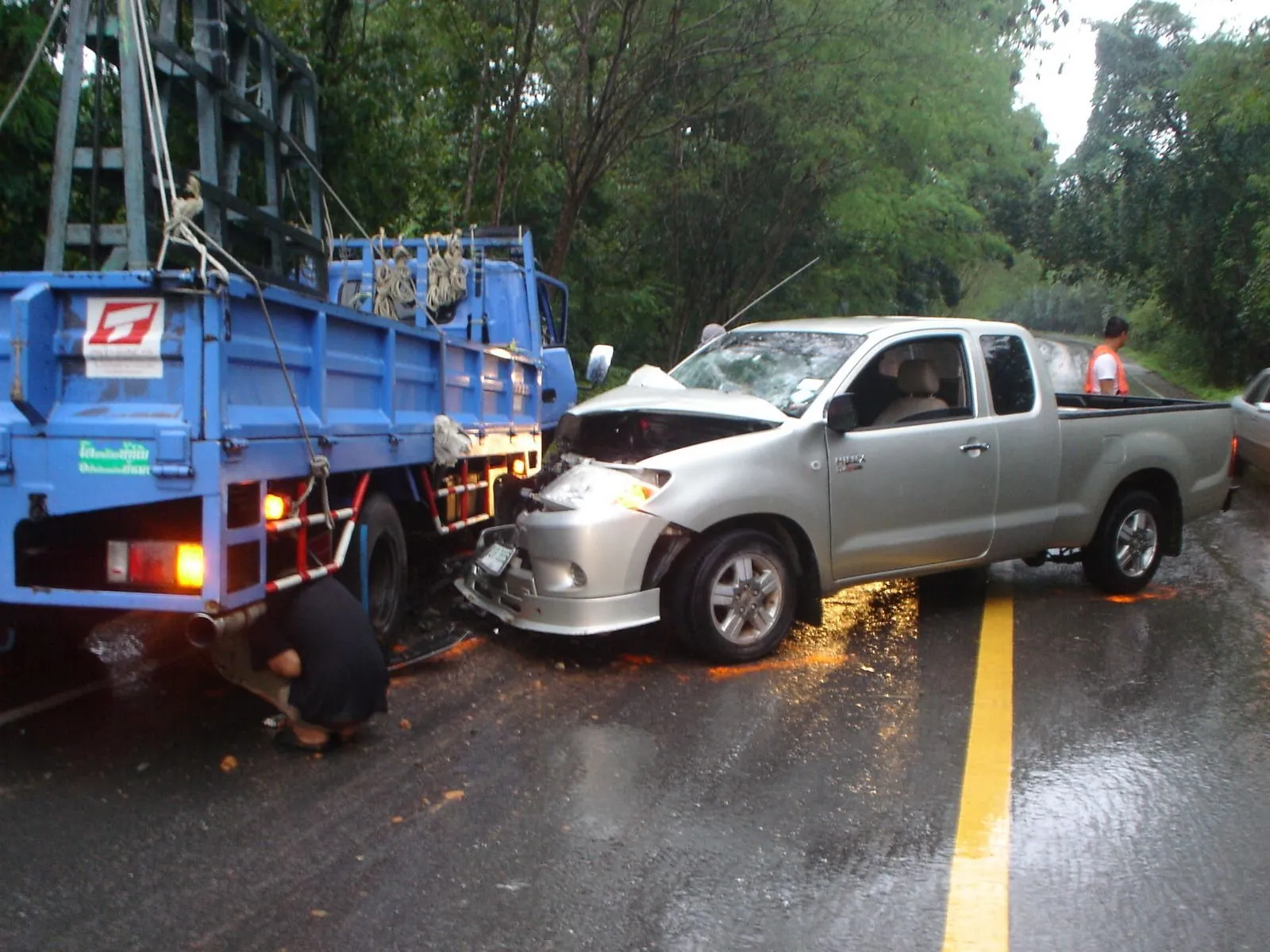
What actually happens when they arrive
- They photograph the vehicles where they stopped, from several angles, with the road and markings visible. This is why nothing should be moved before they get there.
- They take an account from each driver, and often from bystanders.
- They speak to the police officer if one is present, and to each other.
- They reach a view on which vehicle was at fault, and therefore which policy responds.
- The surveyor whose policy is responding issues a claim document — the piece of paper that lets a garage start work and bill the insurer directly.
- Each driver signs an account of what happened. This is where you slow down.
On a clear-cut case in a city the whole thing can be over in twenty minutes. It takes far longer where fault is contested, where anyone is injured, or where one party has no cover.
The signature is the moment that matters. The document you are asked to sign is in Thai. Do not sign on the strength of someone else's summary — not the other driver's, not a helpful bystander's, and not the rental agent's. Call the Tourist Police on 1155 and get an English speaker into the conversation first. Nobody can require you to sign immediately.
What the surveyor can and cannot decide
He decides whether his own insurer accepts the claim, and he agrees a working position on fault with his opposite number. That is a commercial decision between two insurers, and it is normally the end of the matter, because both sides prefer it to be.
He does not decide criminal liability, which is the police and the courts' business, and he does not decide anything at all about a party who has no policy with his company. If you have no cover, a surveyor's view of the accident is simply someone else's opinion — an influential one, because it will be recorded and repeated, but not a determination you are bound by. How fault is decided after a crash goes into what actually shifts the answer.
Which insurance he is actually talking about
Compulsory cover — por ror bor — pays medical benefits to injured people, up to ฿30,000 per person before fault is settled and up to ฿80,000 once it is. It covers people, not property, and it will not repair anyone's vehicle. Por ror bor explained has the limits in full.
So everything the surveyor is negotiating about vehicle damage concerns voluntary insurance — the class 1, 2+, 2, 3+ and 3 policies Thai drivers buy on top. The trap worth knowing at a roadside is that the "plus" classes cover your own vehicle only where another vehicle is involved: lose the front wheel on gravel with nobody else there and a 2+ or 3+ policy pays nothing towards your machine. Thai insurance classes explained sets out what each does.
How to handle a surveyor who is not yours
Politely, factually, and slowly. He is doing a job, and usually doing it straightforwardly — but he is building a file for his employer, and you are the only person at the scene with nobody representing you.
- Give your account of what happened — direction of travel, speed, what the signals were doing, where the other vehicle came from. Facts, not conclusions.
- Do not say the accident was your fault, and do not say it was not. Describe it.
- Photograph the surveyor's card, his vest, and the insurer's name.
- Photograph every document you are shown, including any you decline to sign.
- Ask for a copy of anything you do sign, and take a photograph of it as well.
- Get the claim number before anyone leaves.
- In a hire vehicle, keep the rental company on the phone throughout.
Photograph the scene before the surveyor arrives. His photographs go into his employer's file, not yours. Yours are the only set you will have access to later, and they are the only evidence you control. Wide shots first, showing both vehicles in position, then damage, then plates, then the road surface.
The rental scooter case, in particular
This is where the system leaves a visitor most exposed. We could not obtain rental operators' insurance terms in a form worth relying on, and the position varies enormously between an established car-hire desk and a shop on a beach road. What can be said is structural: a rented scooter may carry nothing beyond the compulsory cover the law requires, which pays nothing for damage to either machine, and in some tourist areas hire motorbikes are not even legally registered — a point the UK Foreign Office makes explicitly in its Thailand advice.
So "the insurance will sort it out" is not a safe assumption on a hired bike. The rental company will look to the deposit instead. Read accident in a rental car or scooter before you need it, and what rental insurance does not cover in Thailand before you sign anything.
When no surveyor comes
If neither vehicle has voluntary cover, no surveyor attends and the scene reverts to two drivers, a police officer and a negotiation — a common outcome on small bikes in the provinces. Your leverage then comes from three things: your photographs, the police report, and the interpreter you get by calling 1155. Do not settle in cash before you understand what you are settling; settling a minor accident at the roadside covers what you give up.
Frequently asked questions
How quickly does a surveyor arrive?
In a city, often before the police. In a rural province, sometimes considerably later, and sometimes not at all if no voluntary policy is involved. Do not move the vehicles while you are waiting unless the position is dangerous or an officer tells you to.
Do I have to talk to the other side's surveyor?
You are not obliged to, but declining rarely helps you. What you should decline is signing anything you cannot read. Give a factual account, keep it short, and ask for an English speaker if you are not confident you are being understood.
What is the claim document he issues?
It is the authority for a garage to carry out repairs and bill the insurer directly, and it carries a claim number. If a repair is being paid for by an insurer, that number is what everything downstream is filed under. Photograph it.
Does the surveyor decide who was at fault?
In practical terms, the two surveyors between them decide which policy pays, and that is normally where the matter ends. It is not a legal determination. Criminal liability, and any court case, is a separate track entirely — see what happens if you are arrested after a crash.
I was on a rented scooter with no insurance. Is the surveyor's word final?
No. He has no contract with you and cannot bind you. But his file and the police report will be the documents that exist, so make sure your own account and your own photographs are on record too, and get the report.
Should I involve my travel insurer at the scene?
Ring their emergency assistance line if anyone is injured or if you are asked to pay a hospital deposit — that is what the 24-hour number is for. For vehicle damage they are usually irrelevant, because travel policies do not repair vehicles. Does travel insurance cover driving in Thailand sets out what they touch.
Can I get a copy of the surveyor's photographs?
Assume not — they belong to the insurer's file. Which is exactly why your own, taken before anyone arrived, matter so much.