Medical evacuation from Thailand is arranged by your insurer's emergency assistance company, not by you, and not by the hospital. The single most useful thing you can do is ring the 24-hour number on your policy as early as possible — before a transfer is agreed, before you are discharged, and certainly before anyone buys a flight. Everything about the process, including whether it is paid for, flows from that call.
The second thing to understand is that "evacuation" and "repatriation" are different products doing different jobs, and the number in your policy schedule for one may bear no relation to the other. Both are near the top of the list of ways a road accident abroad turns into a financial catastrophe.
- Who arranges itYour insurer's assistance company
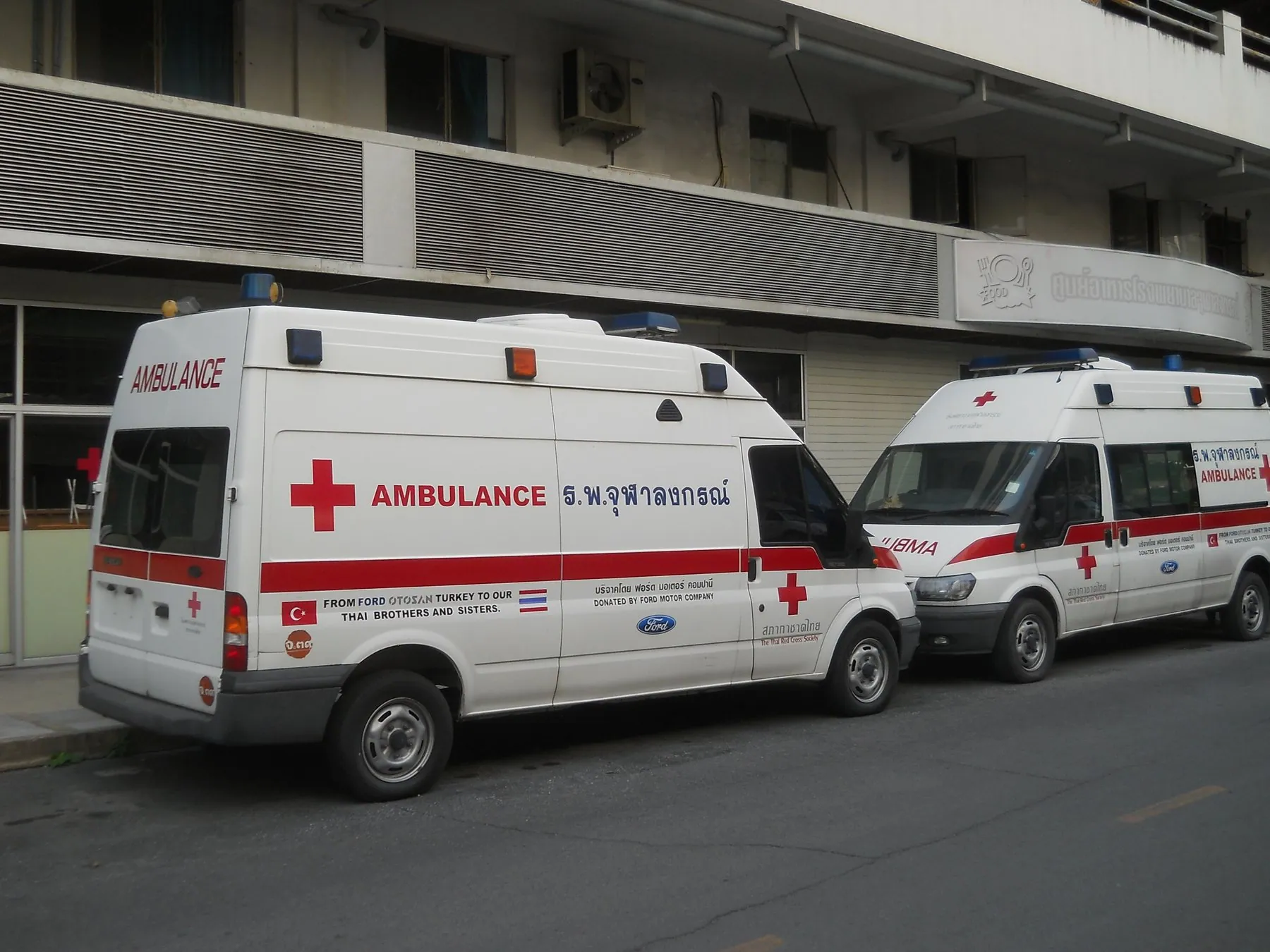
- Ambulance in Thailand1669
- The number that mattersThe 24-hour line on your policy
Do not arrange your own repatriation and expect to be reimbursed. Almost every policy requires prior authorisation from the assistance company for evacuation, repatriation and any transfer between hospitals. Booking a stretcher on a scheduled flight yourself, or agreeing to an air ambulance a hospital offers to organise, is the classic way to end up holding a bill your insurer declines.
The three different things people mean
| Term | What it is | When it happens |
|---|---|---|
| Local transfer | Moving you from the hospital that received you to one better equipped, usually within Thailand | Very common. A district hospital stabilises and sends you on. |
| Medical evacuation | Moving you, under medical supervision, to a facility that can treat you — sometimes Bangkok, sometimes another country | Where the necessary treatment is not available where you are |
| Repatriation | Getting you home, medically escorted or on a stretcher, once you are stable enough to travel | After treatment, often weeks later |
| Repatriation of remains | Returning a body to the home country | A separate policy benefit again, with its own limit |
Most people who are hurt on a Thai road need the first of those and nothing else. Bangkok in particular has hospitals with the specialists for almost anything, so evacuation abroad is rarely medically necessary — the usual reason for going home is that treatment or recovery will be long, not that Thailand cannot provide it.
What it costs
We do not publish a figure, because we could not source one we would stand behind, and because the honest answer is that it varies by more than any single number can carry: the distance, the aircraft, the medical team required, whether a stretcher on a commercial flight will do, and how urgent it is.
What is worth understanding is the ranking. A local ambulance transfer is a small cost. A stretcher and a nurse on a scheduled commercial flight is a substantial one — a stretcher occupies several seats, and the airline charges accordingly, on top of the medical escort. A dedicated air ambulance flying long-haul with a doctor on board is in a different category entirely, and it is among the largest single bills a traveller can generate anywhere in the world.
Check the evacuation limit on your policy, not the medical limit. These are usually separate numbers, and travellers routinely look at the headline medical figure and assume it covers being brought home. It often does not. If you are going to ride a motorbike in Thailand, the evacuation and repatriation limits are the two numbers worth reading before you buy — along with the motorcycle clause. Medical evacuation insurance for Thailand goes through it.
The cover problem, and it is a real one
The reason this page sits in a driving guide rather than a general travel one is that motorbike injuries are the accidents most likely to fall outside cover.
The UK government's advice states plainly that riding without a valid licence "could invalidate your travel insurance and you'll be unable to claim if you have an accident or injury", and its general insurance guidance lists the use or hire of mopeds and quad bikes among activities not usually covered as standard. One insurer's published motorcycle wording requires the rider to hold a home licence valid for that class of machine "regardless of the local laws" — meaning the insurer applies its own licensing test even where Thai police would never have stopped you. The same wording extends to a pillion passenger, whose cover depends on the licence held by whoever is riding.
Put together, that is how a visitor on a 110cc automatic with a car-only licence at home ends up with a head injury, a hospital bill and a declined claim. It is not an obscure edge case; it is the standard shape of the problem. What voids your motorbike cover in Thailand and does travel insurance cover driving in Thailand are the two pages to read before you hire anything, and am I legal to drive in Thailand is the two-minute version.
What compulsory Thai motor insurance contributes
Nothing towards evacuation. The compulsory por ror bor policy attached to the vehicle pays medical expenses up to ฿30,000 per person before fault is established and up to ฿80,000 once it is, with a combined maximum of ฿504,000 per person. It is a medical benefit inside Thailand, not a repatriation product, and ฿80,000 — around £1,840, US$2,320 or €2,000 — is a small fraction of what a serious case costs. Thai hospitals after a crash and what it costs covers how the two layers interact.
How the process actually runs
- Someone rings the assistance line. You, a travelling companion, the hospital, or your family at home. Have the policy number, the hospital name and the treating doctor's name ready.
- The assistance company speaks to the treating doctor. They will not take a patient's or a relative's word for the medical position, and they should not.
- They decide what is medically necessary, and they authorise it. This is the step that must not be skipped.
- They issue a guarantee of payment to the hospital where they are satisfied the claim is covered, which removes the deposit problem.
- They arrange the movement — the local transfer, the flight, the escort, the receiving hospital at the other end, and the ambulance from the airport.
- They coordinate with your family, and with your embassy where needed.
Where a police investigation is open — after a serious crash, particularly one involving another casualty — leaving Thailand may not be straightforward. That is a legal matter running in parallel with the medical one, and it is covered in what happens if you are arrested after a crash. Get your embassy involved early if there is any suggestion of it.
If you have no insurance
The honest answer is that self-funded medical evacuation is out of reach for most people, and what happens instead is that families raise money, embassies advise but do not pay, and the patient stays in Thailand until they are well enough to fly commercially. Your embassy can help with contacting family, with a list of local lawyers and doctors, and in some countries with an emergency loan — but consular assistance is not insurance and no embassy will pay a medical bill or an air ambulance for you.
That is not a lecture. It is the reason the motorbike clause on a policy costing a few pounds a day is the most consequential thing a visitor reads before a holiday in Thailand.
Frequently asked questions
Who do I call first?
1669 for the ambulance at the scene. Then, as soon as you or someone with you can, the 24-hour emergency assistance number on your travel policy. That number is not the same as the claims department, and it is the one that authorises everything.
Will my insurer fly me home just because I want to go home?
No. Repatriation is authorised when it is medically appropriate, and the assistance company's doctors decide that with the treating doctor. Wanting to recover at home is understandable and is not, by itself, a medical reason.
Can I fly home on a normal flight after a crash?
Often, once you are fit to fly, and it is far the commonest outcome. Airlines have their own medical clearance requirements, and anything involving a plaster cast, recent surgery, a head injury or supplementary oxygen needs clearance in advance. The assistance company handles that.
Does the embassy arrange evacuation?
No. Consular staff can contact your family, provide a list of lawyers and doctors, and in limited circumstances help with an emergency loan, but they do not organise or pay for medical evacuation. That is your insurer's job.
How much evacuation cover should I have?
More than you think, and the figure to look at is the evacuation and repatriation limit specifically rather than the overall medical limit. If you plan to ride a motorbike, also check that the policy covers the machine and the licence you actually hold.
Does compulsory Thai motor insurance help with getting home?
No. It pays medical expenses inside Thailand up to the published limits and nothing towards evacuation or repatriation.