Thailand's street dogs are part of the road furniture. They sleep on the warm tarmac, they wander across without looking, and a proportion of them will run at a passing motorbike, barking, sometimes snapping at your ankles. For a visitor on a scooter this is unnerving the first time and genuinely hazardous if you handle it badly — not because the dog is likely to bite you, but because the instinctive reactions of braking hard and swerving are both wrong.
Almost every dog encounter is survivable if you do three things: see it early, keep the bike straight and stable, and do not accelerate away in a panic.
Why the dogs are there
Thailand has a very large free-roaming dog population. Most are not strictly strays: they belong loosely to a house, a shop, a temple or a street, get fed by several people, and are tolerated rather than owned. Temples in particular accumulate dogs, because abandoning an animal at a temple is a common way of avoiding the guilt of abandoning it at all.
That has two consequences on the road. First, they are territorial in a small radius — a dog that erupts at you outside a particular shop will usually not follow past the end of that block. Second, they are not afraid of traffic, because they have lived among it since birth. A European dog treats a road as dangerous; a Thai street dog treats it as the warmest, flattest place to sleep.
Asphalt absorbs heat all day and gives it back at night, which is why the dog problem is really a night driving problem: a sleeping brown dog on black tarmac, at the edge of a scooter headlight, appears with almost no warning. It also explains why they are found in the middle of quiet lanes rather than at the edges.
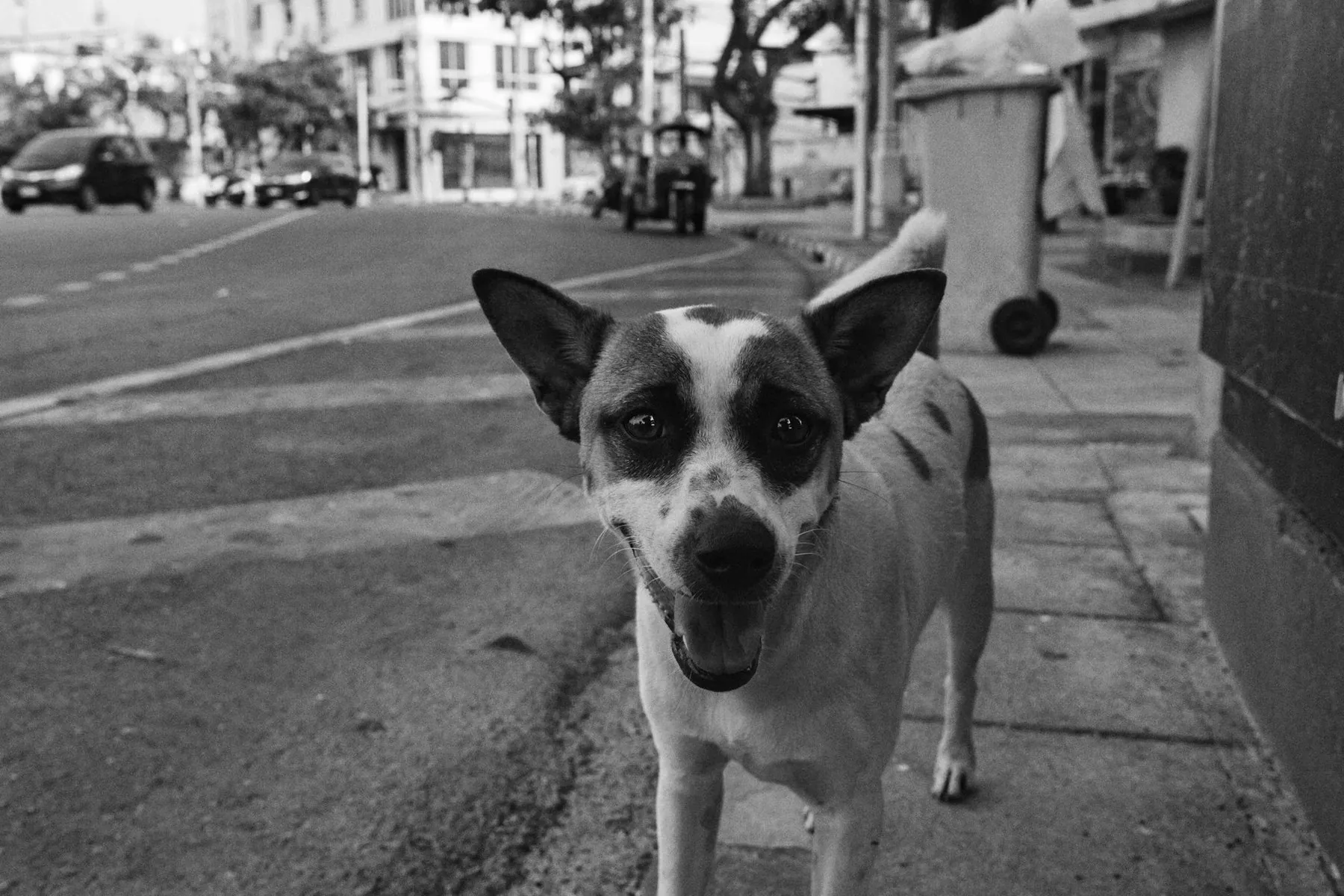
Reading the dog before it becomes a problem
| What you see | What it means | What to do |
|---|---|---|
| Lying flat, asleep, on its side | Genuinely asleep. May wake and bolt in any direction as you arrive. | Slow, move to the far side of the road, pass wide and steady. |
| Lying down, head up, watching you | Awake and assessing. | Slow, do not rev, pass with a wide berth. |
| Standing, head low, ears back, staring | The pre-chase posture. It is going to come. | Slow down before you reach it. Do not accelerate. |
| Trotting parallel to you, barking | Escorting you off its territory. Almost never bites. | Hold a steady speed, do not look at it, ride out of the block. |
| Two or three together | Pack behaviour. More confident, harder to predict. | Slow considerably, or stop and let them lose interest. |
| Puppies at the roadside | An adult is nearby and will be protective. | Slow right down. This is where genuine aggression comes from. |
The single best predictor of a chase is a dog that gets to its feet as you approach and turns to face your line of travel. A dog that stays lying down, or gets up and wanders away, is not interested. The one that stands and squares up has already committed.
The technique: how to ride past
Slow down before you reach it, not as it comes at you
This is the counterintuitive part and it is the whole game. Dogs chase movement, and the instinct triggers on speed and noise. A bike that comes past slowly and quietly is far less interesting than one that accelerates away. It also means that if the dog does cut in front of you, you are travelling slowly enough for it to be a nuisance rather than a crash.
Keep the bike upright and straight
Swerving is what actually injures people. On a small scooter, a violent swerve at low speed puts the front wheel out from under you; at higher speed it puts you into the oncoming lane or off the edge of the road. If a dog runs into your path and you cannot avoid it, brake hard in a straight line and hold your line.
Never swerve for an animal. This is the most important sentence on this page and it applies to dogs, cats, chickens and anything else that runs out. Brake straight and take the hit if you have to. A collision with a dog on an upright, braking bike is very often a survivable knock. Swerving into a pickup is not.
Do not rev, shout, kick or stare
Blipping the throttle or shouting escalates the encounter. Kicking out takes a foot off the board, unbalances the bike, and if you connect at speed you will very likely go down. Keep your feet on the bike and your hands on the bars. As for staring: direct eye contact reads as a challenge to a dog, and more importantly, on a motorbike you go where you look. Stare at the dog and you will steer into it. Look at the gap you want to ride through.
Put the bike between you and the dog
A chasing dog goes for the moving thing closest to it, usually the wheel or your foot. If it comes from the left, move to the right of the lane so the bike's bodywork is between the dog and your leg, and keep your feet tucked in.
If you are being properly harassed, stop. Come to a complete halt, both feet down, and stay calm and still. Most chasing dogs lose interest almost immediately when the moving thing stops moving — the chase instinct has nothing to lock onto. Wait a few seconds, then move off gently.
Where and when it happens
- Residential sois and back lanes — the highest density of territorial dogs anywhere. Threading through the soi network of a Thai town, expect several encounters per kilometre.
- Temples — reliably the largest concentrations, often on a quiet road where you are travelling faster.
- Village stretches of a main road — the dangerous combination, because your speed is high and the dogs treat the highway as their street.
- Islands and beach roads — large populations, quiet roads, and riders who have been drinking.
- Dusk and after dark — dogs are most active at the cooler ends of the day, and least visible.
If you are bitten
Take this seriously. Rabies is present in Thailand and dogs are the main reservoir, so a bite or scratch that breaks the skin from any free-roaming dog is treated as a potential exposure regardless of how the animal looked. The disease is effectively always fatal once symptoms appear and entirely preventable with prompt post-exposure treatment. This is not a wait-and-see situation.
- Wash the wound immediately with soap and running water, thoroughly, for several minutes. This is genuinely effective and it is the first thing every guideline says.
- Apply an antiseptic — povidone-iodine or alcohol — if you have one.
- Go to a hospital or clinic the same day. Any Thai hospital deals with this routinely.
- Tell them whether you have had a pre-exposure rabies course. It changes the treatment, not the need for it.
- Keep the paperwork for your insurer — Thai hospitals and what treatment costs explains how the billing works.
If a dog brought you off the bike rather than biting you, deal with the crash properly too — what to do after a road accident in Thailand covers the sequence, and a graze in this climate needs proper cleaning rather than a plaster.
Cars, and the other side of the problem
In a car the risk to you is negligible, but the risk to the dog is not, and hitting one has practical consequences: a dog on a Thai street usually has someone who considers it theirs, and an emotional roadside conversation about compensation is a real possibility. Brake, do not swerve, and if you do hit an animal, stop.
Cyclists have the hardest time of anyone, because a bicycle is quiet, slow enough for a dog to catch, and offers nothing between the dog and your ankle. Dogs and cyclists in Thailand covers the specific tactics, which differ from what works on a scooter.
Frequently asked questions
Are Thai street dogs actually dangerous?
Individually, mostly not. The great majority of encounters are noise and posturing, and bites on riders are far less common than the barking suggests. What is dangerous is the rider's reaction — swerving, panicking or accelerating — and the fact that a dog in the road at night is effectively invisible.
Should I get a rabies vaccination before I travel?
That is a conversation with a travel clinic rather than a driving website, but the general position is that pre-exposure vaccination is worth considering for long stays, rural travel and anyone riding daily. It does not remove the need for treatment after a bite; it simplifies and shortens it.
Does hooting at a dog work?
Sometimes, on a dog that is asleep or ambling across, a light tap from a distance will move it. Close up it startles the animal into moving unpredictably. Horn etiquette on Thai roads is different from home anyway — the horn here is a mild "I am here" rather than a rebuke.
Is it legal to hit a dog if I cannot avoid it?
There is no offence in being unable to avoid an animal that runs into the road. The issue is social rather than legal — stop, and expect a conversation if the animal belongs to someone. Leaving the scene of any collision is a much bigger problem than the collision.