Thai towns are confusing to a newcomer for one reason: they were not planned as grids. They grew outward from a main road, or a river, or a canal, and the land behind that main road was subdivided by private access lanes that were later adopted, numbered and tarmacked. Those lanes are sois, and they are why a Thai address has two numbers, why so many turnings are dead ends, why your satnav takes you past your hotel, and why the right turn has largely been replaced by a U-turn.
Understand the soi and the U-turn and Thai urban driving stops being mysterious. It is not a chaotic system. It is a consistent one that happens to be unlike the one you learnt on.
- ThanonA road — the main artery
- SoiA numbered side street off a thanon
- TrokAn alley, usually too narrow for a car
- Odd and evenOdd-numbered sois on one side, even on the other
How a Thai address is built
Take a typical address: 123/45 Sukhumvit Soi 23, Khlong Toei Nuea, Watthana, Bangkok. Read it from the small end:
- 123/45 — the plot number and the unit within it. Thai house numbering is not sequential along the street; it reflects the order in which land was registered. Number 12 can sit between 88 and 140. Do not try to count your way along.
- Sukhumvit Soi 23 — the twenty-third numbered lane off Sukhumvit Road, counted outward from the road's starting point.
- Khlong Toei Nuea, Watthana — the sub-district and district. These are what a taxi driver actually uses to orient.
Some sois carry a name as well as a number, and locals will use whichever is better known: Sukhumvit Soi 21 is Soi Asok, Sukhumvit Soi 4 is Soi Nana. A few have only a name. Larger sois have their own sub-sois, written as Soi Sukhumvit 39 Soi 1 or as a slash. In the countryside you will also meet Moo followed by a number, which is a village grouping, not a street.
When you type an address into a navigation app, the soi number is the part that matters most and the house number is the part most likely to be wrong. Search for the soi, drive into it, and find the building visually. This is also why entering a hotel's own name usually works better than its street address — see navigation apps in Thailand.
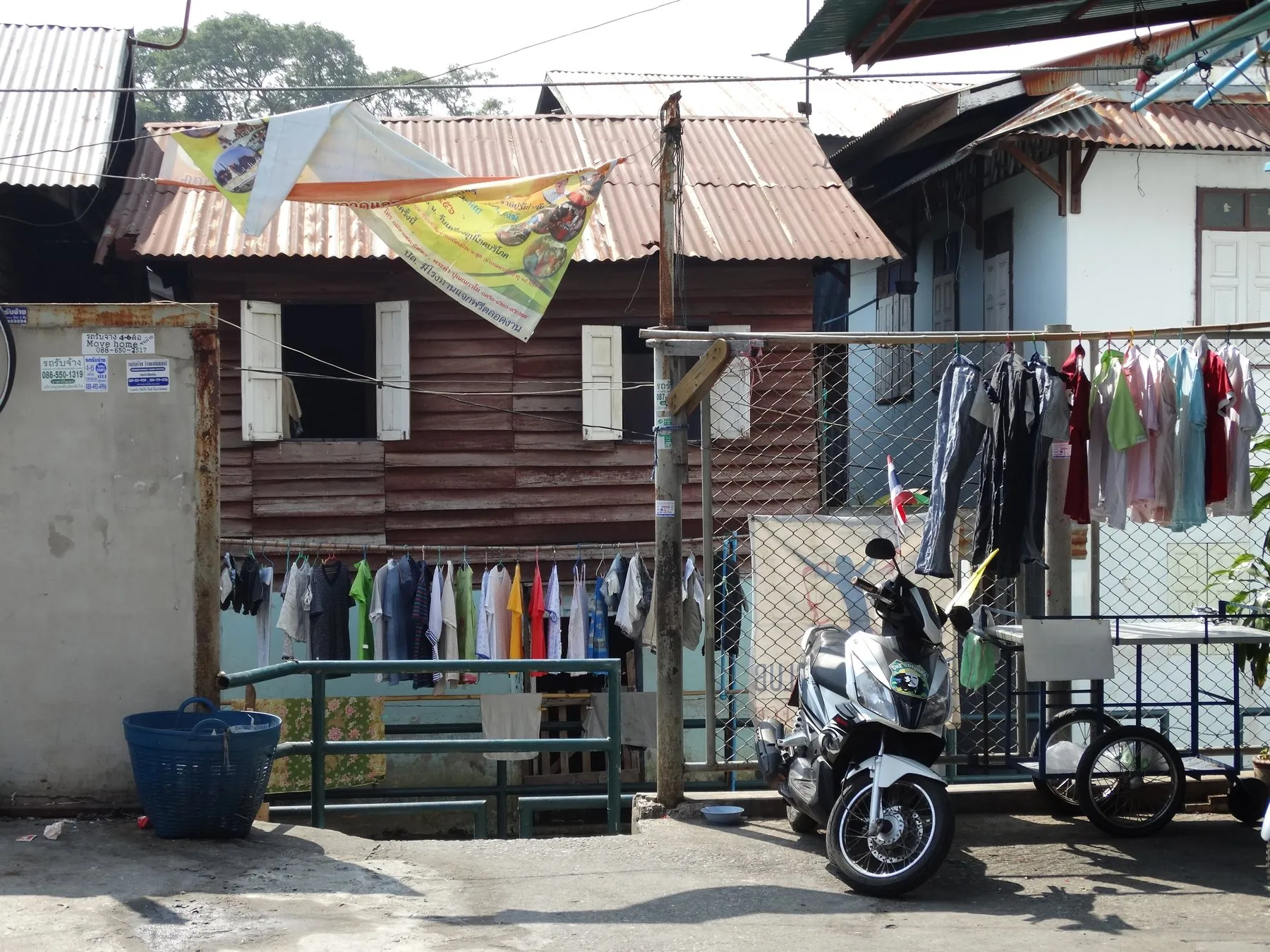
Odd and even, and the side of the road
Sois are numbered outward from one end of the main road, with odd numbers on one side and even on the other. On Sukhumvit, the even sois run north and the odd sois south; on any other road the convention is the same even though the compass directions differ. Consecutive numbers therefore face each other: Soi 11 and Soi 12 are more or less opposite.
The consequence for a driver on a divided road is immediate. Half of all the sois are on the far side of the central reservation, and you cannot turn across into them. This is the single biggest reason Thai journeys are longer than they look.
Why sois are dead ends
Because they were access lanes to individual plots rather than through routes. A very large proportion of Thai sois — the majority in some districts — terminate in a wall, a house, a temple or a canal. Others connect through to the next main road but only via a sequence of turns that no map makes obvious, and some connect through by a route wide enough for a motorbike but not a car.
Two practical rules follow. First, do not treat a soi as a shortcut unless you know it goes through; the cost of being wrong is a three-point turn in a lane the width of your car with a delivery bike behind you. Second, if you are on two wheels you have options a car does not, which is one reason motorbikes are so dominant in Thai towns.
One-way streets
One-way systems are everywhere in Thai old towns — the moat roads of Chiang Mai, the historic grid of Phuket Town, the streets around markets in almost every provincial capital, and the resort grids of Pattaya, where Beach Road runs one way and Second Road the other. Signage exists, but it is often a single small sign at the mouth of the street, sometimes obscured by a parked vehicle, and sometimes in Thai only.
Look at the parked cars. On a one-way street every parked vehicle faces the same direction, and that direction is the direction of travel. It is a faster and more reliable check than hunting for a sign, and it works anywhere in the country.
The complication is that one-way in Thailand is one-way for cars and, in practice, advisory for motorbikes. Riders travelling the wrong way along the kerb edge — to avoid a long detour to the next U-turn — are a constant feature of Thai towns. It is illegal and it is universal. Before pulling out of any soi, look both ways along the edge of the road, not only the way traffic is supposed to be coming from. The rule and the reality are in one-way streets in Thailand and wrong-way riders.
The U-turn, and why the right turn disappeared
Thai highway engineering has spent decades removing right turns from divided roads. A right turn across oncoming traffic is the movement that produces the worst crashes and the biggest delays at a junction, so the design answer here has been to prohibit it and to provide a dedicated U-turn instead. On a modern Thai divided road, the pattern is: pass your destination, take the next U-turn, come back on the other side, turn left in.
U-turns come in several forms and it is worth knowing which you are facing:
| Type | What it looks like | What to watch |
|---|---|---|
| Signalised U-turn | A gap in the central reservation with its own traffic light | Straightforward; wait for green |
| Unsignalised gap | A break in the reservation, sometimes with a short slip lane | You judge the gap yourself across fast traffic. The most dangerous kind. |
| U-turn bridge | A flyover that lifts you over the carriageway and drops you facing back | Committing early; the ramp lane starts a long way back |
| U-turn underpass | The same idea, below the road | Choosing the correct lane before the ramp splits |
The unsignalised gap is where visiting drivers get hurt. You are stationary, often at an angle, waiting to cross two or three lanes of traffic moving at open-road speed, with vehicles behind you nudging forward. Take the gap you actually want, not the one you feel pressured into. The full treatment is in U-turns in Thailand: the rule and the reality.
Motorbikes at U-turns are a specific hazard. Riders often complete a U-turn by cutting straight across into the outer lane rather than building up speed in the inner one, and riders travelling the wrong way along the kerb use U-turn gaps to rejoin correct-direction traffic. If you are approaching a U-turn point at speed in the outer lane, cover the brake.
Left turns that are not junctions
The counterpart to the vanishing right turn is the free-flowing left. At a great many Thai junctions the left-turn lane is separated by an island and is not controlled by the signal at all — you filter continuously while the junction is red. Learning to spot these quickly is worth a lot: sitting at a green-free left filter waiting for a light that does not apply to you is one of the more common visitor errors, and the driver behind will let you know.
Putting it together
A typical Thai urban journey therefore looks like this: main road, past the destination, U-turn bridge, back along the other side, left into the soi, slow to walking pace because the soi is one car wide with bikes parked down one side, find the building by looking rather than by house number, and park facing the way the other cars are facing.
Once that sequence is familiar, every Thai town works the same way, from Bangkok down to a district town of five thousand people. The city-specific quirks sit on top of it: Chiang Mai's moat, Bangkok's density, Phuket's hills. The underlying grammar does not change. If you want the road-rules background rather than the layout, start with how Thai traffic actually works and Thai road signs explained.
What is a soi?
A side street off a main road, numbered outward from one end, with odd numbers on one side and even on the other. Most are residential and many are dead ends.
Why does a Thai address have a slash in it?
The number before the slash is the land plot; the number after it is the building or unit on that plot. House numbers are not sequential along a street, so do not try to count.
Why does my satnav take me past my destination?
Because you cannot turn right into it. Right turns are prohibited or physically impossible on most Thai divided roads, and the movement is made at a U-turn further along. The route is correct even though it looks wrong.
How do I know if a street is one-way?
Look at which way the parked cars face. They all face the direction of travel. It is quicker and more reliable than looking for a sign.
Are motorbikes allowed to ride the wrong way down a one-way street?
No, and they do it constantly. Treat it as an ever-present hazard rather than an exception: look both ways along the kerb edge before pulling out of any turning.
What is a trok?
An alley — narrower than a soi and usually not driveable. If your navigation app routes you into one, it is wrong.