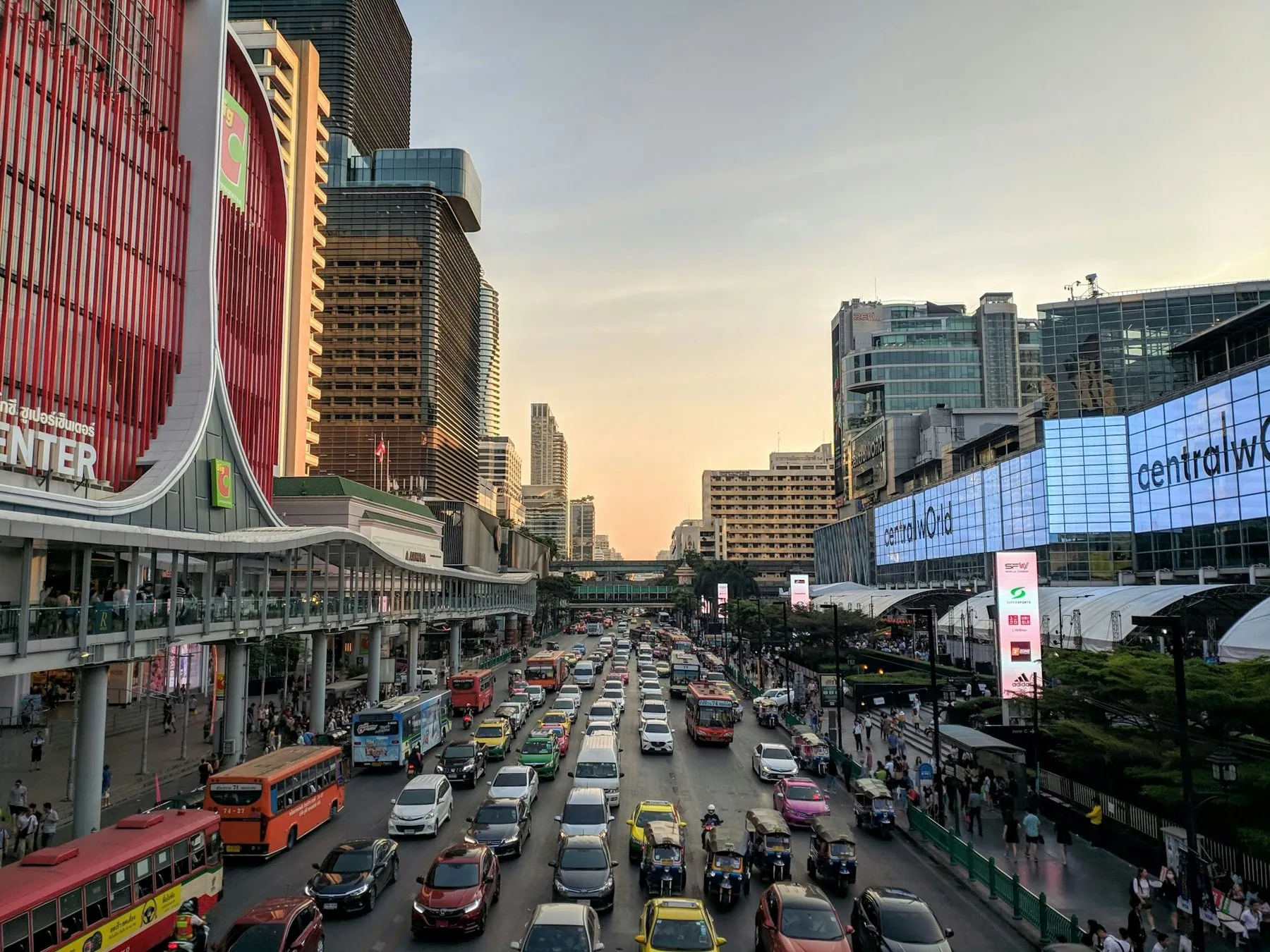
Driving in Bangkok is not chaotic. It is dense, slow and governed by conventions that nobody writes down, and the two things that catch a visiting driver out are not aggression but geometry: the city has removed the right turn from most of its main roads, and it has a second layer of traffic — motorbikes — moving through gaps you would not think of as gaps. Once you understand those two things, Bangkok becomes a city you can drive competently, if slowly.
Whether you should is a separate question, and for most short visits the answer is no. Bangkok has a metro, a skytrain, cheap metered taxis and Grab; a hire car is a liability in the centre and an asset only when you are leaving. The realistic plan for most people is to take the train in town and pick a car up on the day you drive out.
- Worst hoursRoughly 07:00–09:30 and 16:00–20:00
- Best hoursBefore 06:30, and after about 21:30
- Average traffic speedAround 20 km/h across a working day
- Typical central crossing8 km can take 20 minutes or 75
How the city is laid out, and why it matters
Bangkok grew along water. The main roads follow old canal lines and river meanders, which is why the map has no grid and why roads that look parallel meet at odd angles. Hanging off each main road is a system of sois — side streets numbered outward from one end, odd on one side and even on the other, so Sukhumvit Soi 11 and Sukhumvit Soi 12 face each other. Many sois are dead ends or narrow enough that two cars cannot pass. This is the single most useful thing to understand about Thai urban addresses, and it is covered properly in our guide to one-way streets, sois and how Thai towns are laid out.
The practical effect is that Bangkok journeys are not point-to-point. You travel along a main road, past your destination, to a U-turn, back down the other side, and into a soi. A satnav that says "1.4 km remaining" may still have three manoeuvres and eight minutes of queue to get through.
The junction rules that surprise people
On most large Bangkok roads you cannot turn right across the traffic. Central reservations are solid, right turns at signalled junctions are banned outright in many places — Asok Montri Road is a well-known example — and the movement is handled instead by a dedicated U-turn: either a gap in the central reservation with its own signal, or a purpose-built U-turn bridge or underpass. Thai highway engineering leans on this deliberately, because it removes conflicting right-turn movements from junctions. The rule of thumb for a visitor is simple: expect to go past your turning, and plan for it. The mechanics of doing this safely are in U-turns in Thailand.
The second surprise is the free-flowing left turn. At a great many junctions, the left-turn lane is separated by an island and is not controlled by the traffic light at all — you filter left continuously while the main junction is on red. If you sit waiting for a green, the car behind you will be baffled and will tell you so.
Watch what comes past your left flank. That free-flowing left lane, the bus lane and the kerbside are all shared with motorbikes moving faster than the queue. Before any left turn, any pull-in and any door opening, look properly. Mirror alone is not enough — a scooter can be alongside your rear quarter and invisible.
The expressways are the actual answer
Bangkok's elevated toll network is what makes driving here bearable. It is genuinely fast outside peak hours, it is well signed in English as well as Thai, and the tolls are modest. If you are going more than a few kilometres, get up on it. The main routes a visitor meets are:
| Route | Roughly where it goes | Useful for |
|---|---|---|
| Chaloem Maha Nakhon Expressway (First Stage) | Din Daeng south to the port and Dao Khanong | North–south through the old centre |
| Si Rat Expressway (Second Stage) | Chaeng Watthana in the north down through the middle of the city | Getting in and out of the centre |
| Chalong Rat Expressway | Ram Inthra in the northeast to At Narong | The eastern suburbs |
| Burapha Withi Expressway | Bang Na out towards Chon Buri, elevated above Highway 34 | Pattaya and the eastern seaboard |
| Udon Ratthaya Expressway | Pak Kret north to Bang Pa-in | Ayutthaya and the road north |
| Don Mueang Tollway | Elevated above Vibhavadi Rangsit Road to Don Mueang airport | Skipping the airport corridor |
These are run by different operators under different concessions, which is why the toll booths and payment methods are not uniform. How the network fits together, and how it differs from the intercity motorways, is set out in Thailand's expressways and motorways explained.
Keep a handful of 20-baht notes and coins in the door pocket. Cash lanes move faster than you expect when you have the money ready, and the electronic lanes are no use in a hire car unless the rental firm has supplied a tag.
Motorbikes are banned from expressways and motorways in Thailand, and have been for decades, whatever the engine size. There is no big-bike exception. If you are on two wheels you are on the surface streets with everyone else, which is one of the reasons we treat riding a motorbike in Bangkok as its own subject.
Where it seizes up
Bangkok's congestion is not evenly spread. Surveys of driver complaints put the Asok–Phetchaburi junction — where Phetchaburi Road, Asok Montri and Asok–Din Daeng all meet, with signals on every approach — at the top of the list. Rama IV Road, which links the Sukhumvit side to Silom and Sathorn, is slow for most of the daylight hours. Sathorn and the Surasak junction, the Rama IX intersection, Din Daeng, Victory Monument and the approaches to the river bridges are all reliable bottlenecks.
Rain is the multiplier. A serious afternoon downpour will add an hour to a cross-town journey and can flood underpasses outright; on the eastern edge there are documented evenings where drivers have sat on Bang Na–Trat Road for five or six hours after sustained rain. Read the rainy season and flooded roads before you set off in a storm, and Bangkok rush hour for the full timetable of when the city is passable.
Lane discipline, and the other traffic
Lanes in Bangkok are advisory. Cars straddle them, motorbikes use the gaps between them, and the painted line matters less than the space. What is expected of you is that you move predictably, indicate, and do not brake sharply for no reason. Horn use is light and informational rather than hostile: a short beep means "I am here", not "get out of the way".
Buses stop in the live lane. Taxis stop wherever a passenger raises a hand. Delivery riders overtake on either side. The underlying convention is that whoever is ahead by even half a bonnet has the space, and the driver behind yields — a very different mental model from an insistence on right of way, and it is set out in how Thai traffic actually works.
Parking, and getting off the street
Do not plan to park on the street in central Bangkok. Kerb paint carries real meaning here, alternate-day restrictions apply on many roads, and clamping is routine. Use shopping-centre car parks instead: large, cheap, and often free for a few hours against a purchase. Full detail is in parking in Bangkok, including what the kerb colours mean and what happens if you ignore them.
Should you drive here at all?
If your trip is Bangkok-only, no. The BTS and MRT go where visitors go, taxis are inexpensive and Grab removes the language problem. A car adds cost, parking anxiety and hours of queueing for no gain.
If Bangkok is the start of a road trip, that changes things. Pick the car up on the morning you leave, get on an expressway immediately, and the city releases you quickly — often within twenty minutes if you have timed it. Where to collect one is covered in car hire in Bangkok. And if you are merely passing through the region rather than visiting the capital, the outer ring road lets you miss Bangkok altogether.
Is driving in Bangkok dangerous for a foreigner?
Driving a car in central Bangkok at typical traffic speeds is not especially dangerous — everything is moving too slowly for high-energy crashes, and the common outcome is a scraped panel. The serious risk in Thailand sits with motorbikes and with fast roads at night, both covered in the biggest risk factors for visiting drivers.
Can I use Google Maps in Bangkok?
Yes, and its live traffic is the best available. It is weaker on soi numbering and on which side of a divided road an entrance sits, which is where a local app helps. See navigation apps in Thailand.
Why does my satnav keep taking me past the turning?
Because the turn cannot be made directly. Right turns are banned or physically impossible on most main roads, and the movement is done by U-turn further along. The route is correct; it looks wrong.
Are the expressways worth the toll?
Almost always. The tolls are small relative to the time saved. The exception is the peak of the evening rush, when the elevated sections themselves queue.
What happens if I scrape another car?
Nobody moves the vehicles, and both parties wait for the insurance surveyors, who attend the scene rather than assessing later. Do not drive off and do not agree anything before they arrive. The sequence is in what to do after a road accident in Thailand.
Is it easier to drive in Bangkok at night?
Considerably, after about 21:30. The roads empty, the expressways run freely and the city becomes pleasant to drive. Speeds rise accordingly, and so does the proportion of drivers who should not be behind a wheel — see driving at night in Thailand.