The U-turn is the manoeuvre that defines driving in Thailand, and it is the one that most often goes badly wrong for a visitor. On a Thai divided highway there is frequently no right turn at all. If your destination is on the far side of the road, you drive past it, continue to a designated U-turn slot, turn back and approach from the other direction. Learn this in the first hour or you will spend your holiday missing turnings.
The legal rules are in sections 52 and 53 of the Land Traffic Act. The dangerous part is not legal at all — it is the at-grade U-turn, where you must cross two or three lanes of traffic doing 90 to 100 km/h, from a standing start, with no acceleration lane and no traffic signal.
- Thai for U-turn slotจุดกลับรถ (jut klap rot)
- Banned within100 m of a bridge approach
- At junctionsOnly where a sign permits
- Maximum penalty400–1,000 baht (s.157)
Where a U-turn is prohibited
Section 53 sets out three categories. You may not turn where a sign prohibits turning or reversing direction. You may not turn in a safety zone, at a critical point, on a bridge, or within 100 metres of the approach to a bridge. And you may not turn at a junction unless a sign specifically permits it.
Section 52 adds the traffic-gap rule, which is the one that actually governs the manoeuvre. On a two-way road, you may not reverse direction or turn right when another vehicle is approaching or following within 100 metres, unless you can do it safely and without obstructing that vehicle.
What the law says
Section 53: no U-turn where prohibited by sign; none in a safety zone, at a critical point, on a bridge or within 100 metres of a bridge approach; none at a junction unless a sign permits. Section 52: on a two-way road, no reversal of direction or right turn where a vehicle is oncoming or following within 100 metres, unless it can be done safely and without obstruction. Breach of section 53 carries 400 to 1,000 baht under section 157 as originally drafted.
The English translation of the Act renders the Thai term for a U-turn as "reverse conveyance", which reads like reversing. Sections 52 and 53 are the U-turn provisions.
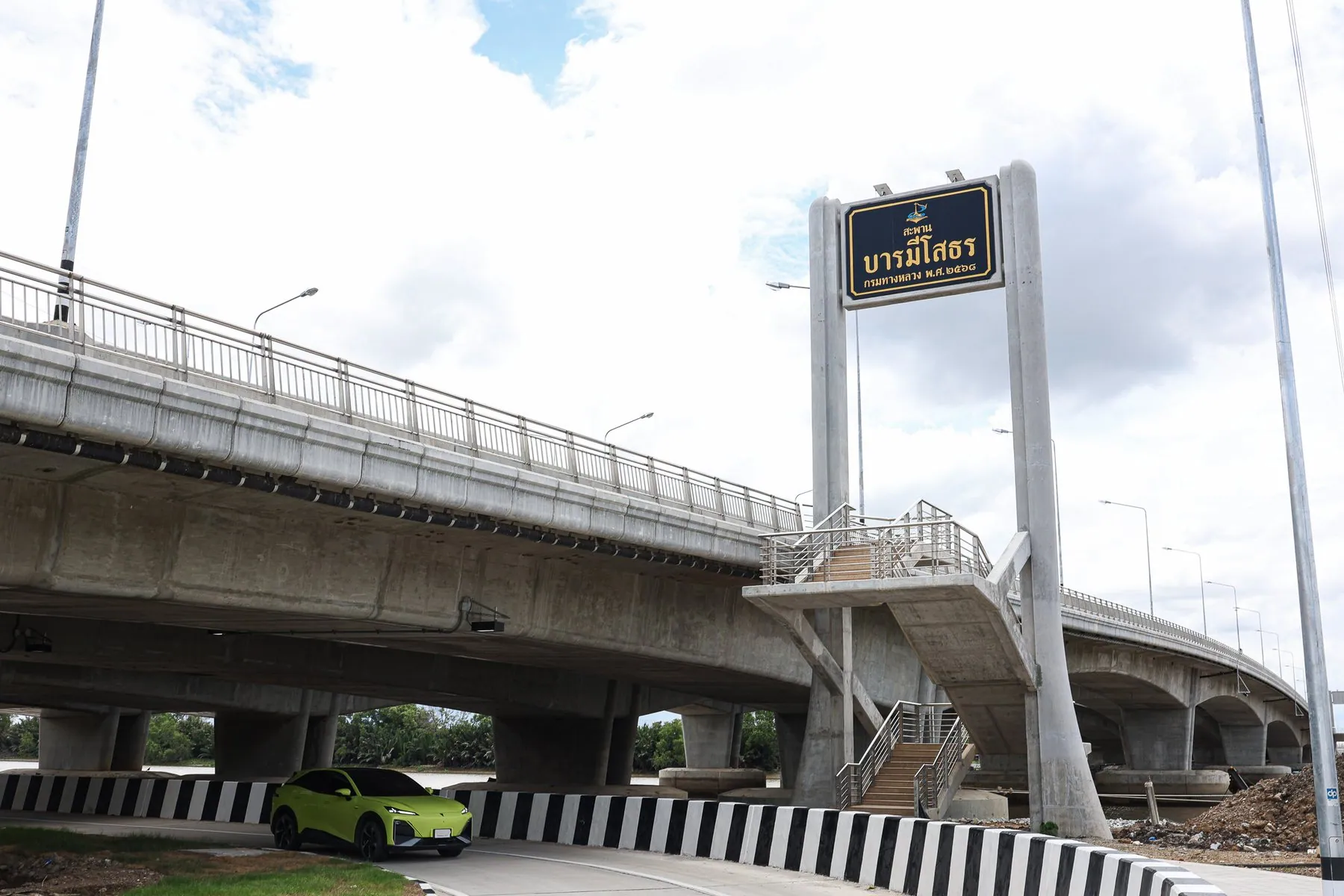
The four kinds of Thai U-turn
They are not equally safe, and knowing which one you are approaching changes how you should drive it.
| Type | What it is | Risk |
|---|---|---|
| U-turn bridge | A flyover that carries you over the carriageway and drops you facing the other way | Low. Grade-separated, no crossing traffic |
| U-turn underpass | The same idea, beneath the road | Low, though the ramps can flood in heavy rain |
| Signalised at-grade slot | A gap in the median with traffic lights | Moderate. Watch for vehicles running the amber |
| Unsignalised at-grade slot | A gap in the median, no lights, no acceleration lane | High. This is the dangerous one |
The unsignalised at-grade slot is where the trouble is. You are stationary in a short median pocket, sometimes with three or four other vehicles and a queue of motorbikes. You need a gap in traffic that is closing at 90 to 100 km/h, and you need it to last long enough for you to pull out, turn through 180 degrees and accelerate to something approaching the speed of the lane you are joining. A small hire car with three passengers and air conditioning does not do that quickly.
Take the gap you want, not the gap you are being pushed into. Vehicles behind you in the U-turn pocket will edge, hoot and occasionally go round you. None of that changes the physics. A misjudged U-turn onto a fast highway is one of the collision types that puts foreign drivers in Thai hospitals, and the vehicle that hits you will be doing highway speed. If the queue is pressuring you, let it: being the slow foreigner costs nothing.
How to drive one properly
The technique that works, for both cars and motorbikes:
- Signal right early and move into the right-hand lane well before the slot, so the traffic behind knows what you are doing.
- Enter the pocket straight and square, not at an angle. Angling in feels faster and blocks the vehicles behind you from lining up.
- Look for the second gap, not the first. The first gap is nearly always the one that closes.
- Commit fully once you move. A U-turn abandoned halfway leaves you across two lanes, and that is worse than either finishing or waiting.
- Accelerate hard, then move left as soon as you have matched the traffic speed. Do not sit in the outside lane at 60 km/h while you gather yourself.
- Check the shoulder before you complete the turn. Motorbikes travel along it in both directions and they arrive from where you are not looking.
On a motorbike, the calculation is different and generally worse. A 110cc scooter carrying two people accelerates slowly, and the rider is exposed. The safest option on a busy highway is often to wait for a genuinely enormous gap, or to use a signalised or grade-separated slot even if it means riding an extra two kilometres. If you are new to riding here, read motorbikes, filtering and Thailand's left lane alongside this page.
Finding the U-turn
U-turn slots are signed, usually with a curved arrow doubling back on itself, and often with a distance. On big highways the signs give you advance warning at 500 metres and again at the slot. In towns they may not be signed at all — you simply see the gap in the median.
The practical problem is that navigation apps handle Thai U-turns unevenly. Some route you through a U-turn perfectly; others tell you to "turn right" at a place where turning right is physically impossible, or route you into a slot that has since been closed off with concrete barriers. Do not follow an instruction that the road in front of you does not support. Navigation apps in Thailand covers which ones cope best.
If you overshoot your turning, do not stop, reverse or attempt to cross the median. Carry on to the next U-turn slot. On a main highway that is rarely more than two or three kilometres, and the detour costs you four minutes. Reversing on a Thai highway is how a small navigational error becomes a serious one.
Why it is built this way
It is worth understanding the logic, because it makes the road layout predictable. Thai divided highways run through ribbon development — shops, houses and workshops line both sides of a road carrying inter-city traffic at 90 km/h. Allowing right turns from the fast lane into every driveway would be lethal. Instead, the median is continuous and access is concentrated at controlled points.
That is a sound design principle, and where the U-turn point is grade-separated it works very well. Where it is a simple gap in the median, the conflict has been moved rather than removed, which is why these slots have such a poor safety record. Thai authorities have progressively replaced at-grade slots with bridges and underpasses on the busiest routes, and the 2021 rules that allow a 120 km/h limit specifically exclude any section that still has an at-grade U-turn — a useful signal about how the risk is regarded officially. See Thailand's 120 km/h highways.
On the toll network the problem largely disappears, because access is by proper interchange throughout. If a route has a tolled alternative and you are unsure of your driving, the toll is usually worth paying — see Thailand's expressways and motorways explained and what tolls cost and how to pay.
Frequently asked questions
Are U-turns legal in Thailand?
Yes, at designated points. They are prohibited where a sign says so, in a safety zone, at a critical point, on a bridge or within 100 metres of a bridge approach, and at junctions unless a sign permits. They are also prohibited under section 52 whenever a vehicle is oncoming or following within 100 metres and the turn cannot be made safely.
Why is there no right turn on Thai highways?
Because the central median is continuous and access is concentrated at controlled U-turn points instead. You drive past your destination, turn at the slot, and come back on the other side. It is a deliberate design decision to keep right-turning traffic out of the fast lane.
What is the fine for an illegal U-turn?
Breaching section 53 carries 400 to 1,000 baht under section 157 as the Act was originally drafted — roughly £9 to £22. As with most Thai traffic penalties, that is a range set by statute rather than a fixed roadside charge, and the amount written on a ticket is normally at the lower end.
Can I do a U-turn on a motorbike at a highway slot?
You can, and riders do it constantly, but it is the most exposed version of the manoeuvre. A small scooter accelerates too slowly to join fast traffic comfortably. Wait for a much larger gap than a car would need, or ride on to a bridge or signalised slot.
What does the U-turn sign look like?
A curved arrow doubling back on itself, usually white on blue for a permitted slot, often with a distance in metres. The Thai term on signs and maps is จุดกลับรถ. More on sign conventions in Thai road signs explained.
My sat nav told me to turn right where I cannot. What now?
Carry on to the next U-turn point and let the app reroute. Never attempt a right turn across a median because the app says so, and never reverse. This is a known weakness of navigation apps on Thai divided highways.