Thailand has two separate networks of toll road, run by two different government bodies, and they are not the same thing. The expressways are the elevated roads that thread through Bangkok on concrete piers, built and operated by the Expressway Authority of Thailand (EXAT). The motorways are intercity dual carriageways with numbered M-routes, built and operated by the Department of Highways, the same department that looks after every ordinary numbered highway in the country. Locals use both words loosely and interchangeably; the signage does not.
For a visitor the practical differences are small but worth knowing: the two networks have separate toll systems, separate electronic tags, separate operating authorities to ring if you break down, and slightly different entry rules. What they have in common is the one that catches people out most often — no motorbikes, on either network, at any engine size.
- ExpresswaysElevated toll roads in and around Bangkok, run by EXAT
- MotorwaysIntercity toll routes numbered M6, M7, M9, M81, run by the Department of Highways
- MotorbikesNot permitted on either
- PaymentCash at a booth, or an electronic tag
The Bangkok expressway network
EXAT's network is the reason Bangkok functions at all. It is a system of elevated roads sitting above the ordinary street grid, entered by ramps that spiral up from ground level, and it lets a driver cross the city without meeting a single traffic light. The oldest of them, the Chaloem Maha Nakhon Expressway, opened in 1981 and runs roughly north–south through the middle of the city. The Si Rat Expressway, opened at the end of the 1980s and operated under concession by Bangkok Expressway and Metro, is the busiest, and links the northern suburbs to the river. Others fan out from there: Chalong Rat towards Ramindra and the north-east, Burapha Withi east from Bang Na on the enormous elevated viaduct above Bang Na–Trat Road, Udon Ratthaya north towards Rangsit and Ayutthaya, and the Kanchanaphisek section that carries the ring road across the south of the city.
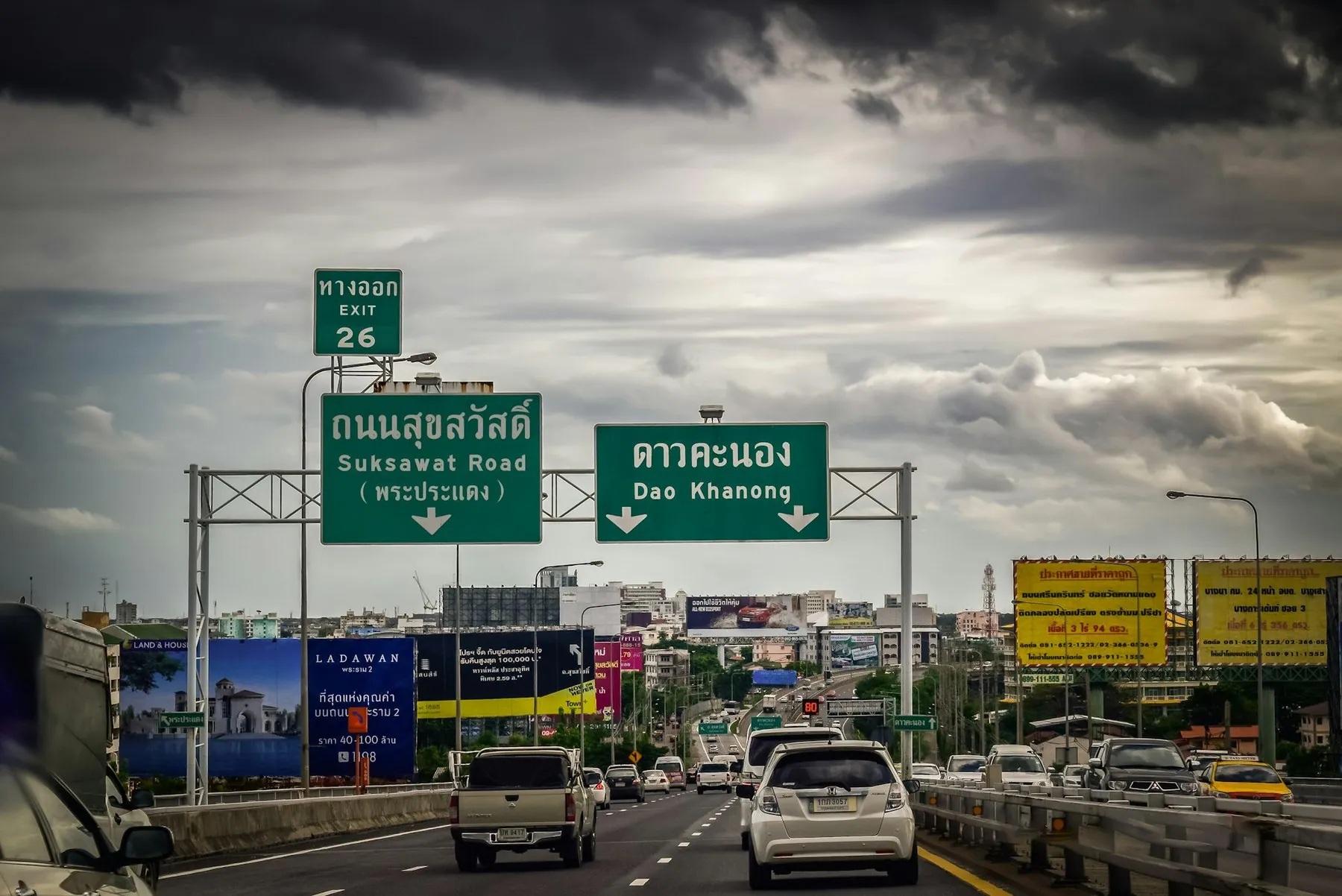
You do not need to memorise the names. What matters is that the green overhead signs on Bangkok's main roads say ทางด่วน and Expressway, with a symbol showing a stylised viaduct, and that once you are on one you stay on it until a numbered exit takes you where you want to go. Getting the exit wrong in Bangkok is expensive in time rather than money, because the next chance to turn round may be several kilometres away. Read more about what this is like from behind the wheel in our guide to driving in Bangkok.
The intercity motorways
The Department of Highways motorway network is much younger and much shorter. Four routes matter to a driver today.
| Route | Runs from | To | Roughly |
|---|---|---|---|
| M7 | Bangkok (Si Nakharin interchange) | Chonburi, Pattaya, Map Ta Phut | 149 km |
| M9 | Bang Pa-in, north of Bangkok | Round the city to Bang Phli and Suksawat | The outer ring |
| M81 | Bang Yai, west Bangkok | Kanchanaburi | 96 km |
| M6 | Bang Pa-in | Nakhon Ratchasima (Korat) | 196 km, opening in stages |
M7 is the one most visitors use, because it is how you get from Bangkok or Suvarnabhumi airport to Pattaya and the eastern seaboard without touching Sukhumvit Road. It is a proper motorway by any standard: wide, well surfaced, grade separated, with nine toll plazas and genuine service areas at Bang Pakong and Si Racha.
M81 to Kanchanaburi is newer and dramatically shortens what used to be a slow crawl out through the western suburbs; it is the sensible way to start the Highway 323 drive to Sangkhlaburi. M6 to Korat has been opening in stages and running free trial periods rather than switching on all at once, and during those trials it has had reduced limits, incomplete junctions and — importantly — no fuel and no services along its length. Check its status before you plan a journey around it, and treat Highway 2, the Mittraphap Road, as the reliable way into Isaan until it is fully open.
M9 and the ring road
M9 is a special case, because part of it is a tolled motorway and part of it is an ordinary free ring road, and they carry the same number. This confuses navigation apps as much as it confuses drivers. The full story is in our guide to the Bangkok Outer Ring Road, but the short version is that if you are driving north to south through Thailand and have no business in the capital, going round is almost always better than going through.
What they are like to drive
Better than the ordinary highways, and that is the point. Both networks are fully access controlled: no U-turn gaps, no motorbikes coming the other way up the hard shoulder, no roadside stalls, no dogs. The surfaces are good. The lane markings are clear. Lorries keep left, mostly.
The elevated expressways in Bangkok have their own character. They are narrow by motorway standards, the lanes feel tight between concrete barriers, the entry ramps merge with very little run-up, and at rush hour they queue solid — being above the traffic does not exempt you from it. See when Bangkok's rush hour actually bites before assuming the expressway will save you.
Motorbikes are not allowed on either network. This applies to every size of machine, including large-capacity bikes on foreign plates. There is no lane for them and no exemption. If you are riding, you take the surface roads — which in Bangkok means Rama IV, Sukhumvit, Phetchaburi and the rest. Our honest assessment of riding a motorbike in Bangkok covers what that involves.
Paying
Every entry to an expressway or motorway is tolled, and the charge is either flat rate for the section or based on how far you go. You can pay cash at a booth or use an electronic tag, and the two networks historically had different tags — Easy Pass on the EXAT expressways, M-Pass on the Department of Highways motorways — with a newer barrier-free system, M-Flow, layered on top of parts of both. Which lane you should be aiming for, and what happens if you pick the wrong one, is covered in how Thai toll roads work and in detail in Easy Pass and M-Flow explained.
If you are in a hire car, keep 20, 50 and 100 baht notes and a handful of 10 baht coins somewhere you can reach without unbuckling. Cash lanes are almost always on the left, and the queue behind you will not be patient.
Speed, cameras and enforcement
Both networks are camera enforced, and the limits are not the same as on ordinary roads. Some motorway sections carry Thailand's highest posted limit; expressway limits in the city are much lower. The numbers, and which roads they apply to, are set out in speed limits in Thailand and Thailand's 120 km/h highways. If a camera catches a hire car, the ticket reaches the rental company and then reaches you — see how speed camera tickets find you.
If something goes wrong
Stopping on an elevated expressway is genuinely dangerous and there is often no hard shoulder to speak of. EXAT and the Department of Highways both run patrol vehicles and call centres, and the emergency procedure differs from an ordinary roadside breakdown. Read breaking down on a Thai expressway before you need it, not after.
Frequently asked questions
Is an expressway the same as a motorway in Thailand?
No. Expressways are the elevated urban toll roads run by the Expressway Authority of Thailand, concentrated in and around Bangkok. Motorways are intercity toll routes numbered M6, M7, M9 and M81, run by the Department of Highways. Different operators, different tolls, different tags.
Can I take a motorbike on the expressway in Bangkok?
No. Motorcycles are barred from the whole expressway and motorway network regardless of engine size. You will be turned back at the toll plaza if you try, and stopped if you get past one.
Do I need a transponder to use them in a hire car?
No. Cash lanes exist at every barrier plaza and are the simplest option for a short visit. The complication is the barrier-free M-Flow gates, which have no booth at all — see the M-Flow guide for how to avoid ending up in one by accident.
Are the expressways worth the toll?
In Bangkok, almost always yes, outside the very worst peak hours. On the intercity motorways it is less clear cut, because the parallel free highway is often decent — but M7 to Pattaya and M81 to Kanchanaburi both save real time.
Which motorway goes to the airport?
Suvarnabhumi sits beside M7 east of Bangkok and is reached from it directly. Don Mueang is on the northern side of the city and is served by the elevated Don Mueang Tollway, a separate concession road above Vibhavadi Rangsit Road, which is tolled in the same cash-or-tag way.