Thailand has very few motorway service areas in the European sense, and it does not need many, because the petrol station does the job instead. A large branded forecourt on a Thai trunk road is a small complex: fuel, a 24-hour convenience store, a coffee franchise, two or three hot-food outlets, clean free toilets, a covered seating area and a car park with security lighting. They appear every twenty or thirty kilometres on any main highway, and they are the reason long-distance driving in Thailand is far more comfortable than the road statistics suggest.
The genuine motorway service areas exist only where there are genuine motorways. Motorway 7 towards Pattaya has proper service facilities at Bang Pakong and Si Racha, reached without leaving the carriageway. Elsewhere — which is to say almost everywhere — you pull off the highway into a forecourt like everyone else.
- Typical spacingA large forecourt every 20–30 km on main highways
- Motorway service areasBang Pakong and Si Racha on M7
- ToiletsFree and generally clean at the big chains
- OpenMost large forecourts run 24 hours
Which brands to look for
The large forecourts are worth aiming for and the small ones are worth skipping. In descending order of what you can expect to find:
PTT Station is the national operator and its flagship sites are the best rest stops in the country. Almost all have a Café Amazon, most have a 7-Eleven, many have a fried chicken or noodle outlet, and the larger ones have a separate air-conditioned building with prayer rooms, baby-changing facilities and a covered area for drivers to sleep. Bangchak sites are similar in scale and quality. Shell, Caltex, PT and Susco vary more: the highway sites are good, the village ones may be two pumps and a dog.
If you need a reliable toilet, a coffee and somewhere to check the map, look for a PTT or Bangchak sign on a green-and-blue or blue-and-green board set well back from the road with a large canopy. The sites that are worth stopping at advertise themselves from a kilometre away.
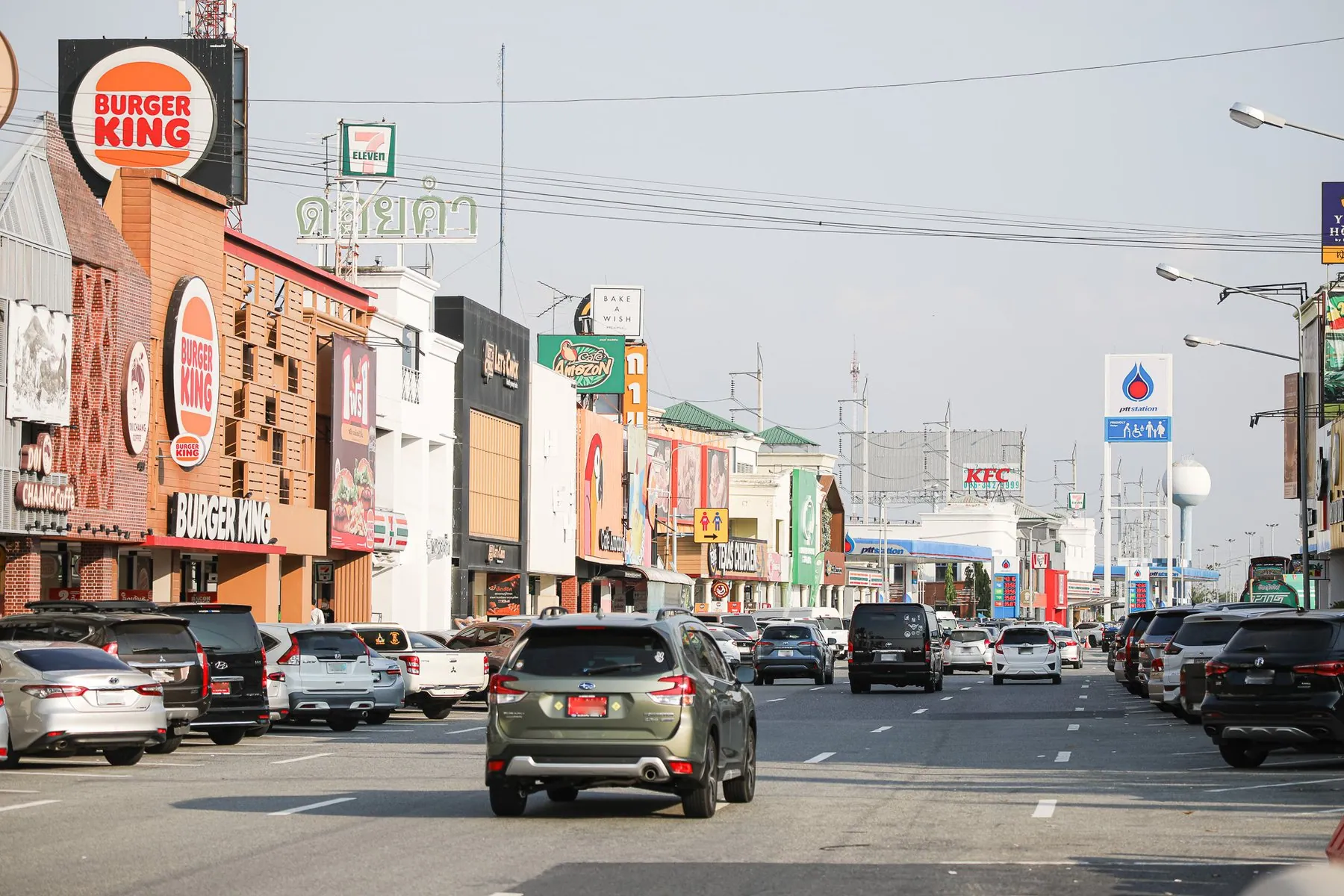
What is inside
Café Amazon deserves its own mention because it is unavoidable: PTT's coffee chain occupies a corner of most of its forecourts, it opens early, the air conditioning works, and it has become the default meeting point and rest stop for Thai drivers. It is not remarkable coffee. It is reliably available coffee at seven in the morning on Highway 41, which matters more.
The 7-Eleven attached to a highway forecourt sells cold water, toasted sandwiches, instant noodles with hot water on the counter, phone top-ups and cheap rain ponchos. On a wet ride, that last item is worth knowing about — see riding a motorbike in tropical rain.
Toilets are the thing most visitors ask about and the answer is reassuring: at the big chains they are free, tiled, cleaned on a rota and posted with a signature sheet. Smaller independent stations may charge a token amount or may be less pleasant. Squat pans still exist alongside seated ones, and the bum gun beside the pan is normal.
The motorway service areas
On Motorway 7, Bang Pakong Service Area and the Si Racha Service Centre work the way a service area does anywhere: signed in advance, entered from the carriageway, exited back onto it, with fuel, food and toilets on site. They are busy on Friday evenings and Sunday afternoons when Bangkok drives to and from the coast.
Motorway 6 towards Nakhon Ratchasima is designed with service centres and rest stops along it, but during its staged and trial openings those facilities have not all been in operation — there have been stretches with no fuel at all. Fill up before you join it and check the current position rather than assuming.
Roadside stalls and the informal stops
Between the forecourts, Thai highways are lined with stalls: fruit in season, grilled chicken, sticky rice in bamboo, coffee carts, and whole clusters of restaurants at particular spots that have become famous for one dish. Some of the best eating in the country happens at a plastic table beside a trunk road.
The stalls themselves are safe; the pulling in and out is not. There is rarely a deceleration lane. Vehicles brake hard from highway speed for a mango stall, and pull out again into fast traffic. Indicate early, get fully off the carriageway, and when you leave, wait for a real gap rather than the one a Thai pickup driver would accept. Pickup behaviour is worth reading on this point.
Sleeping and long breaks
Parking overnight at a large 24-hour forecourt is normal, common and generally tolerated: lorry drivers do it, Thai families driving home for Songkran do it, and the sites are lit and have staff on duty. It is not a formal campsite and there is no facility for it, but nobody will move you on for a two-hour nap in the car park. On a long haul like Bangkok to Chiang Mai, that is often the most sensible response to the tiredness that arrives around hour six.
What you will not find is a motel network. Thailand's roadside accommodation is either a proper hotel in a town, or a resort aimed at holidaymakers, or the curtained short-stay places on the edges of every provincial city. Plan the overnight stop rather than hoping to find one.
Fuel, air and electricity
Attendants serve you at the pump on almost every Thai forecourt — you stay in the car, say which grade and how much, and pay by card, cash or QR code at the end. Which grade to ask for is covered in fuel in Thailand, and it matters, because the pumps are not colour-coded the way they are at home.
Free tyre-inflation points are common, usually round the side by the workshop bay, and worth using at the start of a long drive. Electric-vehicle charging has spread quickly across the main PTT and Bangchak networks along the trunk routes, though coverage thins out fast once you leave them — check your app before committing to a mountain route in an EV.
Frequently asked questions
How often are there services on Thai highways?
On any main numbered highway, a large branded forecourt roughly every twenty to thirty kilometres, and smaller stations much more often than that. Mountain and border roads are the exception — see running out of fuel in Thailand.
Are the toilets at Thai petrol stations clean?
At PTT, Bangchak, Shell and Caltex highway sites, generally yes, and free. Bring tissues anyway; refill is not guaranteed.
Can I sleep in my car at a petrol station in Thailand?
A rest of a few hours at a large 24-hour forecourt is normal and widely done. It is not a campsite, so be discreet, park where the lighting and cameras are, and do not set up outside the vehicle.
Do the motorways have service areas like in Europe?
Only Motorway 7 has full service areas, at Bang Pakong and Si Racha. Motorway 6 is built with them but they have not all been open during its staged opening.
Is it safe to eat at roadside stalls?
Broadly yes, and the busy ones are the safe ones — high turnover means fresh food. The risk on a Thai highway is the car park, not the kitchen.
Do petrol stations take cards?
The large chains do, and almost all take Thai QR payment. Small rural stations and the drum-and-hand-pump operations in remote areas are cash only, so keep some notes for the mountains and for the emptier parts of Isaan.