Getting caught in the rain on a scooter in Thailand is not a maybe, it is a when. The rain arrives faster than you can outrun it, it is heavy enough to hurt at road speed, and the surface is at its most treacherous in the first few minutes. The correct answer, nine times out of ten, is to stop and let it pass — Thai riders do exactly that, which is why twenty scooters cluster under every flyover the moment a storm hits.
The tenth time you cannot stop, and then you need technique. This page covers both.
- Most slipperyThe first five to ten minutes of rain
- Typical afternoon stormThirty to sixty minutes
- Standard local responsePull under a bridge and wait
Reading the sky, and the ten minutes of warning you get
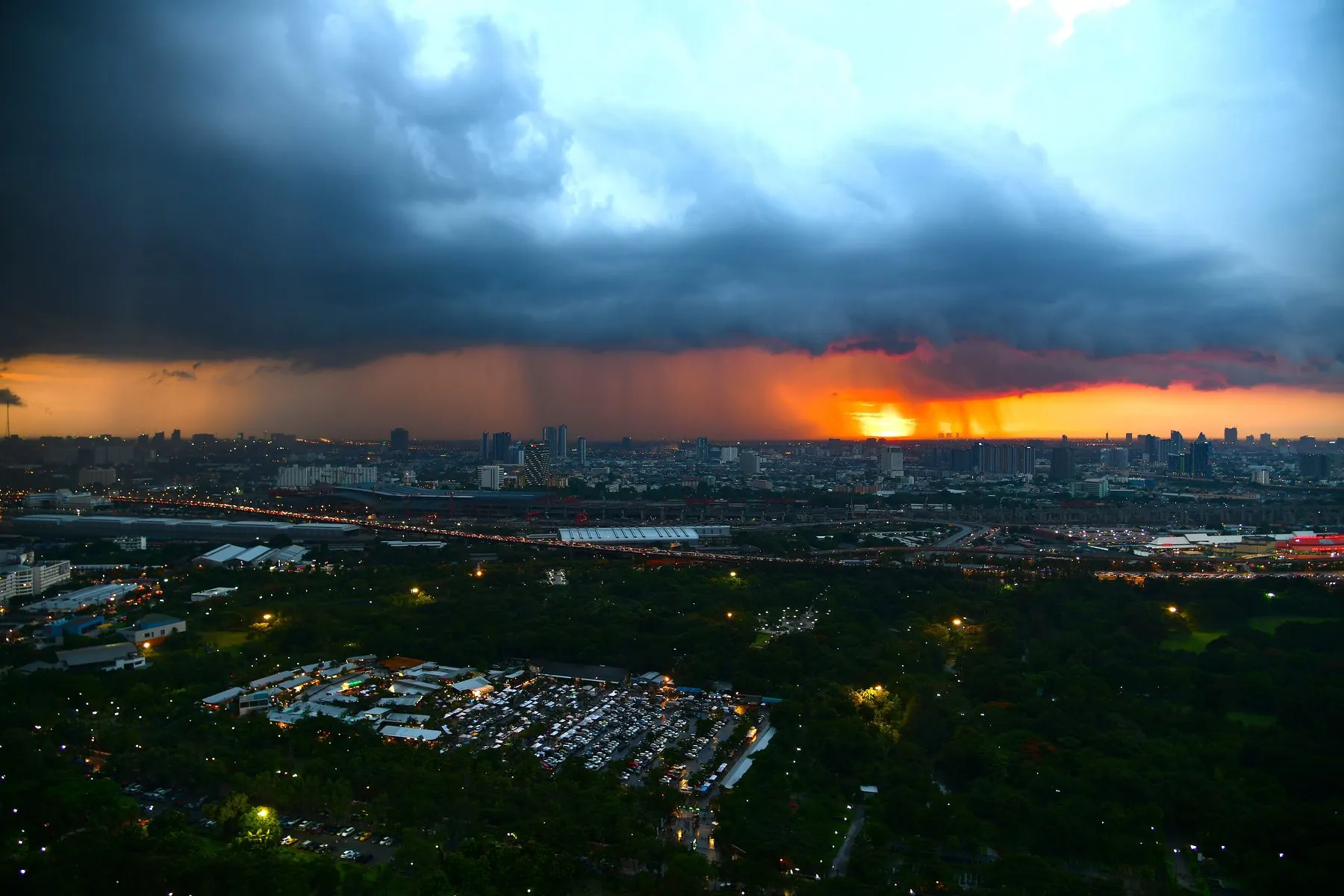
Tropical rain announces itself if you know what to look for. A wall of grey-black cloud with a hard, low base, usually building inland over the hills in mid-afternoon. Dust and litter lifting off the road. On a coast, a visible curtain of rain moving across the water. And, most reliable of all, a sudden drop in temperature and a cool gust — that is the storm's outflow arriving ahead of the rain.
From that cool gust you typically have five to fifteen minutes. Use them to get somewhere with a roof rather than to beat the storm to your destination — outrunning tropical rain on a 125cc scooter is a losing proposition, and the attempt puts you at speed on a road that is about to become slippery.
Where to shelter, in order of preference. A petrol station forecourt canopy — spacious, lit, has a toilet and coffee, and everyone does it. A road bridge or flyover underpass, free and instant, but watch that you are not standing in a traffic lane. A shop awning or the covered front of a 7-Eleven. Avoid a large lone tree in a thunderstorm, and avoid the hard shoulder of a fast road entirely.
Why the first five minutes are the worst
Thai roads accumulate a heavy film of diesel, engine oil, rubber and dust between storms. The first water does not wash it away; it floats it, spreading a thin emulsion across the whole surface. For those minutes the road is genuinely greasy — noticeably worse than it will be twenty minutes later. You can sometimes see it as a faint iridescent sheen in the wheel tracks.
It concentrates where vehicles sit still and drip: the approach to traffic lights, junctions, roundabouts, bus stops, the mouths of petrol stations, and the middle of the lane on any slow road. Those are exactly the places you are also braking and turning.
If the rain has just started and you are still moving, get your speed down and stop. Not "ride carefully" — stop. This is the highest-risk ten minutes of wet-weather riding there is, and it costs you nothing to sit it out. Once the road has been under water for a while, grip improves substantially.
The surfaces that catch riders out
Wet asphalt in good condition still offers usable grip. The problem is everything that is not asphalt.
- Painted markings. Thermoplastic road paint is close to frictionless when wet — lane lines, crossings, the big arrows at junction approaches, the hatching around u-turn slots. Cross them upright and straight, never while leaning or braking.
- Steel. Manhole covers, drain grates, expansion joints on flyovers, and the plates laid over roadworks. A wet steel plate at a lean angle will put the bike down instantly.
- Concrete. Older highway sections and many bridges, often with polished wheel tracks.
- Tiled and polished surfaces. Petrol station forecourts, hotel driveways and the tiled aprons outside shops. Come to a stop before you turn onto them.
- Mud and washed-out gravel. Heavy rain carries dirt and stones off building sites, farm tracks and cut slopes onto the road, usually in a fan across the exit of a bend — see sand and gravel on coastal roads.
How to ride when you cannot wait
The principle underneath all wet-weather riding is that grip is finite and you spend it on one thing at a time. Brake in a straight line, then release the brakes, then turn. Do not brake and lean simultaneously, and do not open the throttle abruptly mid-corner.
Braking
On a scooter, squeeze both levers together rather than grabbing the front. Begin far earlier than you would in the dry and use less pressure over a longer distance. If the front locks in the wet you will be on the ground before you have registered it; if the rear locks, ease off the lever rather than releasing it violently.
Where to put the bike
The centre of a lane is where oil drips collect; the two darker strips where car tyres run are cleaner. Aim for the left-hand wheel track and adjust for the puddles. Treat every puddle as a hole — brown standing water may be shallow or it may be a pothole full to the brim, and you cannot tell by looking. Go around when you safely can, and when you cannot, cross it upright, straight, off the brakes, weight slightly back and arms relaxed.
Space and visibility
Increase your following distance dramatically: you need more room for your own braking, and you need to see the road surface, which the vehicle in front is blocking. Lights on, dipped, and a light-coloured or reflective top layer over the poncho makes an enormous difference — behind a rain-covered tinted windscreen a rider in a dark poncho is close to invisible.
What to wear
The cheap plastic poncho sold at every 7-Eleven is what everyone here uses, and for a short ride it works. Know its limits: the tail can catch in the rear wheel or the chain if it hangs loose, and the hood is useless under a helmet and will balloon and blind you if you leave it up. Tuck the tail firmly under you and put the hood inside. A two-piece rain suit from a motorbike shop is far better if you expect to ride in the rain more than once.
- Visor. Rain on a scratched visor at night is close to opaque. If the shop's helmet has a visor you cannot see through, buy your own — see choosing a helmet that actually protects you.
- Footwear. Wet flip-flops on wet footboards cause a lot of low-speed drops at junctions — riding a scooter in flip-flops makes the wider case.
- Cover your skin. Rain at road speed stings, and a wet crash produces worse abrasion because you slide further. See protective riding clothing in a hot climate.
- Waterproof the phone and passport. A zip-lock bag under the seat costs nothing.
Cold is a real risk on a long wet ride. It sounds absurd in the tropics, but soaked through at road speed in the hills, in the evening, you will get properly cold and your hands will stop working on the levers. If you are shivering, stop and warm up.
After the rain stops
The risks change rather than disappear. Standing water sits in the low spots and worn ruts. Debris — sand, gravel, palm fronds, mud — has been washed across the carriageway, particularly at the bottom of hills and on the outside of bends. And the sun comes back low, producing a sheet of glare on wet tarmac that hides everything on the surface.
Choosing a bike you can ride in the wet
If you are booking for the rainy season, the bike matters more than usual. The 10-inch wheels on the cheapest scooters are considerably worse in standing water and over wet edges than the 14-inch wheels on a standard 125, and tyre condition matters more than tyre brand. Choosing a rental scooter goes through what to look at. If the rain is settled in for days rather than an afternoon, taking a car for that leg is not defeat — it is the same calculation local families make.
Frequently asked questions
Is it safe to ride a scooter in Thai rain at all?
It is manageable, and millions of people do it daily, but your margin for error is much smaller. The two things that turn it from manageable into dangerous are riding in the first few minutes of a storm and riding at your usual dry-weather speed. Remove both and the rest is technique.
My visor keeps fogging up. What do I do?
Open it a crack at low speed to get airflow across the inside; the fog is your own breath condensing. A dedicated anti-fog product or an insert works properly. Riding with the visor fully up in heavy rain is worse, because rain in the eyes at speed is genuinely blinding.
What if I come off in the wet?
Wet crashes tend to be low-speed slides rather than impacts, but you slide further and pick up more abrasion. Get off the road first, then look at the injuries — tropical wounds get infected quickly, so read road rash and exhaust burns before deciding a graze does not need cleaning properly.
Should I just avoid the rainy season?
No. It is green, cheap and quiet, and most days you can ride. Plan mornings, keep the daily distance modest, and build in the possibility of losing an hour to a storm. The rainy season and flooded roads sets out when each part of the country actually gets its rain, which is not the same everywhere.