For one rider on ordinary roads, a 125cc automatic is the right answer almost every time. It is light enough to paddle around a car park, quick enough to keep out of trouble in town, and it is the machine every shop in Thailand has most of. Go up to the 150–160cc class if you will be two-up, carrying luggage, riding real hills, or covering more than about 60 kilometres in a day.
The 110cc step-throughs are cheaper and perfectly pleasant on flat ground with one light rider. They are also the machines most often found halfway up an island climb with the throttle wide open and nothing happening. That is the whole decision, and everything below is the detail behind it.
- Solo, flat roads, short hops110–125cc automatic
- Two-up, luggage or hills150–160cc automatic
- Long distances or mountain routes150cc-plus, or a proper motorcycle
- NeverAnything you cannot hold upright flat-footed at a standstill
The four kinds of machine on a Thai rental forecourt
| Type | Typical examples | Good at | Poor at |
|---|---|---|---|
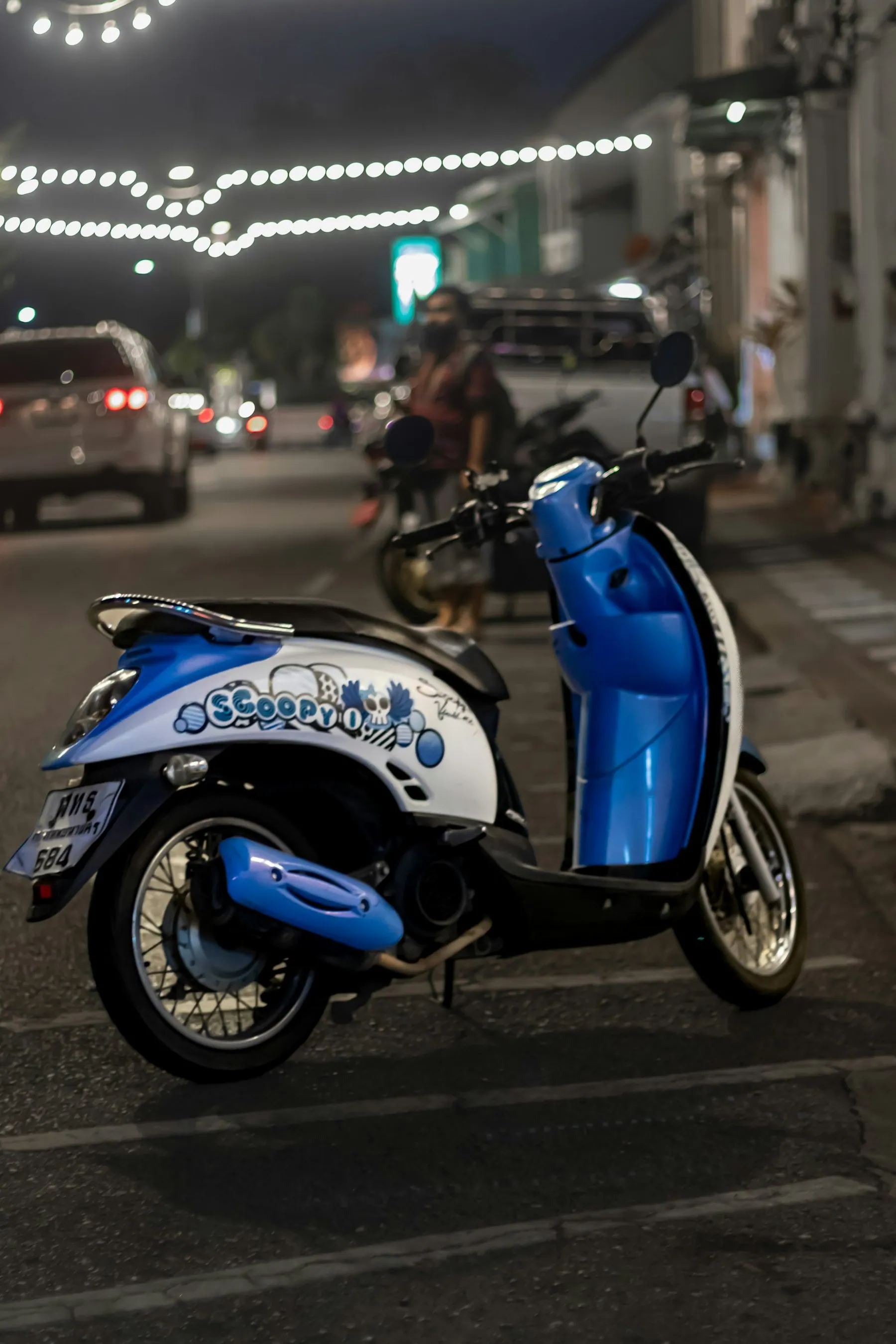
| 110cc step-through automatic | Honda Scoopy, Yamaha Fino and similar retro-styled machines | Cheap, light, easy, fine on the flat with one rider | Hills, two-up, sustained speed, rough surfaces |
| 125cc automatic | Honda Click, Yamaha Mio and the same class from other makers | The default all-rounder; enough power for town and most island roads | Steep gradients with a passenger and bags aboard |
| 150–160cc automatic | Honda PCX, Yamaha NMAX and Aerox, Honda Click in its larger form | Two-up, hills, highway speeds, bigger brakes and better lights | Heavier to manoeuvre; dearer to hire and to repair |
| Semi-automatic underbone | Honda Wave, Yamaha Spark and similar four-speed "gear" bikes | Engine braking on descents; tough, cheap, universally serviceable | Requires gear changes; unfamiliar to riders who have only used twist-and-go |
Model names and displacements change with the year, so treat the table as classes rather than a catalogue. When a shop tells you a bike is "a 125", look at the badge on the side panel and at the registration book if you can — a worn 110 sold to you as a 125 is a small deception that becomes a large one on a hill.
What actually decides it: gradient, load and distance
Gradient. A twist-and-go automatic transmission has no low gear to fall back on. Once the belt is at its limit and the revs are up, that is all the machine has. On the steep concrete access ramps of Koh Tao, the west-coast climbs on Koh Chang, the hills above Lamai on Samui or the road out of Ao Nang, an underpowered 110 with two people aboard will simply stop climbing — and stopping halfway up a 20% ramp is how people get hurt. If your route has hills in it, take the bigger machine.
Load. Two adults and a rucksack roughly doubles the weight the brakes and suspension were designed around. It lengthens the stopping distance, makes the front end light on acceleration and changes how the bike behaves over a bump mid-corner. Riding two-up on a rented scooter covers what that feels like and how to brief a passenger, and carrying luggage and shopping on a scooter covers where the bags should go.
Distance. A 110 will do 60 km/h all day and will feel unpleasant doing it for an hour. Small wheels, a short wheelbase and a firm seat add up quickly. If you are planning a day trip of a hundred kilometres or more, the extra 100 baht for a PCX-class machine buys a genuinely different day. For long mountain routes, look at renting a big bike in Thailand instead — and read mountain roads and hairpin bends before you commit to one.
Wheel size and brakes matter more than the cc figure
Two specifications decide how a small scooter copes with Thai roads, and neither is the engine.
The first is wheel diameter. Scooters in this class run anything from 12-inch to 14-inch wheels; the larger the wheel, the less a pothole, a lip of broken tarmac or a patch of gravel unsettles it. Thai road surfaces are patchy enough that this is a real safety difference rather than a comfort one — see potholes and road surfaces in Thailand.
The second is the front brake. Some cheap step-throughs still have a drum front brake, which fades under repeated hard use and does very little in the wet. A front disc is worth more to you than 40cc. Some 150–160cc machines and the better 125s offer linked braking or ABS; if a shop has one on the rack, take it.
Test both brakes before you leave the forecourt. Roll the bike at walking pace and pull each lever separately. A front lever that comes back to the bar, a rear that does nothing, or a squeal like a train are all reasons to ask for a different machine — which is a normal request that costs nothing at the shop and everything on the road. Our rental handover checklist has the full walk-round.
The semi-automatic Wave, and why so many Thais ride one
The underbone "gear bike" — the Honda Wave being the archetype — has a four-speed gearbox worked with the left foot and no clutch lever. You still change gear; you just do not have to co-ordinate a clutch. Riders who have never used one usually dismiss it, and it is often the better tool.
Two reasons. It has engine braking, which on a long descent is the difference between arriving at the bottom with brakes or without them. And it is the most common machine in the country, so any village mechanic can fix it, usually the same afternoon, usually for very little. If you are riding somewhere steep and remote, a Wave is a serious answer.
The catch is that a rider who has never changed gear on a bike should not learn on a Thai mountain road. Learn on a flat back street for twenty minutes first, or take the automatic.
Storage, and the suitcase problem
Under-seat space on a 110–125 typically swallows one open-face helmet and not much else. The 150–160cc machines have noticeably more, and some take a full-face helmet. Nothing in this class will take a suitcase.
If you are moving between towns with luggage, this is usually the point at which a scooter stops being the right vehicle — a hire car or a bus with the bike rented at the other end is cheaper, drier and safer. Our scooter or car tool asks the questions that decide it. If you are set on the bike, ask the shop for a rear rack or a top box; many have them, and few mention them unless asked.
Condition beats specification
Given a choice between a tired 160 and a well-kept 125, take the 125. The things that hurt visiting riders on rental machines are bald tyres, glazed brake pads, a slack chain on an underbone, and a headlight aimed at the treetops — not a shortage of horsepower.
- Tyres: visible tread across the whole width, no cracking in the sidewall, no bald strip up the centre.
- Brakes: both work, both release cleanly, neither lever comes back to the bar.
- Lights: headlight on both beams, brake light with each lever, all four indicators.
- Horn: it works. In Thai traffic this is a safety device, not a rudeness.
- Mirrors: both fitted, both adjustable, both tight.
- Suspension: sit on it and bounce. A blown rear shock is common and makes bumps dangerous.
- Plate and tax sticker: present and legible. A machine with no plate cannot be legally on the road at all.
Film the walk-round as you do it — the motorbike rental inspection video explains the order — and take the shop's helmet as a starting point rather than an answer. Rental helmets in Thailand covers how to judge the one you are handed.
Frequently asked questions
Is a 125cc enough for two people?
For short, flat journeys, yes, though it will feel slow and it will take longer to stop. For hills, luggage or anything over about half an hour, take a 150–160. Weight matters as much as engine size: two light riders on a 125 is a different machine from two heavy ones.
What is the difference between a Click, a PCX and an NMAX?
Broadly, size and comfort. The Click class is the compact 125-ish commuter; the PCX and NMAX class are larger-framed 150–160cc machines with more storage, better brakes and a more stable ride. Actual displacements vary by model year, so check the badge.
Automatic or semi-automatic?
Automatic if you have never ridden anything else. Semi-automatic if you are going somewhere steep and want engine braking, and are willing to practise on a flat road first.
Does engine size change what licence I need?
No. Motorcycles sit in a single category — category A — under both road-traffic conventions Thailand is party to, and Thailand has declared that it treats mopeds as motorcycles for the Convention's purposes. A 110 needs the same entitlement as a 400. See can you legally rent a motorbike in Thailand?
Should I pay extra for ABS?
If it is on offer and the difference is a hundred baht a day, yes. Most riders who come off a rental scooter do it by grabbing the front brake on a loose or wet surface, which is precisely the event ABS exists for.
Can I take a rented scooter on the expressway?
No. Motorcycles are banned from Thai expressways and motorways at every engine size. Set your navigation app to avoid them — see motorbikes, filtering and Thailand's left lane.