Yes — renting is legal, and there is essentially nothing stopping you. Handing money to a Thai shop in exchange for the temporary use of a motorbike is an ordinary commercial contract, and no Thai law requires the shop to check your entitlement before it does so. That is why a scooter can be in your hands ninety seconds after you walk in.
Riding it is the regulated part, and the two questions get run together constantly. "Can I rent one?" and "am I legal to ride it?" have different answers for a large number of visitors, and the gap between them is where the trouble lives.
- RentingLegal. No licence check is required of the shop
- RidingRequires motorcycle entitlement — a car licence is not one
- Riding without a valid licenceUp to 1 month and/or a fine of up to about 1,000 baht
- Where it really bitesYour travel insurance, not the roadside
What a Thai rental shop is actually obliged to do
Very little, as far as your paperwork goes. Thai law puts the licensing obligation on the person driving, not on the person who lent them the vehicle. There is no equivalent of the checks a European hire-car desk runs — no licence-history query, no endorsement check, no minimum holding period as a matter of law.
What varies is the shop's own policy, and it varies enormously. At one end, a table on a beach road in Patong or Chaweng will take 200 baht and a phone number. At the other, an organised operator renting anything above about 300cc will look properly at your licence, ask for an international driving permit, and turn you away if the categories are wrong. That last group exists because a bigger machine means a bigger loss, not because the law changed.
Do not read a shop's willingness as a statement about the law. A rental shop is not a licensing authority and has no obligation, capability or incentive to assess whether you may ride. The one entity that will assess it in detail is your insurer, after the event.
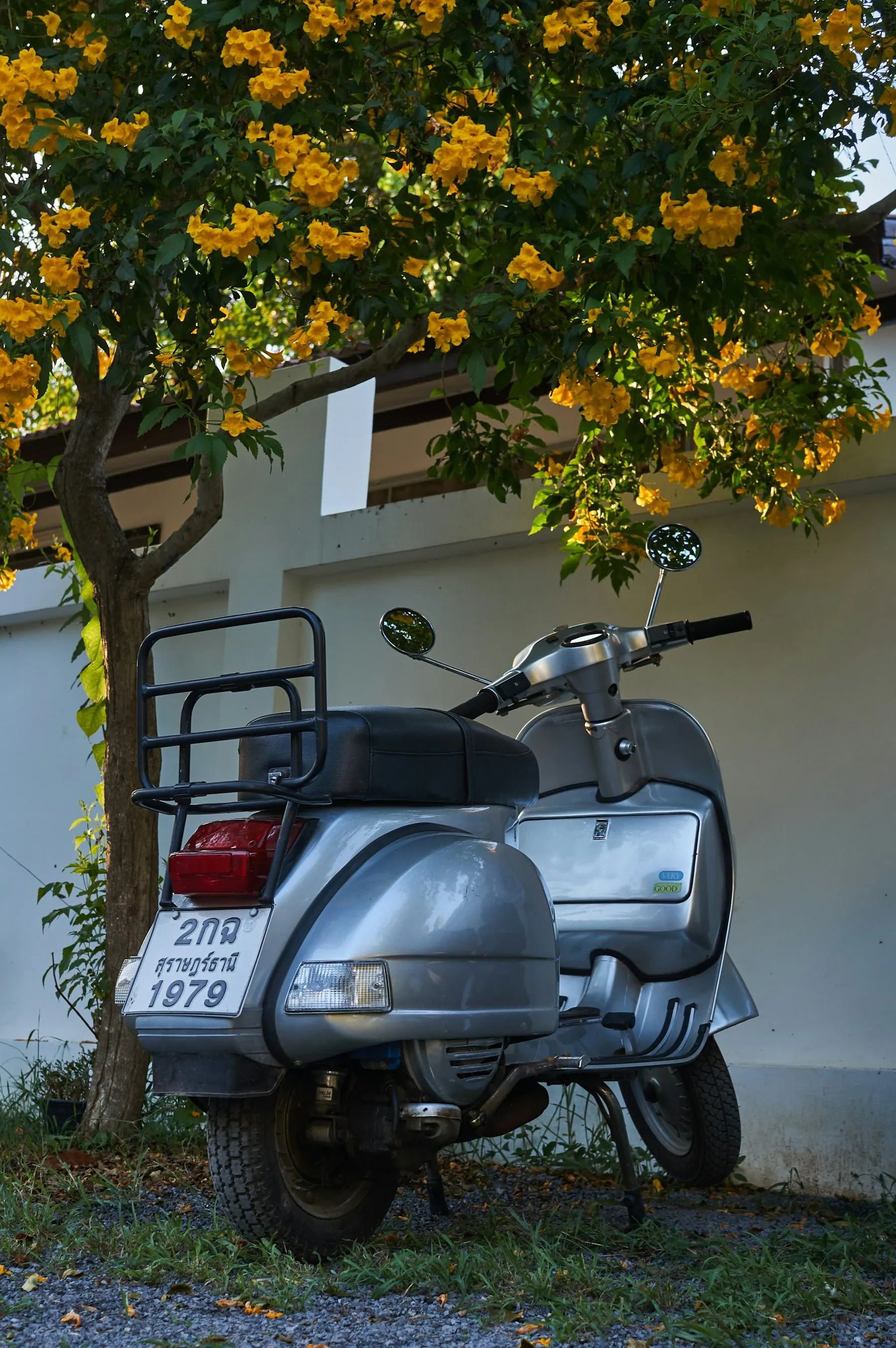
The riding side: what you actually need
Thailand issues a private car licence and a private motorcycle licence as separate documents; one does not imply the other. For a visitor riding on a foreign licence, the same split applies through the road-traffic conventions Thailand is party to. Motorcycles are category A; cars are category B. Category A is a single category — the treaty text covers "motor cycles with or without a sidecar" with no small-engine tier beneath it — and Thailand has separately declared to the UN treaty depositary that it treats mopeds as motorcycles for the purposes of the Convention.
The practical effect is short. If your home licence covers cars only, you have no motorcycle entitlement, and neither the size of the engine nor the automatic transmission nor the shop's shrug creates one. Which licence can I use in Thailand? takes it document by document, and renting a motorbike in Thailand is the full rental picture.
On top of the entitlement sits the international driving permit, which is a certified translation of it rather than a licence in its own right. Which booklet you need depends on your nationality, because Thailand is party to both the 1949 and 1968 conventions and your own country will only be a party to one of them. The international driving permit for Thailand works out which one applies to you; the important scheduling point is that you cannot buy one after you arrive.
What happens if you are stopped
Roadside checkpoints in Thailand are routine, and in tourist areas they are usually a licence-and-helmet check rather than a search. They tend to sit in the same places repeatedly: on the approach roads to beaches and nightlife districts, and at provincial boundaries.
Riding without a valid licence carries, under the Motor Vehicle Act, up to one month's imprisonment and/or a fine of up to about 1,000 baht — the Royal Thai Police quoted the same ceiling when they listed unlicensed driving among the ten offences singled out for strict enforcement from April 2026. Failing to produce a licence you do hold is a separate and lesser matter, with a maximum of around 1,000 baht. These are maximums; a routine ticket is normally written well below them.
Two things police cannot do
Since 20 September 2019 a traffic officer has had no power to confiscate a driving licence at the roadside, and a driver may satisfy the requirement to produce one by showing the original, a photocopy or electronic licence information. A demand framed as "pay now or I keep your licence" does not describe the law. The lawful route is a written or printed ticket, paid later at a bank, a convenience store, a post office, the station named on it, or online.
Police checkpoints in Thailand covers what happens at one, stopped without a licence in Thailand covers this specific stop, and what a legitimate Thai police receipt looks like covers the paperwork.
The part that costs real money
The fine is an irritation. About 1,000 baht is somewhere around £23 / US$28 / €26 — less than two days' scooter hire on an island. It is not the reason to care.
The UK government's wording is unambiguous: "If you drive a car or ride a motorcycle in Thailand without a valid licence, it could invalidate your travel insurance and you'll be unable to claim if you have an accident or injury." The bill that follows a serious motorcycle injury in Thailand — private hospital, orthopaedic surgery, sometimes an air ambulance — runs into figures no traveller carries. What voids your motorbike cover in Thailand sets out the exclusions in full.
Insurers apply their own licensing test rather than Thailand's. One Australian insurer's motorcycle wording, which we have read, requires the rider to hold a home licence valid for the class of machine and "a licence valid for the country that you are riding in", "regardless of the local laws". Policies differ and you have to read your own motorcycle clause — but the pattern to expect is that the insurer asks what your licence covered, not what the shop asked for.
There is also a drink-driving trap that catches people who never intended to test it. Thailand's lower 0.02% blood-alcohol limit applies to anyone driving a category of vehicle their licence does not cover, as well as to under-20s and provisional licence holders. Ride a scooter on a car licence and you are effectively at zero tolerance regardless of age — see drink-driving limits in Thailand.
The machine itself may not be legal either
One risk sits with the bike rather than the rider, and it is rarely mentioned. UK government travel advice notes that "motorcycles and scooters for hire in tourist areas are often unregistered and cannot be used legally on a public road". A vehicle that cannot lawfully be on the road cannot be lawfully ridden by anyone, whatever entitlement the rider holds.
A visitor cannot realistically audit a Thai registration book, so this comes down to who you rent from. A shop with a fixed premises, a business name, a stock of machines with visible plates and tax stickers, and a trading history is a different proposition from a rack of bikes on a pavement. Hotel desks or street shops covers how to work out who you are actually contracting with.
Age, and the other clauses in the agreement
Thai licensing sets a minimum age of 18 for a car and 15 for a restricted motorcycle licence, with full motorcycle entitlement from 18. For a visitor the relevant threshold is different: a state party to the 1968 Convention may refuse to recognise a permit held by anyone under 18, and the 1949 Convention's minimum recognised age is 18 as well. Under-18s should not assume anything about riding here — see minimum driving age in Thailand.
Rental agreements carry terms that matter more than most people notice, and the UK government specifically advises checking "any limits on engine size and necessary licences" in the lease agreement before you hire. Look also at what the contract says about unsurfaced roads and about who pays for theft. Rental deposits in Thailand explained covers the security side, and our rental handover checklist is a printable walk-round.
Frequently asked questions
Is it illegal for a Thai shop to rent me a bike I cannot legally ride?
We have found nothing that puts that duty on the shop. The licensing offence attaches to the person riding. In practical terms, the shop faces no consequence and you face all of them.
Do I need to show a licence to rent a scooter?
Often not. Many shops ask for a deposit and a photograph of a passport page and nothing else. Operators renting larger machines usually do check, and some refuse riders whose licence has no motorcycle category.
Does a 110cc or 125cc machine count as a moped rather than a motorcycle?
Not in Thailand. Thailand declared under Article 54(2) of the 1968 Convention that it treats mopeds as motorcycles for the Convention's purposes, and category A has no engine-size sub-division in either convention. The "it's only a moped" argument has no legal footing here.
What is the fine for riding without a licence?
The Motor Vehicle Act sets a maximum of one month's imprisonment and/or a fine of up to about 1,000 baht, and the Royal Thai Police quoted the same ceiling in their 2026 enforcement campaign. It is a maximum, not a fixed charge.
Will an IDP make me legal on a car-only licence?
No. The Convention states that an international permit "shall be issued only to the holder of a domestic permit" and it carries the categories from that licence. If there is no category A on the licence, there is none on the permit.
What if I have decided to ride anyway?
Then read renting a motorbike without a licence in Thailand first, so you are choosing with the consequences in front of you rather than behind you.