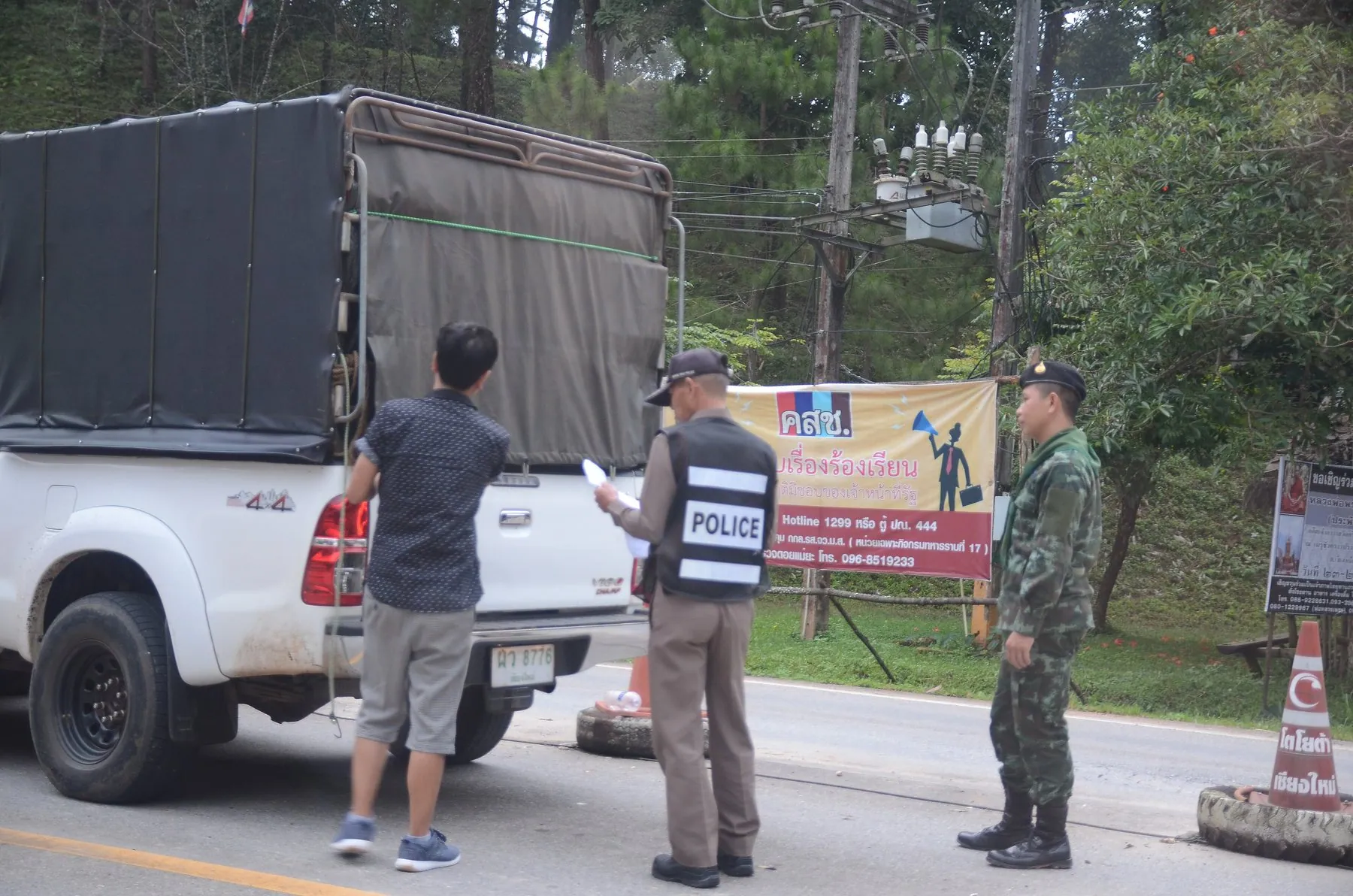
A Thai police checkpoint is, in the overwhelming majority of cases, a document check. Officers stand at a coned gap in the traffic, wave most vehicles through and pull a few in. You stop, take your helmet off, hand over your licence, the officer looks at it, hands it back, and you go. The whole encounter takes under a minute. Checkpoints sit on the approach roads to beaches and nightlife districts, at provincial boundaries, on the way in and out of towns, and outside the entrances to some islands' main strips.
The part worth knowing before it happens is what the officer can and cannot do. Since 20 September 2019 a traffic officer has had no power to take your driving licence at the roadside, and there has never been a power to demand cash there either. The only lawful outcomes of a traffic offence at a checkpoint are a warning or a written ticket that you pay somewhere else, later. Knowing that turns an encounter most visitors find intimidating into an administrative one.
- Typical stopUnder a minute; licence and helmet
- What you must be able to showDriving licence and a copy of the vehicle registration
- Licence seizureAbolished 20 September 2019
- If you have offendedA warning, or a written ticket paid later
The four kinds of checkpoint you will meet
They are not all the same thing, and telling them apart tells you what is about to be asked of you.
The daytime document check. The commonest by far. A handful of officers, a few cones, usually on a straight stretch with room to pull in, often near a junction or a beach road. They are looking at helmets, licences and, on cars, tax and insurance stickers on the windscreen. This is the one that catches visitors on rented scooters.
The night-time breath-test checkpoint. Set up after dark on roads leading away from bars and clubs, and vastly more numerous during the holiday periods covered in drink-drive checkpoints at Songkran and New Year. Officers here have a specific statutory duty to test where they have reasonable grounds, and a refusal has consequences a visitor rarely expects.
The provincial or security checkpoint. Permanent structures on main highways at provincial boundaries and near sensitive areas, often manned jointly with other agencies. These are usually about vehicles and people rather than traffic law, and foreign drivers in cars are routinely waved straight through.
The temporary or campaign checkpoint. Put up for a defined push — a school-zone campaign, a helmet campaign, or the ten-offence enforcement drive the Royal Thai Police Traffic Management Centre announced from 1 April 2026, which named speeding, red lights, failing to stop for pedestrians, mobile phone use, wrong-way driving, no helmet, no seatbelt, no licence, driving under the influence and reckless driving as its priorities.
The power to stop you, and its limits
A traffic officer's authority to pull you in comes from section 142 of the Land Traffic Act, and it is broader than most people assume: an officer may order a driver to stop where the vehicle does not comply with the general condition requirements, or where the officer finds that the driver or anyone in the vehicle is breaching the Act or the law concerning the vehicle. In practice, that means you can be signalled in without the officer needing to point to a specific thing you have done wrong first.
What the law says
Section 142. A traffic officer or competent official may order the driver to stop the vehicle where the vehicle does not comply with section 6, or where the officer finds the driver or a person in the vehicle is breaching this Act or the law concerning that vehicle.
Section 154. Failing to obey an order to stop, or to submit to a test, carries a fine not exceeding 1,000 baht — roughly £23 / US$30 / €26 — each time.
What section 142 does not contain is as important as what it does. There is no power to seize your driving licence. There is no power to take cash. There is no power to hold your passport. And where an officer finds a fault with the vehicle rather than with your driving, the remedy in section 143 is a written order to have it repaired — not an immediate penalty for the fault itself.
What the officer actually looks at
Two documents cover almost every stop a visitor will ever have.
- Your driving licence. Since 20 September 2019 you may produce the original, a photocopy, or electronic licence information. If you are driving on a foreign licence, carry the international driving permit with it — and read which licence you can actually use in Thailand if you are not certain your entitlement covers what you are driving.
- A copy of the vehicle registration. Rental firms usually keep a photocopy in the seat compartment or the glovebox. Check it is there before you drive away — the shop will not always volunteer it.
- On a motorbike: that you and your passenger are wearing helmets. See Thailand's helmet law and the second-helmet problem, which is what actually catches people out.
- On a car: the tax disc and compulsory insurance sticker on the windscreen, and seatbelts in the front. Heavy window tint is normal on Thai cars and is not usually what a checkpoint is about.
Put everything in one place before you set off. Licence, IDP, registration copy and rental agreement in a single plastic wallet under the seat or in the door pocket. A stop where you produce all four in five seconds is a completely different event from one where you empty a rucksack onto the tarmac.
How to handle a stop
None of this is complicated, and most of it is simply the behaviour you would use anywhere.
Slow early and pull in where the officer indicates rather than where you would prefer. On a motorbike, switch off, put the stand down and take your helmet off — officers ask for this and it is the point at which the tone of the encounter is set. Sunglasses off. Stay on the bike or in the car unless you are asked to get out. Hand over the documents with both hands if you can manage it; it is a small courtesy that registers.
Speak plainly and slowly. Many roadside officers have limited English and the checkpoint is noisy. If nothing is being communicated at all, that is exactly the situation the tourist police hotline on 1155 exists for — it puts an English-speaking police officer on the phone, which changes the character of a stop more than anything else available to a visitor.
Do not argue about whether you committed the offence. The roadside is not where that gets decided, and section 141 gives you a route that does not involve arguing: the ticket, and payment, settle the case administratively. If you genuinely dispute the allegation, the place to raise it is the station named on the ticket.
If you have committed an offence
The officer has exactly two options under section 140: give you a warning, or issue you with a traffic ticket — a bai sang — requiring payment of a determined penalty fine. The ticket is a printed or handwritten document of which the officer keeps a copy, and it names the offence, the vehicle, the amount, and where and by when to pay. It is a demand for payment later, not a demand for cash now. On-the-spot traffic tickets goes through what appears on the slip line by line, and how to pay a traffic fine in Thailand covers the channels.
The amount is set from a schedule issued by the Commissioner-General of the Royal Thai Police under section 140, not by the officer's judgement and not by the maximum in the Act. That distinction matters enormously and it is the thing most English-language guidance gets wrong: nearly every penalty in the Land Traffic Act is written as a maximum, and the figure written on a routine ticket is normally well below it. Traffic fines in Thailand and what they cost sets out the ceilings and explains why they are not the same as the price.
Nobody can take your licence at the checkpoint. The power to seize a driving licence at the roadside was removed by the Land Traffic Act (No. 12), in force from 20 September 2019. Under the old rule an officer could hold the licence and give you a receipt that served as a temporary licence for up to seven days; that no longer exists. A great deal of advice still in circulation online describes the old system. If a demand is framed as "pay now or I keep your licence", it does not describe the law as it currently stands — see what travellers report about informal roadside payments.
Breath tests, and why refusing is the worst option
Where an officer has reasonable ground to believe a driver is intoxicated or otherwise unfit to drive, section 142 does not merely permit a test — it says the officer shall order one. Breath is the primary method; urine or blood may be used where a breath test cannot be carried out.
Refusal does not get you out of it. Under section 142 the officer may detain you for an appropriate period as necessary to complete the test, and — this is the part that surprises British and Australian readers in particular — where you refuse without reasonable justification, the Act creates a legal presumption that you were driving over the limit. The Royal Thai Police confirmed in 2026 that they treat a refusal as equivalent to drink-driving and carrying the same penalties. There is no separate, lesser "failure to provide" offence to fall back on. The detail is in refusing a breath test in Thailand, and the limits themselves — including the much lower one that applies if you are riding without the right licence category — are in drink-driving limits in Thailand.
Drink-driving is also outside the ticket system entirely. Section 140 expressly excludes it from being dealt with by warning or fixed fine, along with drug-driving, failing to stop after a collision and street racing. Those go to an investigating officer and then to a court.
Where and when they appear
Checkpoints are not random, and after a few days in one place you will know where they are. The same spots get used repeatedly: a particular junction on the road down to the beach, the same stretch outside town, the bridge onto the island's main road. Local riders slow down at them out of habit long before you see anything.
They thicken up markedly at night in nightlife areas, on public holidays, and during the seven-day national road-safety pushes around Songkran in April and New Year. In the towns where a lot of visitors ride, they are a routine feature of the day — the town pages for Phuket and Pattaya both deal with where riders meet them.
Foreign drivers are stopped disproportionately in tourist areas. That is very widely reported by visitors, consistently enough that it would be dishonest to leave it out, but it is not something anyone can source to an official document — treat it as the reported experience it is, not as policy.
Frequently asked questions
Can Thai police take my driving licence at a checkpoint?
No. The power to seize a driving licence at the roadside was removed with effect from 20 September 2019 by the Land Traffic Act (No. 12). A court can still suspend or revoke a licence after a conviction — for drink-driving it must — but that is a different process entirely, and it does not happen at a checkpoint.
Do I have to hand over the original licence, or is a copy enough?
A photocopy or electronic licence information is legally sufficient, and has been since the same 2019 change. In practice most officers will accept whichever you offer. If you are driving on a foreign licence you should carry the international driving permit alongside it; that is what the accompanying document is for.
What happens if I do not stop?
Failing to obey an order to stop is its own offence under section 154, with a fine not exceeding 1,000 baht each time. It also converts a one-minute document check into something much more serious, and there is nothing to be gained by it.
Will they ask for my passport?
A traffic stop is about the vehicle and the driver, not immigration, and the documents that belong to it are the licence and the vehicle registration. A passport may come into it at a security or provincial checkpoint. A photocopy of the photo page and the entry stamp is worth carrying anyway; the original is safer in the hotel.
Can they search me or the vehicle at a traffic checkpoint?
A search is a different power from the traffic-stop power in section 142, which is about compliance with the Act and the condition of the vehicle. What Thai police can and cannot ask you for goes through where the line sits and what to do if it is crossed.
I do not have a motorbike licence. Should I avoid checkpoints?
No — riding to avoid a checkpoint is far more dangerous than the fine. But you should understand your position before you get on the bike, because the ticket is the least of it: riding without the correct entitlement can put you outside your travel insurance in a country where a serious motorcycle injury means a private hospital bill. Stopped without a licence in Thailand sets out both halves.
How long does a checkpoint stop actually take?
Under a minute if your documents are in order and you have them to hand. The stops that turn into twenty-minute events are almost always the ones where the driver cannot produce anything and the conversation has to start from scratch.