Helmets are compulsory in Thailand for the rider and for the passenger. Section 122 of the Land Traffic Act requires both to wear a crash helmet, and it makes the rider separately liable for riding while a passenger is not wearing one. Since the 2022 amendment came into force on 5 September that year, the maximum fine has been 2,000 baht.
Maximum is the word to hold on to. Thai traffic penalties are written as ceilings, and the amount actually entered on a roadside ticket comes from a police schedule that sits well below the statutory figure. What makes the helmet rule worth taking seriously is not the fine. It is that helmet use is a standard condition of motorcycle cover, and a head injury without cover in Thailand is the single most expensive thing that can happen to a visiting rider.
- Who must wear oneRider and passenger, both
- Maximum fine2,000 baht, since 5 September 2022
- Previous maximum500 baht
- Demerit points1 point, on a Thai licence
- EnforcementOn the Royal Thai Police's strict-enforcement list from April 2026
What section 122 requires
The provision is short and does four things.
Land Traffic Act, section 122
The rider of a motorcycle and any person carried on it must wear a crash helmet while the vehicle is in motion. The rider commits an offence if he rides while his passenger is not wearing one. The specification of the helmet is prescribed by ministerial regulation. Exempted are monks, novices, priests and other religious adherents wearing a traditional turban, together with any person prescribed by ministerial regulation.
Two features of that are worth drawing out. First, the passenger's helmet is the rider's problem as well as the passenger's — the Act creates a distinct offence for the rider. That is dealt with in full on passenger helmets in Thailand, because in practice it is where the rule most often fails: rental shops hand over one helmet.
Second, the standard the helmet must meet is set by ministerial regulation rather than in the Act, which is why the legal question ("are you wearing a helmet?") and the useful question ("will this helmet do anything for you?") are so far apart. The law is satisfied by a fastened lid. Your skull is not.
Whether the old rule doubling the fine for a rider carrying an unhelmeted passenger survived the 2022 amendment is something we could not trace in any source published since. We are not going to assert it either way. Assume that riding with an unhelmeted pillion exposes you to a penalty and leave the arithmetic to the officer.
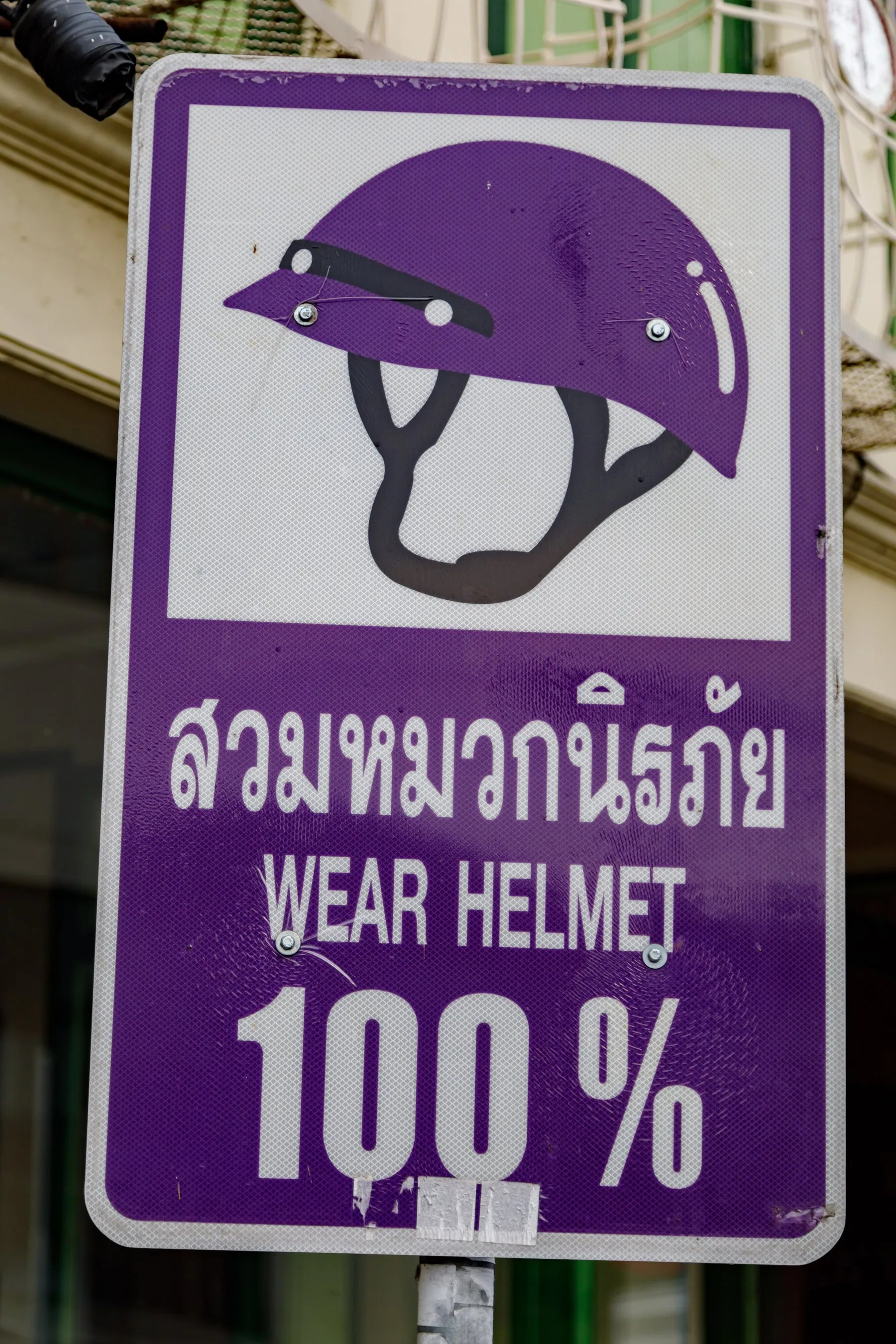
What the fine really is
The 2022 amendment raised the ceiling from 500 baht to 2,000 baht — roughly £45, $60 or €50 at the top. But almost every fine in Thai traffic law is expressed as "a fine not exceeding" a figure, and the amount on an actual ticket is set by a schedule issued by the Commissioner-General of the Royal Thai Police under section 140. We were not able to obtain that schedule, so we will not print a roadside figure. What can be said is that the amount written on a helmet ticket is normally well below the statutory maximum, and that travellers consistently report three-figure sums rather than four.
The ticket itself works like any other fixed-penalty matter: it names the offence, the vehicle and the amount, and it tells you where and by when to pay. Since 20 September 2019 an officer cannot keep your licence at the roadside, so a demand framed as "pay now or I hold your licence" does not describe the law. On-the-spot traffic tickets in Thailand explains the paperwork and how to pay a traffic fine covers the channels.
For anyone holding a Thai licence there is a second consequence: no helmet is a one-point deduction under Thailand's driving licence points system, from a starting balance of twelve.
How it is actually enforced
Helmet law in Thailand is the clearest example on this site of a rule that is absolute in the text and patchy on the road. Ride through any provincial town and you will see unhelmeted riders constantly; pillion helmet use is lower still. None of that is a guide to what will happen to you.
Enforcement is concentrated at static checkpoints rather than on patrol, and the checkpoints go where they are productive — the approach roads to beaches, the exits from nightlife districts, provincial boundaries, and the roads out of tourist centres in Phuket, Pattaya, Chiang Mai and on the islands. Foreign riders report being pulled in disproportionately in those areas, which is widely said and not something anyone publishes. No helmet is also one of the ten offences the Royal Thai Police singled out for strict enforcement from April 2026, alongside speeding, seatbelts and drink-driving.
The practical reading: the odds of being stopped on a quiet rural road are low, and the odds of riding out of Patong or Chaweng without a helmet and not being stopped are considerably lower. See police checkpoints in Thailand for what the stop itself involves.
The consequence that is not the fine
Riding without a helmet is a breach of local law, and that is the hook most travel policies use. The UK government tells its citizens plainly that a helmet is required by law when riding a motorcycle in Thailand, and insurers commonly make helmet use a condition of motorcycle cover in their own wording.
What sits underneath if cover is declined is Thailand's compulsory motor insurance, Por Ror Bor. It attaches to the vehicle rather than the driver, it pays for injury and never for property damage, and its medical ceiling is a figure that a serious head injury treated at a private hospital in Bangkok or Phuket can pass inside a day. The gap between that ceiling and the real bill — plus air ambulance repatriation, which is a five-figure sum in any currency — is what your policy exists to cover.
The arithmetic is not close. A helmet ticket costs a modest amount of baht. An uninsured head injury with medical evacuation is a six-figure amount in pounds or dollars. That is the whole argument, and it does not depend on how far you are going or how slowly. See what voids your motorbike cover in Thailand and medical evacuation insurance for Thailand.
Wearing one is not the same as wearing one properly
Two things defeat the point while technically satisfying the officer. An unfastened strap means the helmet leaves your head at the first impact, which is the most common failure by a distance — the chin strap is the entire mechanism. And a helmet several sizes too large does the same thing more slowly.
What the rental shop hands over with the key is frequently an open-face lid of unknown age, with a perished strap and no visor. Whether that helmet will protect you, what to look for, and what is worth buying if you are here for more than a week are covered on choosing a helmet that actually protects you — that is the page for the equipment question, and this page is only about the law. What the shops typically supply is described in rental helmets in Thailand.
Frequently asked questions
Do I have to wear a helmet on a quiet island road?
Yes. The requirement in section 122 has no exception for road type, speed or distance. The exemptions are for monks, novices, priests and other religious adherents wearing a traditional turban, plus anyone prescribed by ministerial regulation.
Does the helmet have to meet a particular standard?
The Act says the specification is prescribed by ministerial regulation. We could not obtain that regulation, so we will not tell you which marking makes a helmet legal here. If you want a helmet that will do its job rather than one that satisfies a glance, buy one carrying a recognised international certification and read our guide to choosing one.
What about a bicycle — do I need a helmet?
Section 122 is a motorcycle provision. The cyclist's obligations sit elsewhere in the Act and are set out in bicycle law in Thailand. Whatever the law says, the case for a helmet in Thai traffic is strong.
Can I be fined twice in one day for the same thing?
Each stop is a separate matter. Travellers often report being waved through a checkpoint after producing a ticket issued earlier the same day, but that is a courtesy rather than a rule, and it is not something to rely on.
Will a helmet ticket follow me home?
Unpaid tickets attach to the vehicle and to the registered owner, which for a hire bike means the rental company — and the rental agreement will pass the charge to your card, usually with an administration fee. Unpaid traffic fines in Thailand explains the mechanism, including the new link between unpaid fines and vehicle tax renewal.
Does a helmet ticket affect my insurance even if I was not hurt?
A ticket on its own is not a claim. The exposure arises when there is an injury and the insurer looks at whether you were complying with local law and with the policy's own conditions at the time. That is when the absence of a helmet stops being a small-fine problem.