A Thai traffic ticket — a bai sang — is a document the officer fills in and keeps a copy of. It names the offence, the vehicle, the amount to be paid, and where and by when to pay it. It is not a demand for cash at the roadside: it is a demand for payment later, at a bank, a convenience store, a post office, the police station named on the slip, or online. Your licence stays with you, because the power to seize it at the roadside was removed in September 2019.
You normally have seven days from receiving the ticket to pay, and paying settles the case. Section 141 puts it in exactly those terms — on payment, the case "shall be deemed settled" — so there is no court appearance to follow for an ordinary fixed-penalty offence.
- What it isA written demand for payment later, not a roadside charge
- Time to payNormally 7 days from receipt
- Your licenceStays with you — no seizure power since 20 Sept 2019
- Effect of payingThe case is deemed settled (s.141)
The three kinds of ticket in circulation
All three do the same legal job, but they reach you in different ways and they are not all payable through the same channels.
The handwritten ticket. A carbon-copy pad, filled in by the officer, one copy to you and one retained. Still in wide use, particularly away from the cities. This is the version that may have to be paid at the issuing station rather than over a shop counter, so read the station name on it carefully.
The electronic ticket. Printed from a handheld terminal at the roadside. It carries two QR codes: one to pay through mobile banking, and one to look the ticket up on the police website. This is the version the retail and online payment channels are built for.
The camera-generated ticket. Produced from a speed or red-light camera and sent by post. Nobody stops you; the first you know of it is an envelope, or in practice a message from your rental company. Speed cameras in Thailand and how tickets find you deals with that route in full.
Behind all of them sits the Police Ticket Management system, PTM, run by the Royal Thai Police. It is what makes a ticket a record rather than a piece of paper, and it is why an unpaid ticket does not simply evaporate.
What section 140 actually provides
What the law says
Section 140. Where a traffic officer finds a person committing a breach of this Act, whether by himself or by using any device, the officer may give a warning or issue a traffic ticket requiring the payment of a determined penalty fine. Where the driver is not present, the ticket is fixed to the vehicle where it can be seen; where that is impossible, it is sent with the evidence by registered post to the domicile of the registered owner, and is deemed received 30 days after it was sent.
Section 141. The recipient shall pay the amount stated on the ticket, at the place stated on the ticket or at a place gazetted by the Commissioner-General, within the time stated on the ticket — or send a postal money order or bank draft payable to the Commissioner-General by registered post. On payment, the case shall be deemed settled.
Two details in there matter to a visitor more than they look. First, an officer may act on what a device records, not only on what they see — the ticket does not require a stop. Second, where the driver was not identified, the registered owner is presumed to be the offender unless they prove someone else was driving. That is the mechanism that sends hire-car tickets to the hire company.
What the amount on the slip means
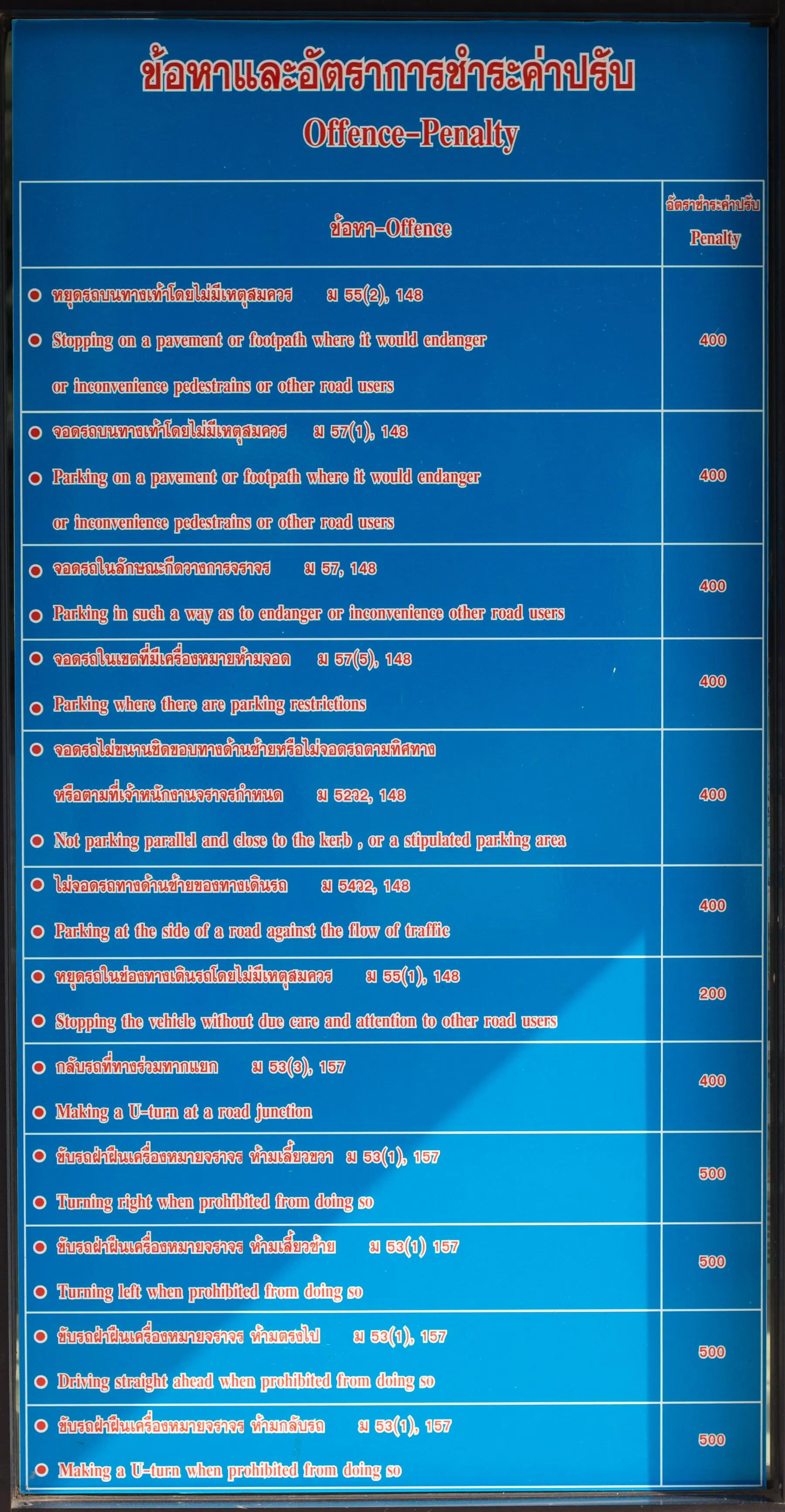
The figure written on the ticket is not the maximum in the Act. It comes from a schedule of determined penalty fines issued by the Commissioner-General of the Royal Thai Police under section 140, and it is normally well below the statutory ceiling — the ceiling exists for cases that go to a court, or for an officer writing at the top of the range for something serious.
This is why we do not print a price list. The maximums are documented and are set out in traffic fines in Thailand and what they cost. The fixed-penalty schedule is not something we could obtain, and every confident figure you will find online for "the on-the-spot fine for no helmet" traces back to a rental shop or a forum post rather than to the police.
Some offences cannot be ticketed at all. Section 140 expressly excludes drink-driving, drug-driving, failing to stop and assist after a collision, street racing and a handful of others from being dealt with by warning or fixed fine. If one of those is alleged, no ticket resolves it — the matter goes to an investigating officer and then to a court, which can also suspend or revoke a licence. See drink-driving penalties in Thailand.
Reading the ticket you have been handed
Most of it will be in Thai. You are looking for four things, and they are in fixed positions on the form.
- The ticket number. Printed or written at the top. It is what identifies the record in PTM and what you will need to pay online.
- The amount. A baht figure. If there is no amount, the ticket is incomplete.
- Where to pay. A named police station, or a reference to the electronic channels. On an e-ticket, the QR codes do this job.
- The deadline. Normally seven days from receipt.
Photograph the slip on the spot, both sides, before you fold it into a pocket. A thermal-printed e-ticket fades, a handwritten one goes through the wash, and the photograph is what you will actually use when you come to pay. What a legitimate Thai police receipt looks like covers the other half — what you should end up holding once you have paid.
Does one ticket cover you for the rest of the day?
You will hear this from other travellers and from rental shops: get ticketed for no licence in the morning, show the same slip at the next checkpoint, and you are waved on. It is described often enough, by enough people, that it plainly reflects something real about how checkpoints operate in practice.
What it is not is a rule. Nothing in the Land Traffic Act creates a same-day immunity, and there is no police announcement we can point to that establishes one. Section 141 says that payment settles the case; an unpaid ticket in your pocket is an outstanding matter, not a permit. Treat being waved through as a courtesy some officers extend, not as an entitlement you can rely on — and certainly not as a reason to keep riding without the licence you were ticketed for in the first place, which is a decision with insurance consequences that outrun the fine by several orders of magnitude.
What happens next
You pay, through one of the official channels in how to pay a traffic fine in Thailand, and a confirmation should reach you by SMS within 24 hours. That, or the bank or shop slip, is your proof. If nothing arrives, the PTM call centre is 1220.
If you do not pay, section 141 bis takes over: the investigating officer issues a summons requiring you to appear, and where the summons cannot be served the officer notifies the vehicle and land transport registrars. Since 1 August 2026 that hook has real consequences, because unpaid fines are now linked to the annual vehicle tax disc. Unpaid traffic fines in Thailand sets out how that works and who it actually lands on.
On a rental, tell the shop the same day. A ticket against a hire vehicle is the registered owner's problem first and yours second. Telling the rental company immediately, with a photograph of the slip, is far cheaper than letting them discover it later and take the fine plus an administration fee out of your deposit.
Frequently asked questions
Will the officer take my driving licence until I pay?
No. That power was removed with effect from 20 September 2019. Under the old system an officer could hold the licence and give you a receipt valid as a temporary licence for seven days; that no longer exists, and any advice describing it is out of date.
How long do I have to pay a Thai traffic ticket?
Normally seven days from receiving it. The deadline is written on the ticket, and for a posted ticket the Act deems you to have received it 30 days after it was sent — whether or not it actually arrived.
Can I pay the officer directly instead?
No. The Act provides for a warning or a ticket, and section 141 provides for payment at the place named on the ticket or a gazetted place. There is no roadside payment mechanism. Informal roadside payments deals with what travellers report and what the official process looks like.
I was given a ticket in Thai and I have no idea what it says. What now?
Photograph both sides and take it to the station named on it, or to your hotel reception, or to the rental shop — all three will read it in seconds. If you are stuck, 1155 reaches an English-speaking police officer who can tell you what the offence and the amount are.
What if I disagree with the ticket?
The roadside is not where that is decided, and arguing there achieves nothing. The station named on the ticket is the place to raise it. Bear in mind that paying settles the case under section 141, so pay only when you are content to close the matter.
Do tickets go on my record at home?
A Thai fixed-penalty ticket is a Thai administrative matter recorded against the vehicle and, where there is one, a Thai licence. There is no mechanism we are aware of that transmits it to a foreign licensing authority. That is not a reason to ignore it — the consequence usually lands on a rental deposit instead.