A Thai speed camera does not ticket the driver. It tickets the vehicle. Section 140 of the Land Traffic Act lets an officer act on what he finds "by oneself or by using any device", and the citation that follows names the registered owner, who is presumed to be the offender unless he proves somebody else was driving. For a hire car, the registered owner is the rental company — which is why a speeding ticket from a holiday in Thailand reaches you as a charge on your credit card several weeks after you got home, rather than as a letter.
That mechanism explains almost everything visitors find confusing about Thai speed cameras: why you never hear anything at the time, why the rental company charges an administration fee, and why there is very little you can usefully do about it after the fact.
- Who is liableThe registered owner
- DeliveryRegistered post to the owner's address
- Deemed received30 days after sending
- Maximum for speeding4,000 baht
What the law says
Section 140: on finding a breach, whether in person or by using a device, a traffic officer may give a warning or issue a traffic ticket requiring payment of a determined penalty fine. Where the driver is not present, the ticket is fixed to the vehicle where it can be seen; where that is not possible it is sent with the evidence by registered post to the domicile of the registered owner. The owner is deemed to have received it 30 days after it was sent. Where the driver was not identified, the registered owner or possessor is presumed to be the offender unless he proves that another person was driving.
The 30-day deemed-service rule does real work where postal delivery is unreliable: the clock runs whether or not the letter arrives. The presumption against the owner is what makes the rental-company mechanism function — the company need not prove you were driving, it simply has a contractual right to recover the fine.
Where the cameras are
Enforcement is concentrated on inter-city highways rather than in towns, and within that it clusters in predictable places.
- Where a limit drops — the approach to a village, a school, a junction or a bridge, where a 90 km/h road becomes 60 or less.
- On long straight highway sections where speeds naturally rise, particularly on the main north–south and north-east corridors.
- On the approach to major provincial towns.
- At checkpoint sites, where a hand-held device is used and the driver is stopped there and then.
You will meet three kinds of device: fixed gantry cameras on major highways; mobile camera vans parked on the shoulder or in a lay-by, which are common and easy to miss; and hand-held radar or laser used by officers at a roadside stop, which produces an immediate ticket rather than a postal one — the process described in police checkpoints in Thailand.
The tolerance question
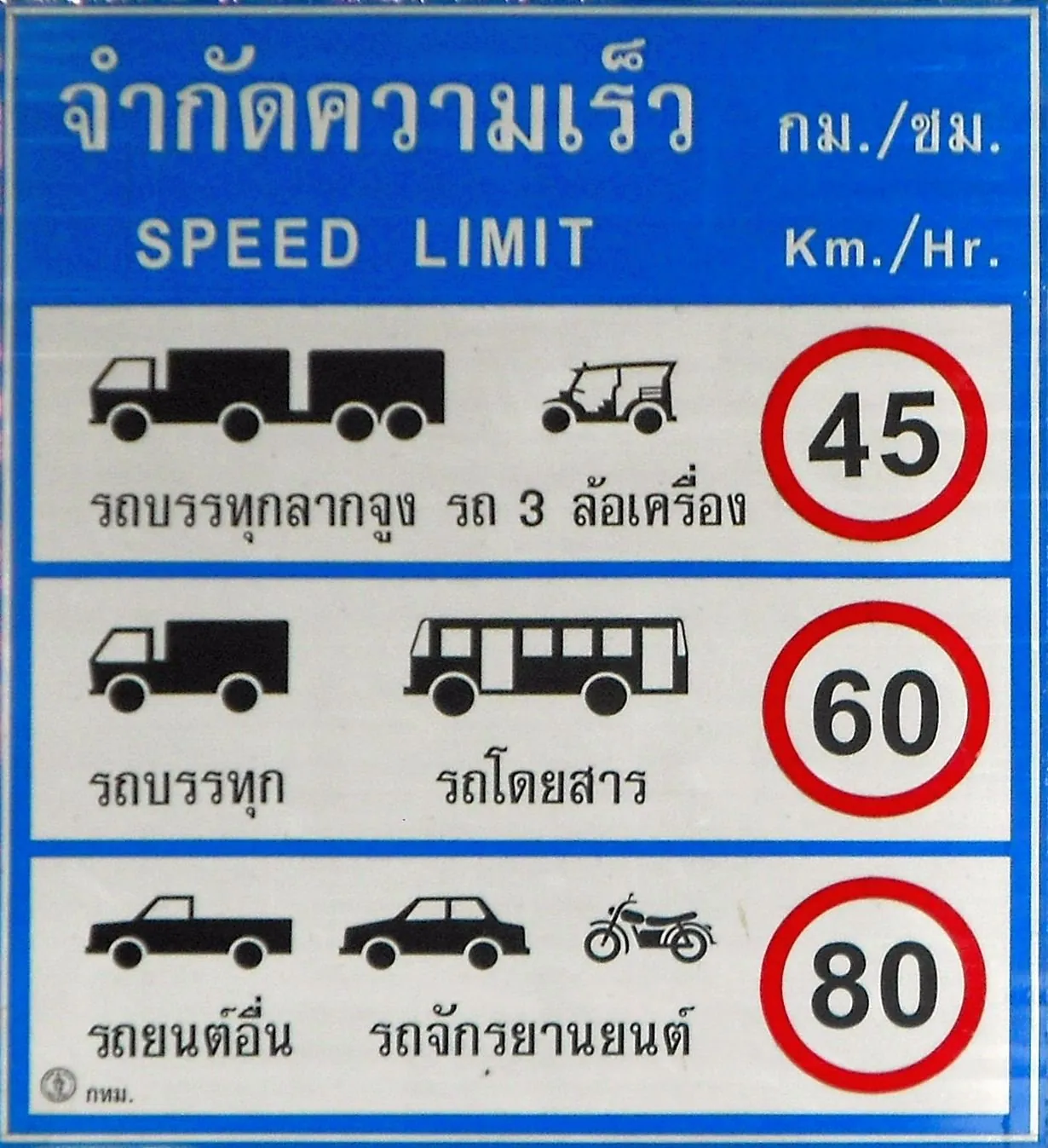
Everybody asks, and we are not going to give you a number.
Thai drivers and visitors report consistently that cameras are set to trigger well above the posted limit rather than at it. That is a widely reported enforcement practice, not a published rule. There is no threshold in the Act, no figure the Royal Thai Police have announced, and the practice plainly varies between provinces, between devices and between campaigns. A reader who set their cruise control on the strength of a figure we printed would be relying on something nobody has confirmed, on a road where the consequence of being wrong is not the fine but the crash.
Drive to the sign. The posted limit is the only number with any legal standing, and it is what a camera is set against. Any "tolerance" you have heard about is folklore until somebody publishes the schedule, and folklore is a poor basis for choosing a speed on a road with the accident record Thailand has.
How a ticket actually reaches you
Follow the chain and the timings make sense.
Day 0. The camera records the vehicle. The record goes into the Police Ticket Management system, the national platform the Royal Thai Police run for tickets and fines.
Weeks 1–4. A ticket is generated against the registered owner and posted by registered mail to the address on the registration. For a hire car that is the rental company's office.
Weeks 3–8. The rental company matches the date and time against its booking records and charges the fine to the card it holds, normally with an administration fee on top. Most rental agreements provide for this explicitly.
Later. If nothing is paid, the enforcement chain in section 141 bis begins: a summons to the recipient and, where that cannot be served, notification to the vehicle registrars. From 1 August 2026, unpaid fines are linked to the vehicle's annual tax renewal — a change announced on 23 July 2026 that is not retrospective and applies only to tickets issued on or after that date. It bites on Thai vehicle owners rather than on short-stay visitors. Unpaid traffic fines in Thailand covers it in full.
If you are driving a hire car
Three things worth doing, none of them complicated.
Read the fines clause before you sign. It will tell you the administration fee, and the fees vary widely between the international chains and the local firms. Renting a car in Thailand covers what else to look for.
Keep the rental agreement and the dates. If a charge appears that does not match a day you had the car, you have the evidence to dispute it. That happens more often than it should — see disputing a rental charge in Thailand.
Do not assume silence means nothing happened. The gap between the offence and the charge is routinely six weeks or more, and there is no notification in between. If you know you were speeding on a highway with a gantry, expect it.
You can check whether a Thai-registered vehicle has outstanding tickets on the Royal Thai Police e-ticket portal at ptm.police.go.th. It is most useful to people who own a vehicle here; for a hire car, the rental company is the one who sees the tickets.
If you own the vehicle
Then the ticket comes to you, and the deemed-service rule means the 30-day clock runs from posting regardless of whether the letter arrived. Tickets can be looked up and paid on the PTM portal, which takes cards and mobile-banking QR payments, and through Krungthai Bank, 7-Eleven, CenPay outlets, Boonterm kiosks, post offices and police stations. An SMS confirmation should follow within 24 hours; the PTM call centre is 1220 if it does not.
One limitation worth knowing: the retail and online channels are built for electronic tickets, and a handwritten ticket may have to be paid at the station that issued it. How to pay a traffic fine in Thailand sets out each channel.
Can you contest a camera ticket?
In principle, yes: the presumption in section 140 is rebuttable, because the registered owner is presumed to be the offender unless he proves that another person was driving. In practice, a visitor whose ticket arrives as a card charge from a rental company is disputing a contractual charge with the rental firm, not a ticket with the police, and the argument that works is about dates and identity rather than about speed. Keep the paperwork and take it up with the rental company and, failing that, with your card issuer.
What a speeding ticket costs
The maximum is 4,000 baht — roughly £90 or US$120 — since the 2022 amendment to the Land Traffic Act raised it from 1,000 baht. As with almost every Thai traffic penalty, that is a statutory ceiling and not the amount on a routine ticket. The fixed penalty comes from a schedule issued by the Commissioner-General of the Royal Thai Police under section 140, which we have not been able to obtain, so we do not publish a typical figure. On top of the fine, a rental company's administration fee is often a similar order of magnitude again.
Under section 141, paying the amount stated on the ticket by the stated deadline settles the case — there is no separate court appearance for an ordinary fixed-penalty offence. For the full picture on what gets enforced, see traffic fines in Thailand and what they cost, and for what the limits are in the first place, speed limits in Thailand for every road type.
Frequently asked questions
Will a Thai speeding ticket follow me home?
Not as a letter. The ticket goes to the registered owner, which for a hire car is the rental company. It will charge the fine and usually an administration fee to the card it holds, typically several weeks after you have left. There is no international enforcement mechanism reaching a foreign driver directly.
How long does it take for a Thai speeding ticket to arrive?
Weeks. The ticket is posted to the registered owner, who is deemed to have received it 30 days after sending. A rental company then matches it to a booking and charges it. Six weeks between the offence and the charge appearing is entirely normal.
How much over the limit triggers a Thai speed camera?
We do not publish a figure. Cameras are widely reported to be set above the posted limit rather than at it, but no threshold has been published and the practice varies. Drive to the sign — it is the only number with legal standing.
Where are speed cameras in Thailand?
Mostly on inter-city highways, clustered where limits drop — village approaches, school zones, junctions — and on long straight sections. Fixed gantries, mobile camera vans on the shoulder, and hand-held devices at police checkpoints are all in use.
Do speed cameras catch motorbikes in Thailand?
Enforcement against motorbikes is mostly done at roadside checkpoints rather than by camera, partly because rear-plate photography of small bikes is less reliable. That is a practical observation rather than an exemption: the limits apply to riders too, and motorcycles are banned from the toll network entirely.