In the absence of a sign, the working assumption for a car in Thailand is 80 km/h in a built-up area and 90 km/h outside one. Where a sign is posted, the sign is the limit and it beats every general figure on this page. On specific, signposted stretches of divided highway the limit is 120 km/h; on motorways, expressways and tollways it is whatever is posted, usually somewhere between 100 and 120 km/h. That is the whole answer, and the rest of this page is the detail behind it.
The complication worth understanding straight away is that Thailand does not have one speed-limit system. It has three, made under different laws, and they are routinely confused with one another. The Land Traffic Act regulations set the default limits on ordinary roads. A separate 2021 regulation made under the highways legislation allows 120 km/h, but only on qualifying sections that the Department of Highways has designated and signed. And motorways, expressways and concession tollways have instruments of their own again. Any source that gives you a single national table without saying which of these it is describing is oversimplifying.
- Car, built-up area80 km/h (no sign)
- Car, outside built-up area90 km/h (no sign)
- Designated highway sections120 km/h, signposted
- Maximum penalty for speeding4,000 baht
What the law says
Section 67 of the Land Traffic Act: a driver must drive at the speed set by ministerial regulation, or at the speed shown on the sign on that road. A sign may set a maximum or a minimum, but it may not set a maximum above the figure in the regulation.
The statutory penalty for speeding under section 152, as the Act was originally drafted, was a fine not exceeding 1,000 baht. The 2022 amendment raised the ceiling to 4,000 baht.
The general limits
These come from ministerial regulations made under the Land Traffic Act — principally Regulation No. 6 of B.E. 2522 (1979), with Regulation No. 10 of B.E. 2524 (1981) reducing the rural limit for small cars from 100 to 90 km/h. We have not been able to retrieve the regulations themselves, and the table below is reconstructed from secondary sources. The two figures that matter most to a visitor — 80 km/h urban and 90 km/h rural for an ordinary car — are corroborated by several independent reports. The heavier-vehicle rows are not, and should be treated as indicative.
| Vehicle | Built-up area | Outside a built-up area |
|---|---|---|
| Car up to 2,200 kg | 80 km/h | 90 km/h |
| Car over 2,200 kg | 60 km/h | 90 km/h |
| Bus or truck without a trailer | 60 km/h | 90–100 km/h |
| Any vehicle with a trailer | 45 km/h | 65 km/h |
An ordinary hire car, a pickup and a rental scooter all fall in the first row. Note that there is no separate general limit for motorcycles on ordinary roads in this table — motorcycle-specific figures appear in the 2021 highway regulation, which applies only to designated sections.
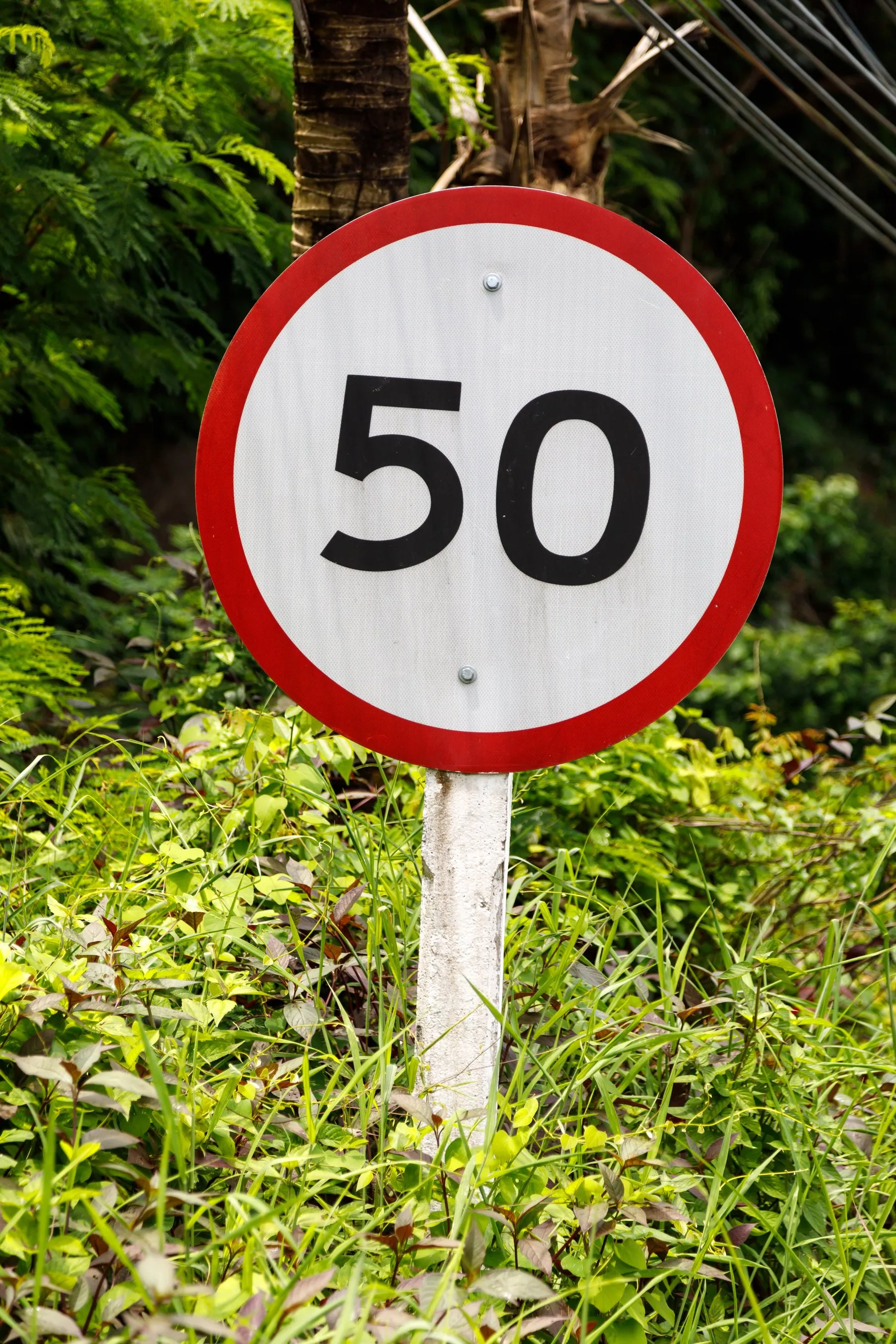
Follow the sign, always. The general figures above are what applies when nothing is posted. Thai roads are extensively signed, particularly through villages, past schools and on the approach to junctions, and a posted limit of 60 or 50 km/h on a rural highway is common. Section 67 makes the sign binding, and it is what a speed camera is set to.
The 120 km/h sections
In March 2021 the Transport Minister signed a ministerial regulation on speed limits for driving on highways, which came into force on 1 April 2021. It is widely — and wrongly — reported as "Thailand raised its speed limit to 120 km/h". It did not. It created a ceiling of 120 km/h that applies only where a highway meets strict physical conditions and the Department of Highways has designated and signposted that section.
A section qualifies only if it has at least two lanes running in the same direction, is divided by a traffic island with median barriers, and has no at-grade U-turn slot. That last condition is the important one: the ground-level gap in the median where vehicles turn back on themselves is the most dangerous feature of a Thai highway, and a section that still has one cannot carry the higher limit. If you have read U-turns in Thailand you will recognise why.
| Vehicle on a designated 120 km/h section | Maximum |
|---|---|
| Car | 120 km/h |
| Bus carrying 7–15 passengers | 100 km/h |
| Bus over 15 passengers; truck over 2,200 kg | 90 km/h |
| School bus | 80 km/h |
| Small motorcycle | 80 km/h |
| Large motorcycle, from 400 cc / 35 kW | 100 km/h (reported; one source gives 110) |
| Towing vehicle, small four-wheeled vehicle | 65 km/h |
| Minimum in the outermost (right) lane | 100 km/h |
The minimum is unusual and worth noting: on these sections, the right-hand lane carries a floor of 100 km/h as well as a ceiling of 120. It is the only place in the Thai system where a minimum speed applies to ordinary traffic.
The first designated section was Highway 32 between Bang Pa-in in Ayutthaya and Ang Thong — km 4+100 to km 50+000, both directions, 45.9 kilometres — from 1 September 2021. Further sections were added on the same date, and the Department of Highways has continued to add sections by announcement since. There is no consolidated public list that we have been able to retrieve, so the only reliable way to know whether you are on one is the sign. Thailand's 120 km/h highways goes into this in full.
Do not assume a big divided highway is a 120 km/h road. The overwhelming majority of Thailand's highway network is not designated, and on an undesignated road the general 90 km/h rural limit applies. The higher limit exists on specific signposted stretches and nowhere else, and a driver who assumes otherwise is speeding by 30 km/h on a camera-covered road.
Motorways, expressways and tollways
This is the murkiest corner, and we would rather say so than give you a false certainty.
Motorways and expressways were brought into the speed-limit framework by their own instrument in 1999, and secondary sources commonly give 120 km/h for motorways and 110 km/h for expressways for cars. But in February 2025 the first ministerial regulation written specifically for concession highways and tollways set a maximum of 100 km/h for cars, with a minimum of 90 km/h in the rightmost lane except where traffic, visibility or road conditions prevent it. Trucks over 2,200 kg, buses over 15 seats and school buses are capped at 80 km/h, and towing and small four-wheeled vehicles at 65 km/h. The example road named in the reporting is the Uttaraphimuk Elevated Tollway in Bangkok, Highway No. 5.
Those two positions do not sit comfortably together, and we have not been able to reconcile them from primary sources. The honest formulation, and the one we use across this site, is: treat the motorway and expressway limit for a car as posted, usually somewhere between 100 and 120 km/h, and follow the signs. That is not evasion — it is what section 67 requires of you anyway. See Thailand's expressways and motorways explained for which roads are which, and toll roads in Thailand for what they cost.
One thing about the toll network is unambiguous: motorcycles are banned from all of it, at every engine size. That is covered in motorbikes, filtering and Thailand's left lane.
How speed is enforced
Enforcement is a mix of fixed cameras, mobile camera vans and police officers with hand-held devices. It is concentrated on inter-city highways rather than in towns, and it clusters at the points where a limit drops — the approach to a village, a school zone, a junction.
Travellers and Thai drivers alike report consistently that cameras are set to trigger well above the posted limit rather than at it. We are describing a widely reported enforcement practice, not a rule, and we do not publish a tolerance figure — there is no published threshold, the practice varies between provinces and devices, and a reader who drives to a number we printed would be relying on something nobody has confirmed. Drive to the sign.
Speed enforcement is also cyclical. Speeding sits first on the list of ten offences the Royal Thai Police Traffic Management Centre named for strict enforcement from April 2026, and enforcement intensifies enormously during the "seven dangerous days" around Songkran and New Year. Speed cameras in Thailand and how tickets find you explains the mechanics, including why a camera ticket for a hire car reaches you as a card charge weeks after you get home.
What it costs
Since the 2022 amendment the maximum penalty for speeding is 4,000 baht — roughly £90 or US$120. That figure is a statutory ceiling, and this distinction matters more here than anywhere else on the site.
Almost every penalty in Thai traffic law is written as "a fine not exceeding X". The amount actually written on a roadside or camera ticket is a fixed penalty drawn from a schedule that the Commissioner-General of the Royal Thai Police issues under section 140, and it is normally far below the statutory maximum. We have not been able to obtain that schedule, so we do not publish a figure for what a speeding ticket typically says. The numbers circulating on forums and rental-shop noticeboards are not sourced and we will not repeat them. What we can tell you is the structure: the ceiling is 4,000 baht, a routine ticket is well under it, and payment under section 141 settles the case with no separate court appearance.
For a Thai licence holder there is a second consequence. The demerit points system has been running since January 2023: every licence starts with 12 points, offences deduct between 1 and 4 depending on severity, a deduction is restored a year after the offence, and reaching zero brings a 90-day suspension. Published lists of points per individual offence contradict one another, so we do not reproduce one. The system is built around the Thai licence, and we have found nothing showing points being applied to a foreign licence holder — see Thailand's driving licence points system.
What speed you should actually drive
The posted limit is a legal ceiling, not a target, and on a Thai road it is frequently the wrong speed.
On a rural highway, 90 km/h is legal and often too fast. The carriageway carries motorbikes at 40 km/h, agricultural vehicles at 20, dogs, pedestrians and vehicles emerging from unmarked accesses. Sit at 80 and you lose very little time and gain a great deal of margin.
At night, reduce further. Unlit vehicles, unlit obstructions and unlit pedestrians are the defining hazard, and your headlights define your safe speed rather than the sign. Driving at night in Thailand is worth reading before your first night drive.
In rain, reduce a great deal. Tropical downpours drop visibility below 60 metres in seconds, standing water is common and the first rain after a dry spell lifts oil off the surface. The rainy season and flooded roads covers it.
Through villages, slow before the buildings start rather than when you reach them. This is where limits drop, where children are, and where enforcement sits — see school and village speed limits in Thailand.
On a scooter, the rental machine is the constraint. A 110cc or 125cc automatic carrying two people is unstable above about 70 km/h, has modest brakes and small wheels that find every pothole. The legal limit is not the relevant number.
Journey times in Thailand are governed by traffic, junctions and towns rather than by cruising speed. On a 300-kilometre drive, the difference between averaging 80 and 90 km/h is about twenty-five minutes; the difference between leaving at 07:00 and leaving at 09:00 is often more than an hour. Plan the departure rather than the speed — the driving time calculator will give you a realistic figure.
Frequently asked questions
What is the speed limit in Thailand?
Where nothing is posted, 80 km/h for a car in a built-up area and 90 km/h outside one. Where a limit is posted, the posted figure applies and overrides the general one. Specific signposted stretches of divided highway carry 120 km/h, and motorways, expressways and tollways carry their own posted limits, usually between 100 and 120 km/h.
Is the speed limit really 120 km/h in Thailand?
Only on sections the Department of Highways has designated and signposted. A qualifying section must have at least two lanes in each direction, a median with barriers, and no at-grade U-turn slot. The first was Highway 32 between Bang Pa-in and Ang Thong from September 2021. The rest of the highway network remains at the general limits.
What is the speed limit for motorbikes in Thailand?
On ordinary roads the general limits apply — a scooter is not given a separate figure in the general table. On designated 120 km/h sections, small motorcycles are limited to 80 km/h and machines from 400 cc or 35 kW to a reported 100 km/h. Motorcycles are banned from motorways and expressways entirely.
What is the fine for speeding in Thailand?
The maximum is 4,000 baht since the 2022 amendment, up from 1,000 baht under section 152 as originally drafted. That is a ceiling. The amount on an actual ticket comes from a police fixed-penalty schedule and is normally well below the maximum; we do not publish a figure because that schedule is not something we have been able to obtain.
How much over the limit can I go before a camera triggers?
We do not publish a tolerance figure. Cameras are widely reported to be set above the posted limit rather than at it, but that is a reported practice rather than a published threshold, it varies between provinces and devices, and driving to an unconfirmed number is a poor idea. Drive to the sign.
Is there a minimum speed on Thai highways?
On designated 120 km/h sections, yes: 100 km/h in the outermost lane. The February 2025 tollway regulation sets a 90 km/h minimum in the rightmost lane on the roads it covers, except where traffic, visibility or road conditions prevent it. Elsewhere there is no general minimum.
Will a speeding ticket follow me home?
Not usually, and not directly. A camera ticket is issued against the registered owner, which for a hire car is the rental company — it will normally charge the fine and an administration fee to your card. From 1 August 2026 unpaid fines are linked to the vehicle's annual tax disc, which affects Thai vehicle owners rather than short-stay visitors. See unpaid traffic fines in Thailand.