Thailand did raise its highway speed limit to 120 km/h. It did not raise it on Thai highways generally, and that distinction is the entire content of this page. The 2021 regulation created a ceiling of 120 km/h that applies only where a stretch of highway meets three physical conditions and the Department of Highways has separately designated it and put up signs. Everywhere else, the ordinary limits still apply — 90 km/h for a car outside a built-up area.
If you are on a Thai highway and you have not seen a 120 sign, you are not on a 120 km/h road. There is no other way to tell.
- InstrumentMinisterial regulation, signed 4 March 2021
- In force1 April 2021
- First designated sectionHighway 32, Bang Pa-in–Ang Thong
- Minimum in the right-hand lane100 km/h
What the regulation actually did
The Transport Minister signed a ministerial regulation on speed limits for driving on highways on 4 March 2021, and it was published in the Royal Gazette and came into force on 1 April 2021. It raised the permitted maximum on qualifying highway sections from 90 to 120 km/h for cars.
The qualification test is strict, and it is worth reading carefully because it explains why so little of the network is covered:
A section qualifies only if it has all three
- At least two lanes running in the same direction — so a single-lane-each-way road cannot qualify, however straight
- A traffic island with median barriers dividing the two directions — a painted centre line or a grass strip is not enough
- No at-grade U-turn slot — no ground-level gap in the median where vehicles turn back on themselves
And then the Department of Highways must separately designate that section and signpost it.
The third condition does most of the work. Thailand's divided highways are riddled with at-grade U-turn slots, because on a road with a continuous median that is how anybody reaches anything on the other side. A vehicle emerging from a standing start into 120 km/h traffic with no acceleration lane is a catastrophic combination, and the regulation simply excludes it. Where the U-turns have been replaced by bridges or underpasses, the section can qualify; where they have not, it cannot. U-turns in Thailand explains why the manoeuvre carries the risk it does.
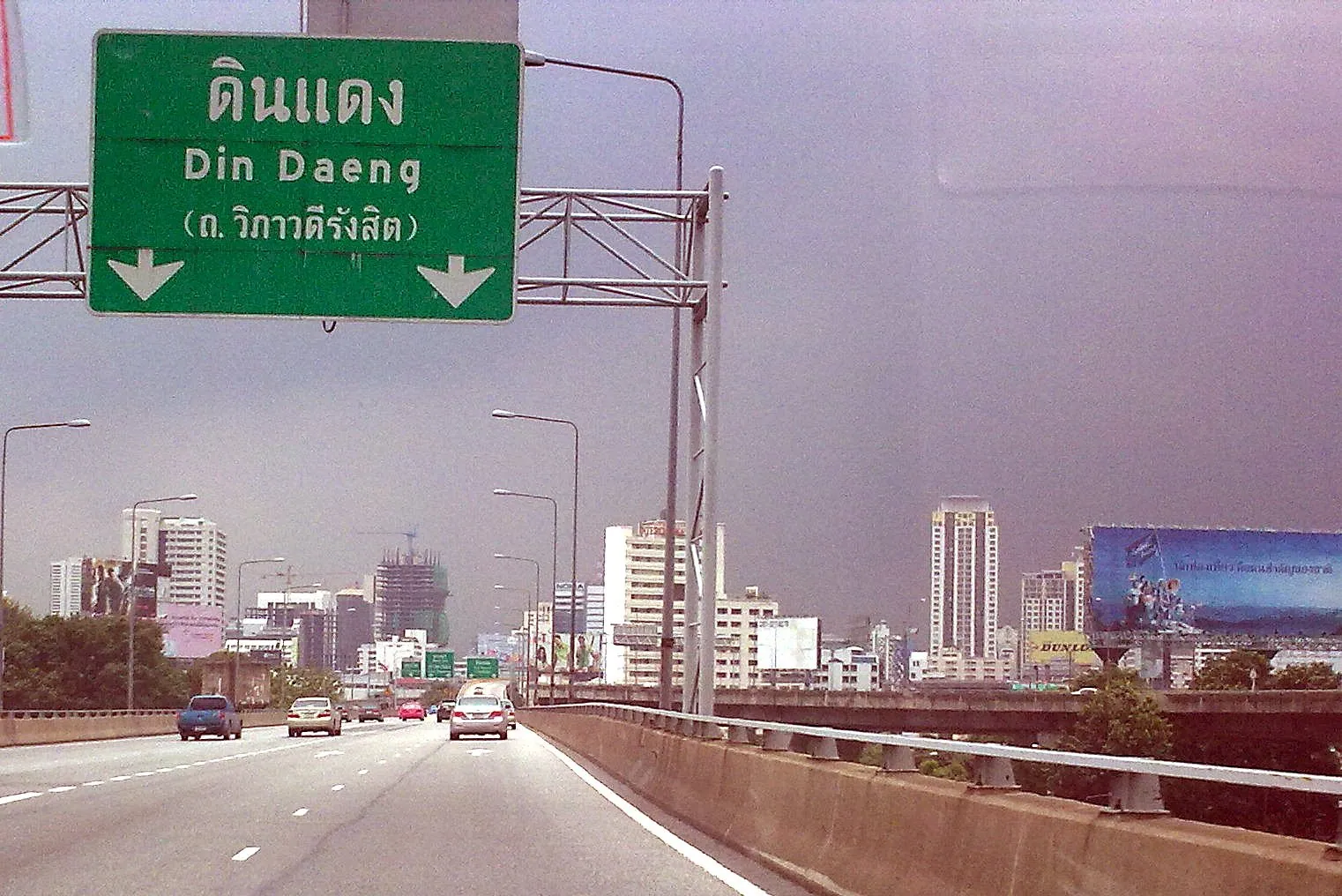
The limits on a designated section
| Vehicle | Maximum |
|---|---|
| Car | 120 km/h |
| Bus carrying 7–15 passengers | 100 km/h |
| Bus over 15 passengers; truck over 2,200 kg | 90 km/h |
| School bus | 80 km/h |
| Small motorcycle | 80 km/h |
| Large motorcycle, from 400 cc or 35 kW | 100 km/h — reported; see the note below |
| Towing vehicle; small four-wheeled vehicle | 65 km/h |
| Minimum, outermost (right) lane | 100 km/h |
Two honest caveats. The large-motorcycle figure is reported as 100 km/h by one outlet and 110 km/h by another, and we have not been able to resolve it from the regulation itself — treat 100 as the safe number. And you will see it written that the left-hand lane on these sections is capped at 80 km/h and the middle at 100. One news report says that; the regulation as reported elsewhere specifies only the 120 km/h maximum and the 100 km/h minimum in the outermost lane. We do not repeat the lane-by-lane caps because we cannot confirm them.
The 100 km/h minimum in the right-hand lane is the genuinely unusual provision, and the one visitors most often do not know about: it is the only place in the Thai system where ordinary traffic faces a floor as well as a ceiling. It means the outside lane on these sections behaves much more like a European overtaking lane than the Thai norm described in lane discipline in Thailand.
Which roads are designated
The first section came into effect on 1 September 2021: Highway 32 between Bang Pa-in in Ayutthaya and Ang Thong, from km 4+100 to km 50+000, in both directions — 45.9 kilometres. That is the one section we can name with confidence, from contemporaneous reporting in more than one outlet.
Six further sections were announced for the same date, described in reporting as including stretches of Highway 1 in Pathum Thani and Nakhon Sawan and a further stretch of Highway 32 in Sing Buri. The Department of Highways has continued to add sections by announcement in the years since.
We are not going to publish a current list, because there is no consolidated public list we have been able to retrieve and a stale one would be worse than none. What matters practically is that Highway 32 and Highway 1 form the main route north out of Bangkok towards Ayutthaya, Nakhon Sawan and eventually Chiang Mai — so the sections that do exist sit on the corridor most visitors driving north will use. See Bangkok to Chiang Mai by road.
The sign is the only reliable indicator. Not the width of the road, not the presence of a median, not the fact that everybody around you is doing 120. If you have not passed a sign showing 120, assume the general 90 km/h rural limit applies — and note that speed cameras on undesignated highways are set to that lower figure.
Why the change matters less than it sounds
Three reasons the higher limit changes your driving less than the headlines suggested.
The coverage is small. Thailand's highway network runs to tens of thousands of kilometres; the designated sections are measured in tens of kilometres each and there are not many of them.
The traffic does not travel at 120. Even on a designated section, the carriageway carries trucks capped at 90 and buses at 90 or 100. The limit permits 120; the traffic supplies something lower.
It saves almost no time. Over the full 45.9 kilometres of the Highway 32 section, the difference between 90 and 120 km/h is about eight minutes — and that assumes an unobstructed run at the maximum, which you will not get. On a 700-kilometre drive to Chiang Mai the higher limit is a rounding error next to traffic, junctions and the towns you pass through.
Driving a designated section safely
The regulation exists because these sections are engineered to a higher standard than the rest of the network. That is real, and they genuinely are the easiest highway driving in Thailand outside the toll roads. Some things do not change.
- The shoulder still carries motorbikes. Small motorcycles are limited to 80 km/h on these sections and they are still using the near side. Do not drift left without looking.
- Stopping distance at 120 km/h is roughly twice what it is at 80. A hire car with four people and luggage, on tyres you have not inspected, is not a car you know.
- Check your tyres before a fast run. Thai heat and rental-fleet maintenance are a poor combination at sustained speed, and a blowout at 120 km/h is a different event from one at 80. The car rental handover inspection is where to catch this.
- The limit reverts without much ceremony. A designated section ends where the signs say it ends, often at a junction, and the traffic slows abruptly.
If your priority is a fast, predictable run out of Bangkok, the tolled motorway network is usually the better tool than hunting for designated highway sections. Access is by proper interchange, there are no U-turn slots and no motorbikes at all. It costs money and it is worth it — see Thailand's expressways and motorways explained and Easy Pass and M-Flow.
What happens if you exceed it
The ordinary speeding penalty applies: a maximum of 4,000 baht since the 2022 amendment to the Land Traffic Act, up from 1,000 baht under section 152 as originally drafted. That is a ceiling rather than a fixed charge — the amount written on a ticket comes from a Royal Thai Police schedule and is normally well below it.
Enforcement on these corridors is camera-based, and a camera ticket is issued against the registered owner — for a hire car, the rental company, which will charge it to your card. Speed cameras in Thailand and how tickets find you explains the mechanism, and the full picture on limits is in speed limits in Thailand for every road type.
Frequently asked questions
Where does the 120 km/h limit apply in Thailand?
Only on highway sections that the Department of Highways has designated and signposted, and only where the road has at least two lanes in each direction, a median with barriers and no at-grade U-turn slot. The first was Highway 32 between Bang Pa-in and Ang Thong, from 1 September 2021.
How do I know if I am on a 120 km/h section?
By the sign, and only by the sign. There is no consolidated public list we can point you to, and the physical appearance of the road is not a reliable guide. If you have not seen a 120 sign, assume 90 km/h.
Is there a minimum speed on these roads?
Yes — 100 km/h in the outermost (right-hand) lane. It is the only place in the Thai system where a minimum applies to ordinary traffic, and it is intended to keep slow vehicles out of the overtaking lane.
What is the motorcycle limit on a 120 km/h section?
Small motorcycles are limited to 80 km/h. Machines from 400 cc or 35 kW are reported at 100 km/h, though one summary gives 110; treat 100 as the safe figure. Motorcycles remain banned from motorways and expressways entirely.
Are the lanes capped individually at 80 and 100 km/h?
One news report says the left lane is capped at 80 and the middle at 100. We have not been able to confirm that from the regulation, which as reported elsewhere specifies only the 120 km/h maximum and the 100 km/h minimum in the outermost lane. We do not repeat the lane caps as fact.
Did Thailand raise the national speed limit to 120 km/h?
No. It created a ceiling of 120 km/h available to qualifying, designated and signposted sections. The general limits on ordinary roads — 80 km/h built-up and 90 km/h rural for a car — are unchanged.