The rule is that you drive in the leftmost lane and use the lanes to your right only to overtake, to pass an obstruction, to position for a junction, or when you are moving faster than the traffic on your left. That is section 34 of the Land Traffic Act, and it is a perfectly conventional keep-left rule of the sort used across the left-hand-driving world.
What Thailand does differently is sort its lanes by what you are driving rather than by how fast you are going. Motorbikes, trucks and passenger-transport vehicles are legally confined to the leftmost lane. Slow vehicles must keep as far left as possible. The result is a road where the left lane contains everything heavy, everything slow and everything on two wheels, and where the outside lane is not a fast lane so much as the lane with fewer obstructions in it.
- Default laneLeftmost
- Motorbikes and trucksLeftmost lane (s.35)
- Straddling a lane lineProhibited (s.43(6))
- Maximum penalty200–500 baht (s.151) for s.34
What the law says
Section 34: on a road with two or more lanes in the same direction, drive in the leftmost lane, or the lane next to a bus lane. You may use a lane to the right to pass an obstruction, on a one-way road, when approaching a junction where you need to be to the right, to overtake, or when travelling faster than the traffic in the left lane.
Section 35: a vehicle travelling more slowly than others must keep as near as possible to the left edge. Motorcycles, trucks and passenger-transport vehicles on a multi-lane road must use the leftmost lane or the lane next to a bus lane — but this does not apply to a private goods vehicle up to 1,600 kg or to a private car.
Section 43(6): straddling a lane line is prohibited, except when changing lane, turning or reversing direction.
How a Thai multi-lane road really sorts itself
On a three-lane carriageway outside a city, the pattern you will meet again and again looks roughly like this.
| Lane | What is in it | What to expect |
|---|---|---|
| Hard shoulder | Motorbikes in both directions, parked vehicles, vendors, dogs, pedestrians | Not a driving lane. Treat as occupied at all times |
| Left lane | Motorbikes, trucks, buses, songthaews, anything turning off soon | Slow, cluttered, frequent stopping without warning |
| Middle lane | Cars and pickups making progress | The most usable lane on most highways |
| Right lane | Faster cars, and anything about to make a U-turn | Vehicles decelerating hard to enter a U-turn slot |
The item in that table that surprises people is the last one. Because right turns off a divided highway are usually impossible, the right-hand lane is also the lane you must be in to reach a U-turn slot. Vehicles therefore move into the outside lane and then slow sharply. A driver treating the outside lane as a fast lane and closing at 120 km/h finds a pickup at 40 km/h with its right indicator on. Leave a real gap.
The outside lane is not a fast lane. It carries U-turning traffic, it is where vehicles sit when they are lost, and it is where a police checkpoint on the far side will funnel you. On a road with a designated 120 km/h limit there is a legal minimum of 100 km/h in the outermost lane — the only place in the Thai system where a minimum applies — but on ordinary highways, expect the right-hand lane to be slower than the middle one as often as not.
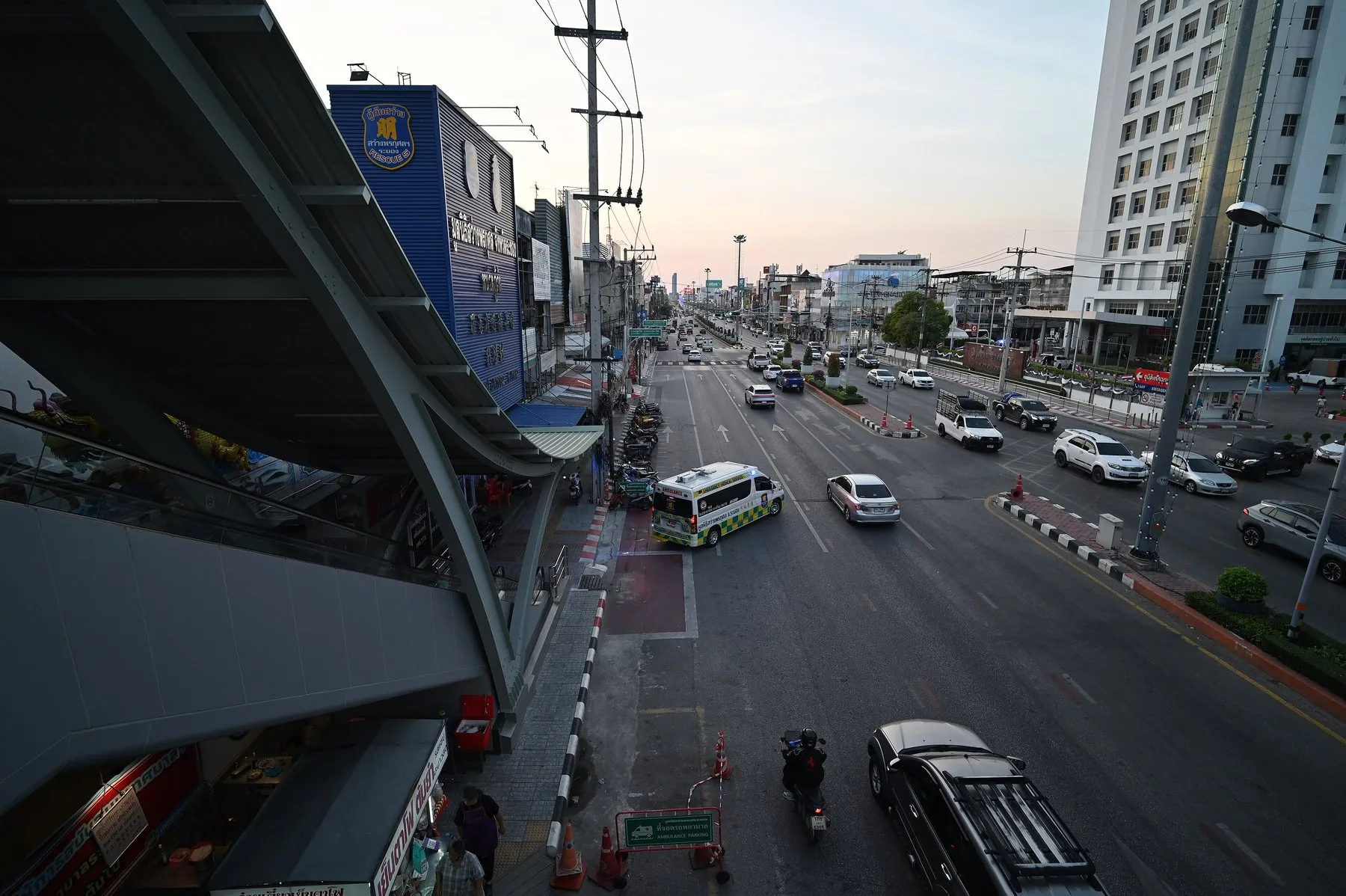
Motorbikes and the left lane
Section 35 is the most consistently ignored rule in Thailand. Written down, a motorcycle belongs in the leftmost lane and nowhere else. On the road, motorbikes occupy every lane, filter between them and use the shoulder in both directions.
For a car driver, the useful conclusion is not that riders are breaking the law but that the left lane is legally full of two-wheeled traffic and the other lanes contain it anyway. There is no lane in which you can stop checking. For a rider, the exemption is worth knowing because it explains why the police occasionally do enforce it — and why the shoulder, which feels like the safest place, is where wrong-way riders come from. That is all set out in motorbikes, filtering and Thailand's left lane.
The lane markings themselves
Lane discipline in Thailand is loose partly because the markings often are. Older highways have faded lines, resurfaced sections lose their markings for months, and in heavy rain at night the paint disappears entirely. On some rural roads a nominally two-lane carriageway is used as three because the lanes are wide and nobody has repainted them.
Two practical points follow. First, a vehicle drifting across a line is more likely to be following a line that is no longer there than to be doing anything deliberate. Second, in rain the lane you can see is not necessarily the lane everyone else is using, and the safest position is behind a vehicle whose driver knows the road. Thai road markings and kerb colours explained covers what the different lines mean when you can see them.
Bus lanes
Bangkok and a few other cities operate bus lanes, marked and signed, and the Act treats them as a defined category: section 34 refers to "the lane next to a bus lane" as your default position, and section 48 prohibits overtaking through a bus lane.
Enforcement is variable and the lanes are frequently occupied by taxis and motorbikes regardless. The reason to stay out of one is less the fine than the fact that a bus lane in Bangkok contains buses moving at speeds the rest of the traffic is not, and the buses do not expect a hire car in there. Buses and coaches on Thai roads explains how they behave.
Practical lane strategy for a visitor
- On a three-lane highway, live in the middle lane. It has the fewest surprises: no shoulder traffic on your left, no U-turn deceleration on your right.
- Move left well before your exit. Thai exits come up quickly and the left lane may be moving slowly.
- Shoulder-check before every lane change, in a car and on a bike. Mirrors do not show a filtering motorbike.
- Do not sit alongside a truck. Thai heavy vehicles change lane with limited warning and some have no working indicators at all.
- Signal, even though many drivers do not. Being predictable is the one contribution you can reliably make.
- Accept being undertaken. It is normal here, it is not directed at you, and reacting to it makes things worse.
In city traffic, pick a lane and stay in it. Lane-swapping in Bangkok gains almost nothing — the queues move at similar average speeds — and every change is an opportunity to meet a motorbike you did not see. Driving in Bangkok goes into the wider strategy.
Penalties
Failing to keep left under section 33 or misusing lanes under section 34 carries 200 to 500 baht under section 151 as the Act was originally drafted. The slow-vehicle and motorcycle-lane rules in section 35 fall under section 157, at 400 to 1,000 baht. Straddling a lane line under section 43(6) also falls under section 157.
You will be aware that these figures are small — under £25 at the top end. They are also statutory ranges rather than fixed roadside charges, and lane offences are not among the ten the Royal Thai Police singled out for strict enforcement from April 2026. In short, nobody is going to fine you for using the middle lane. The reason to hold a lane properly is the traffic, not the ticket. For what does get enforced and what it costs, see traffic fines in Thailand and what they cost.
Frequently asked questions
Which lane should I drive in on a Thai highway?
Legally, the leftmost, using lanes to the right only to overtake, pass an obstruction, position for a junction or travel faster than the traffic on your left. Practically, the middle lane of a three-lane highway is the least eventful place to sit.
Is the right-hand lane the fast lane in Thailand?
Not reliably. It carries traffic decelerating to enter U-turn slots and is used by anyone who wants to be there. On sections designated for 120 km/h there is a 100 km/h minimum in the outermost lane, but that applies only to those specific signposted stretches.
Are motorbikes allowed in any lane?
No. Section 35 confines motorcycles to the leftmost lane or the lane next to a bus lane on multi-lane roads. The rule is very widely ignored, so as a driver you should expect motorbikes anywhere on the carriageway regardless.
Can I drive on the hard shoulder?
You should not. The shoulder is not a running lane, and it is occupied by motorbikes travelling in both directions, parked vehicles and pedestrians. Moving onto it briefly to give room to an overtaking vehicle is a recognised local courtesy — check it is clear before you do.
Why does everyone overtake me on the left?
Because Thai lanes sort by vehicle type rather than by speed, and a driver who wants to pass will use whichever side has space. It is not aimed at you. The consequence is that you must check your near side before every lane change — see overtaking and undertaking on Thai roads.
What is the fine for being in the wrong lane?
Section 34 breaches attract 200 to 500 baht under section 151; section 35 and lane-straddling breaches attract 400 to 1,000 baht under section 157. Both are statutory ranges rather than fixed roadside amounts, and lane offences are rarely the reason a visitor is stopped.