Two systems of paint govern where you may drive and where you may stop in Thailand. The lines on the carriageway follow international convention closely — white for lane separation, yellow for the centre of a two-way road, solid for prohibition, broken for permission. The paint on the kerb is the part visitors have never encountered, and it is the part that gets cars clamped: red and white means no stopping at all, yellow and white means no parking but a brief pause is accepted, and a plain or black-and-white kerb means parking is normally allowed.
The complication is that Thai road markings are frequently worn, faded or absent, especially after resurfacing, and in a night downpour they disappear entirely. Learn what they mean, then learn not to depend on them.
- Red and white kerbNo stopping
- Yellow and white kerbNo parking; brief loading only
- Solid centre lineDo not cross to overtake
- Straddling a lane lineProhibited (s.43(6))
Kerb colours
| Kerb | Meaning | Where you see it |
|---|---|---|
| Red and white | No stopping and no parking at any time, not even momentarily | Junctions, bends, bus stops, fire access, narrow stretches, hospital and police frontages |
| Yellow and white | No parking, but stopping briefly to set down or pick up passengers or goods is accepted | Outside shops, hotels, markets and schools |
| Black and white, or unpainted | Ordinary kerb. Parking normally permitted, subject to signs | Residential streets, side roads, most of the country |
The kerb code is a settled and consistently described convention, but we have not been able to trace it to a published government instrument, and we would rather tell you that than dress it up as a section of the Act. Treat a posted sign as overriding the paint in every case, and treat faded paint as no instruction at all — in which case the sign, or the behaviour of the cars already parked, is what you go by. More on stopping and parking generally in parking rules in Thailand.
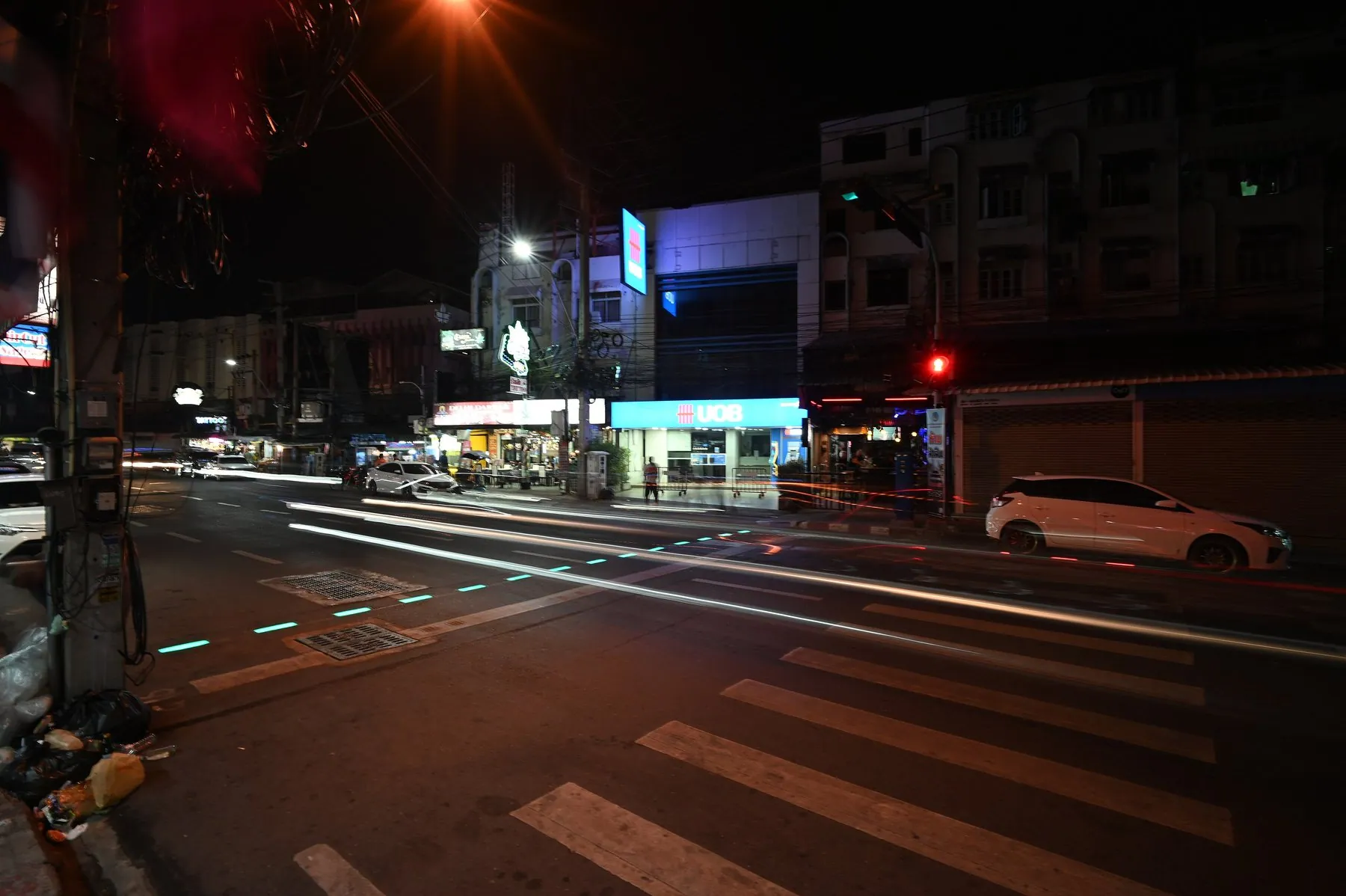
Lines on the carriageway
| Marking | What it means |
|---|---|
| Broken white line | Lane divider on a road with two or more lanes in the same direction. You may change lane when it is safe |
| Solid white line | Lane divider you should not cross — approaching junctions, on bridges, through tunnels |
| Broken yellow line (centre) | Centre of a two-way road. Overtaking permitted where safe |
| Solid yellow line (centre) | Centre of a two-way road. Do not cross to overtake |
| Double solid yellow | No crossing in either direction |
| Solid and broken yellow together | Overtaking permitted only from the side with the broken line |
| Yellow zigzag | No stopping — commonly at bus stops and outside schools |
| White hatched area / chevrons | Keep out. Marks a physical or notional traffic island, often at the approach to a U-turn slot |
| Transverse white bars across the lane | Slow down — a visual and sometimes audible warning ahead of a hazard, village or junction |
| Stop line (solid, across the lane) | Stop here. Under section 72, its presence is one of the things that makes the road you are joining a secondary road |
| Give-way line (dotted, across the lane) | Give way. Same effect under section 72 |
What the law says
Section 43(6) prohibits straddling a lane line, except when changing lane, turning or reversing direction. Section 47 prohibits crossing the centre line to overtake, and section 48 prohibits overtaking through a bus lane. Section 72 provides that a road counts as a main road for priority purposes where the joining road carries a stop sign, a give-way sign, a "Stop" marking on the surface, a solid stop line or a dotted give-way line.
Breaches of sections 45 to 48 carry 400 to 1,000 baht under section 157 as the Act was originally drafted.
Section 72 is the reason the paint matters legally rather than just practically: the presence or absence of a stop line or give-way line is one of the things that determines who has priority at a junction. Where none of those markings is present, no road is the main road and priority falls back on the general rules — and, in practice, on the informal hierarchy described in the unwritten rules of the road in Thailand.
Markings that behave differently here
The hard shoulder line. A continuous white line separates the carriageway from the sealed shoulder on most highways. In Thailand the shoulder beyond it is a working part of the road: motorbikes use it in both directions, slow vehicles pull onto it, and oncoming traffic moves onto its own shoulder to make room for an overtake. That convention is described in overtaking and undertaking on Thai roads. The line is real; the space beyond it is not empty.
Yellow box junctions. Present in Bangkok and larger cities, hatched in yellow, meaning do not enter unless your exit is clear. Observance is variable. The place the principle genuinely matters is at a railway level crossing, where the same discipline is what prevents the worst kind of collision — see level crossings in Thailand.
Pedestrian crossings. White ladder or zebra markings. Since the 2022 amendment, failing to stop for a pedestrian at a crossing carries a maximum of 4,000 baht and it is on the Royal Thai Police's April 2026 strict-enforcement list. Compliance has historically been poor, which is a reason for a pedestrian to be careful and not a reason for a driver to roll through.
Motorbike waiting boxes. Painted areas at the stop line at some urban traffic signals, intended to hold filtering motorbikes ahead of the cars. Where they exist, use them; where they do not, riders filter to the front anyway.
When the paint is not there
This is the practical heart of the subject. On a great many Thai roads the markings have worn away, been covered by resurfacing, or were never applied. A nominally two-lane rural carriageway may be used as three because the lanes are wide and unmarked.
Three consequences to plan for:
- A vehicle drifting across a line is usually following a line that is no longer visible rather than doing anything deliberate.
- At night in rain, markings vanish. Wet asphalt does not reflect, headlights scatter, and the safest position is behind a vehicle whose driver knows the road. Driving at night in Thailand covers this.
- On a motorbike, painted markings are slippery. Thermoplastic paint offers noticeably less grip than asphalt, badly so when wet. Avoid braking or turning on a painted area, particularly a crossing or a large hatched box.
For riders: treat paint, steel and manhole covers as ice in the wet. Zebra crossing bars, hatched boxes, painted arrows, level-crossing rails and steel plates over roadworks all lose grip dramatically in rain. Cross them upright, at as close to a right angle as the road allows, and do not brake on them. See riding a motorbike in tropical rain.
What it costs to ignore the paint
The line offences themselves are cheap. Straddling a lane line, crossing the centre line to overtake and overtaking through a bus lane all fall under section 157 at 400 to 1,000 baht — roughly £9 to £22 — and those are statutory ranges rather than fixed roadside charges.
The kerb offences are where the money is, because the sanction is not a fine but removal. A vehicle moved or immobilised by a traffic officer under section 59 attracts a charge of not less than 500 baht plus storage of not less than 200 baht a day, and damaging a wheel clamp is a criminal matter carrying up to three months' imprisonment and a fine of up to 5,000 baht. Traffic fines in Thailand and what they cost puts the whole schedule in context.
Frequently asked questions
What do red and white kerbs mean in Thailand?
No stopping and no parking at any time, not even briefly. They mark junctions, bends, bus stops and places where a stopped vehicle would block the road, and they are enforced by clamping and towing.
What does a yellow and white kerb mean?
No parking, but you may stop briefly to set down or pick up passengers or goods. In practice that means staying with the vehicle. It is the commonest marking outside shops and hotels.
Can I park where the kerb is black and white?
Generally yes, subject to any sign. Black and white is used to make the kerb visible rather than to prohibit anything, and an unpainted kerb carries the same default. Signs override the paint.
What does a yellow centre line mean in Thailand?
The same as elsewhere: yellow separates opposing directions of traffic. Broken means overtaking is permitted where safe; solid means do not cross to overtake; double solid means no crossing in either direction.
Are Thai road markings reliable?
Not always. Faded, resurfaced and missing markings are common, and at night in heavy rain they are effectively invisible. Where the paint is not there, drive as though no priority exists and leave more room.
Why are painted markings dangerous on a motorbike?
Thermoplastic road paint offers markedly less grip than asphalt and much less again when wet. Crossings, hatched boxes and painted arrows are common places for a front wheel to let go. Cross them upright and do not brake on them.