Thailand has a complete traffic code. It is the Land Traffic Act B.E. 2522, it has been amended thirteen times, and every rule on this site comes out of it. It is also not what decides who goes first at a Thai junction. That is decided by an unwritten hierarchy of size, speed and commitment, and a visitor who drives here without understanding it will spend the whole trip surprised.
This page is a description, not an endorsement. Knowing the informal system does not make it right and does not give you permission to join in. It makes the traffic around you predictable, which is the entire point: a driver who can anticipate what the pickup ahead is about to do is a much safer driver than one who is waiting for it to obey section 71.
The hierarchy
Roughly, in descending order of who takes the space:
| Rank | Vehicle | Why |
|---|---|---|
| 1 | Buses and coaches | Enormous, on a schedule, and physically unable to stop quickly |
| 2 | Heavy trucks | Same logic, often overloaded, often with poor brakes |
| 3 | Pickups | The default Thai vehicle. Numerous, driven with confidence |
| 4 | Cars | Ordinary traffic |
| 5 | Motorbikes | Small and agile, so they take gaps rather than priority |
| 6 | Pedestrians and cyclists | Bottom of the pile, in practice, whatever the law says |
The organising idea is not aggression. It is that the vehicle least able to stop goes first and everyone else adjusts around it, which — as a piece of collective physics — is a defensible arrangement. Where it breaks down is at the bottom of the table, and Thailand's road-safety record is largely a record of what happens to the people in rows five and six.
As a visitor you are below all six rows. You do not know the roads, you cannot read the signs at speed, and everyone else can tell within two seconds that you are hesitant. That is not a reason to drive assertively to compensate. It is a reason to leave more space, go more slowly, and let people past.
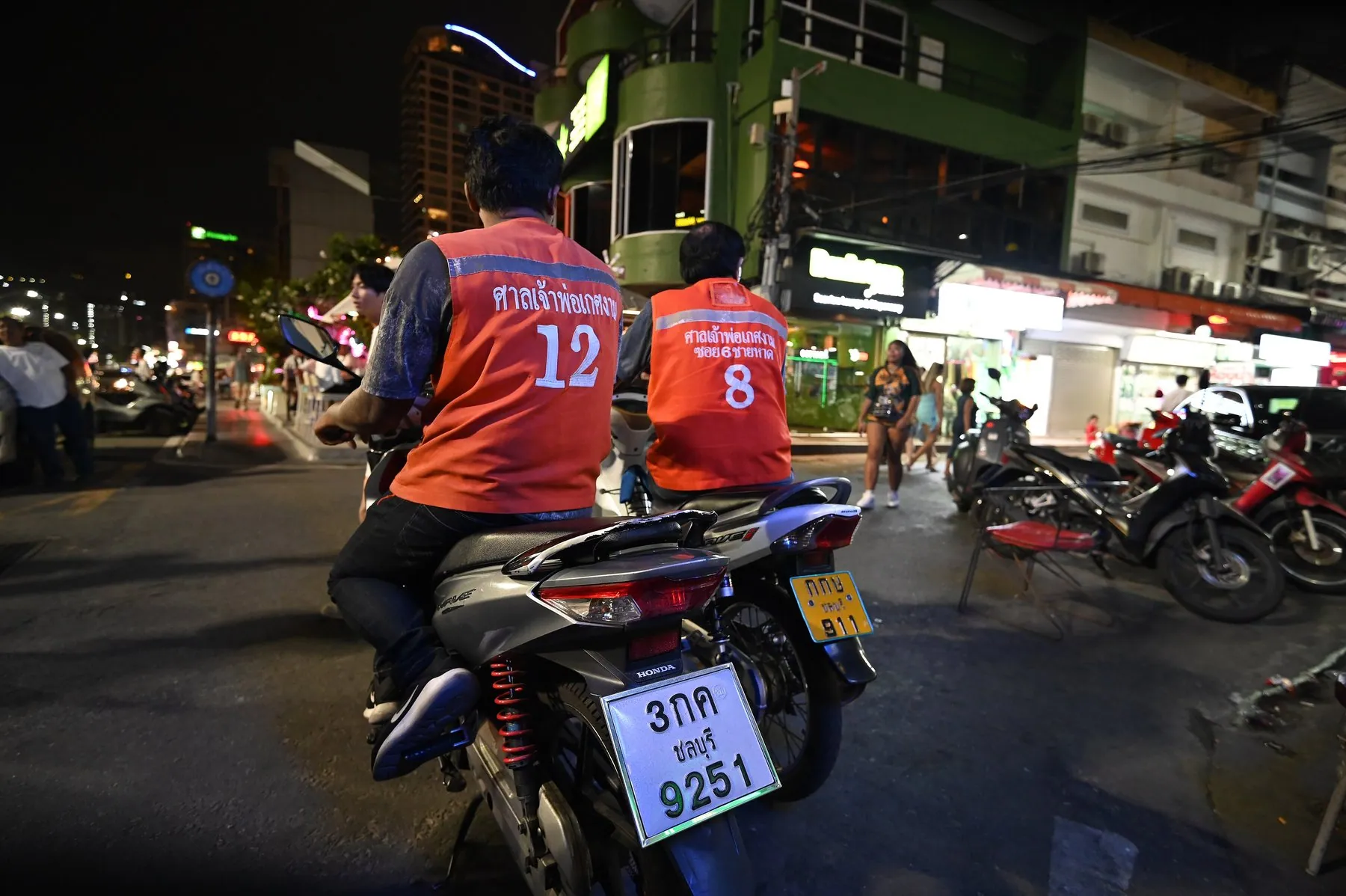
Rule one: movement is communication
Thai drivers signal intention by moving. A vehicle that noses out from a side road is not being reckless; it is announcing that it intends to come, and expecting you to make room. A vehicle that stops dead and waits is announcing that it will wait indefinitely.
Foreign drivers default to the second and are then baffled that nobody lets them out. In dense traffic a driver who never edges never moves. The technique is to move steadily and predictably — slow, continuous, unmistakable — rather than in nervous darts. Predictability is what the system runs on, and it is the one contribution you can reliably make.
Rule two: the gap belongs to whoever is in it
A gap in Thai traffic is not reserved for the vehicle whose turn it is. It belongs to whatever gets there. This applies to lane changes, junctions, roundabouts and queues, and it is why leaving a large following distance in city traffic simply results in a motorbike occupying it.
The consequence for a visitor is not to close up your following distance — that trades a small annoyance for a large risk. It is to accept that the gap will be filled, and to leave it anyway.
Rule three: the responsibility runs backwards
In much of Europe and North America, the driver joining traffic bears the responsibility for doing it safely. In Thailand, in practice, the driver already on the road is expected to absorb whatever the joining driver does. That is why vehicles pull out into small gaps with apparent unconcern: the assumption is that you will adjust.
This is the single most important adaptation. Your following distance, your speed and your readiness to brake are not courtesy; they are the mechanism by which the system works at all. Drive as though everything ahead of you might move sideways, because it might.
The most useful habit to import is the two-second-plus gap, everywhere, all the time. It gives you room for the pickup that pulls out, the songthaew that stops without warning, and the motorbike that appears from the shoulder. In Thai city traffic it will constantly be filled by somebody. Rebuild it and carry on.
Rule four: motorbikes are everywhere and follow their own physics
Legally, motorcycles belong in the leftmost lane. Practically, they use every lane, the space between lanes, the hard shoulder in both directions and, in Bangkok, the pavement. A rider will overtake you on either side, filter to the front at every red light, and emerge from a direction the road layout says is impossible.
Three defensive habits follow, and they are non-negotiable here:
- Shoulder-check before every lane change, in a car and on a bike. Mirrors do not show a filtering motorbike.
- Look both ways at every junction, including one-way streets and dual carriageways. Wrong-way riders on the shoulder are a leading cause of collisions involving foreigners.
- Check your near side before you open a door, every time. In stationary traffic something is filtering past.
Motorbikes, filtering and Thailand's left lane covers where riders are supposed to be, and one-way streets and wrong-way riders covers the wrong-way problem specifically.
Rule five: indicators are optional and the horn is not aggression
Many Thai drivers do not indicate, and some use both indicators to mean "going straight on" at a crossroads. A short beep of the horn means "I am here" or "I am passing", not "how dare you". And a flash of the headlights means "I am coming through", which is the reverse of the British and Australian convention and the single most dangerous thing on this page to get wrong. Horn and headlight etiquette on Thai roads sets it out properly.
Signal anyway. You are not going to change the local norm, but you can be the vehicle whose intentions are legible, and that is worth more to your own safety than it is to anyone else's.
Rule six: never lose your temper
Public anger carries a social cost in Thailand that is difficult to overstate. A raised voice, a gesture, an aggressive horn — these do not read as ordinary road frustration. They read as a serious loss of face, and they escalate situations that would have resolved themselves.
For a foreign driver the calculation is one-sided. You have no local standing, no language, and no idea who you are shouting at. If something happens, stay calm, stay in the vehicle if it feels tense, and call 1155 for the Tourist Police, who will send an English-speaking officer. Tourist police in Thailand explains what they can and cannot do, and your rights as a foreign driver covers the rest.
Rule seven: follow a local vehicle
When you genuinely do not know what to do — an unmarked roundabout, a chaotic junction, a one-way system in a town you have never seen — sit behind a Thai-driven pickup and go where it goes. It knows the road, it knows the convention at that particular junction, and its driver has more standing in the negotiation than you do.
It is not a sophisticated technique and it works everywhere in the country.
What this does not excuse
The informal system explains the traffic. It does not change the law, and it will not help you afterwards.
Fault after a collision is decided at the scene, usually with an insurance surveyor present, and it is decided on the rules as written — see how fault is decided after a crash in Thailand. "Everyone does it" is not a defence, and it certainly is not a defence to your insurer, who may decline a claim for injury sustained while breaking the law. That is the calculation behind what voids your motorbike cover in Thailand.
The rules themselves, written down and sourced, are in right of way in Thailand, lane discipline and overtaking and undertaking. Read those to know where you stand. Read this one to know what is about to happen.
Frequently asked questions
Do Thai drivers follow the rules of the road?
Selectively. The traffic code is comprehensive and enforcement is concentrated on a small number of offences — helmets, licences, drink-driving and, since April 2026, a named list of ten. Day-to-day priority is settled by an informal hierarchy of size and commitment rather than by the statute.
Who really has priority in Thai traffic?
The bigger and faster vehicle, in practice: buses, then trucks, then pickups, then cars, then motorbikes, then pedestrians and cyclists. The legal position is different and is set out in right of way in Thailand.
Is driving in Thailand aggressive?
Not in the way that word is usually meant. It is assertive and fluid rather than hostile, and overt anger is rare and socially costly. The danger comes from density, speed differentials and vulnerable road users, not from drivers trying to intimidate each other.
How do I get out of a side road if nobody lets me?
Move out slowly and steadily rather than waiting for a gap to be offered. A vehicle that edges predictably will be accommodated; a vehicle that sits still will wait all day. Do it smoothly, and never in a sudden dart.
Should I drive assertively to fit in?
No. Drive predictably, slowly and with large gaps. Assertiveness here rests on knowing the roads and reading other drivers, neither of which a visitor has. Being the cautious foreigner costs you a few minutes and nothing else.
What should I do if another driver is angry with me?
Stay calm, do not respond in kind, and do not get out of the vehicle if the situation feels tense. Call 1155 for the Tourist Police, who will send an English-speaking officer. Escalation is a much worse outcome for a visitor than for the other party.