One-way streets in Thailand are signed much as they are anywhere else, and cars obey them. Motorbikes frequently do not. That is the whole of what a visitor needs to understand, and it changes how you should treat every side turning, every soi mouth and every hard shoulder in the country: a road being one-way tells you where the cars will come from. It does not tell you where the motorbikes will come from.
Driving against the flow of traffic is a real offence with a real penalty — a maximum of 2,000 baht since the 2022 amendment to the Land Traffic Act, and one of the ten offences the Royal Thai Police singled out for strict enforcement from April 2026. It is also, on any given morning, something you will see a dozen times.
- Driving against the flowUp to 2,000 baht
- Since5 September 2022 (Act No. 13)
- On the 2026 enforcement listYes
- Demerit pointsYes — mid-range band
How one-way streets are signed
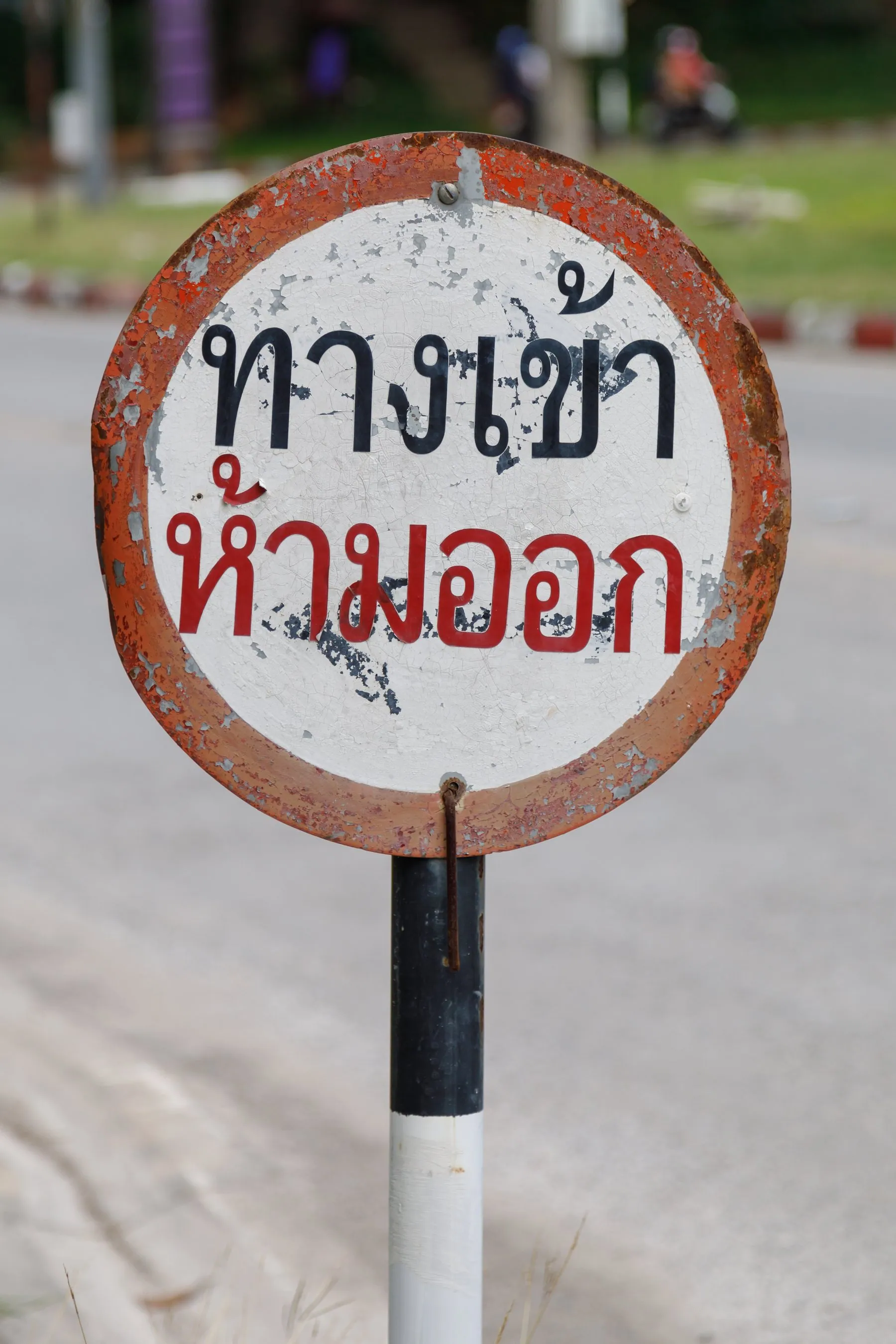
Thailand uses the international conventions. A white arrow on a blue rectangle indicates the permitted direction of travel. A white horizontal bar on a red circle — the "no entry" sign — indicates that you may not enter from this end. Both are usually posted at the mouth of the street and repeated at intervals.
Two complications are worth knowing about. First, on smaller sois the sign may be a single faded plate on a pole, partly obscured by a tree, a cable or a parked vehicle, and easy to miss at speed. Second, some streets are one-way only at certain times of day — around schools and markets particularly — and the restriction is set out on a supplementary plate that will be in Thai. If a street's traffic is all flowing one way and you cannot see why, the answer is usually a time restriction. Thai road signs explained covers the sign vocabulary; reading road signs in Thai script without Thai covers the supplementary plates.
The most reliable one-way indicator is not the sign, it is the parked cars. If every vehicle on both sides of the street is facing the same way, the street is one-way and you now know which way. This works in every Thai town and it works when the sign has fallen off.
Wrong-way riders: why it happens
It is worth understanding the logic, because it lets you predict where it will happen rather than being merely surprised by it.
Thai road design concentrates access at controlled points. On a divided highway there is often no right turn and no gap in the median for kilometres — you drive to a U-turn slot and come back. For a car that is a four-minute detour. For someone on a 110cc scooter going 150 metres to buy something, riding the wrong way along the hard shoulder is thirty seconds. The same calculation applies to a one-way soi where the legal route round is a kilometre.
So wrong-way riding clusters in entirely predictable places:
- The hard shoulder of any divided highway, especially near shops, schools and markets on one side.
- The last hundred metres before a U-turn slot, where riders cut back rather than go round.
- One-way sois with a long legal detour, particularly in Bangkok and older town centres.
- Around markets at opening and closing time.
- Outside schools at drop-off and pick-up — see school zones in Thailand.
This is the collision that catches visiting drivers. You emerge from a side road onto a one-way street, you look in the direction traffic is legally coming from, and something hits you from the other side. Look both ways at every junction in Thailand, including the ones where the layout says nothing can come from that direction. There is no situation in this country where a single-direction check is enough.
What the penalty is, and what it is not
The 2022 amendment set the maximum for driving against the flow of traffic at 2,000 baht — roughly £45 or US$60. It is a ceiling. The amount written on an actual roadside ticket is set by a Royal Thai Police schedule under section 140 and is normally well below the statutory maximum. We do not publish a figure for what a ticket typically says, because the police schedule is not something we have been able to obtain, and the numbers circulating on rental-shop noticeboards and forums are not sourced.
Wrong-way driving does carry demerit points against a Thai licence, in the middle of the four-tier range. Published lists of points per offence disagree with one another, so we do not reproduce a table; what is consistent across sources is the structure — deductions of one to four points from a starting balance of twelve, with a 90-day suspension at zero. Thailand's driving licence points system explains how it works and why it is mostly a matter for residents rather than visitors.
If you go the wrong way by accident
It happens, usually in a town centre with a one-way system and a navigation app that has not caught up with a recent change. What to do:
Stop as soon as it is safe, and pull to the side. Do not reverse down the street. Reversing into traffic you cannot see is worse than the original error.
Wait for a gap and turn round, or if the street is short and clear, continue to the next junction at walking pace with your hazards on and leave at the first opportunity.
If you are stopped for it, the process is the ordinary ticket process: the officer may give a warning or write a ticket, and since 20 September 2019 there is no power to confiscate your driving licence at the roadside. On-the-spot traffic tickets in Thailand sets out what should happen and what the paperwork looks like.
Riding the wrong way yourself
Visitors on scooters copy what they see, and what they see is riders going the wrong way along the shoulder constantly. Three reasons not to.
It is an offence on the strict-enforcement list, which means it is one of the small number of things police are actively looking for in 2026, and tourist areas are where enforcement is concentrated.
It puts you at fault in any collision. Fault in Thailand is determined at the scene, usually with an insurance surveyor present, and a rider travelling against the flow will be found responsible. How fault is decided after a crash explains the process.
And it can cost you your insurance. Most travel policies exclude injury sustained while committing an illegal act or while riding without the correct licence. A wrong-way collision hits both possible exclusions at once, and the sum at stake is a hospital bill, not a fine. What voids your motorbike cover in Thailand is the page to read before you ride.
One-way systems in Thai towns
Most Thai towns of any size have a one-way system in the centre, and they are frequently more extensive than a visitor expects. Chiang Mai's moat is a two-lane one-way loop in each direction with the two loops separated by water, so getting the direction wrong means driving a long way round. Pattaya's Beach Road and Second Road form a one-way pair. Bangkok has one-way sois everywhere, some of them with a contraflow bus lane.
The practical technique in an unfamiliar town is to accept the extra distance. A one-way system is designed to make you go round; fighting it produces exactly the wrong-way manoeuvre this page is about. One-way streets, sois and how Thai towns are laid out covers the geography, and driving in Chiang Mai and driving in Pattaya cover those two systems specifically.
Frequently asked questions
What is the fine for driving the wrong way in Thailand?
The maximum is 2,000 baht, set by the 2022 amendment to the Land Traffic Act. That is a ceiling rather than a fixed charge — the amount on a roadside ticket comes from a police schedule and is normally well below it.
Why do motorbikes ride the wrong way down one-way streets?
Because the legal alternative is often a long detour. Thai road design concentrates access at U-turn points and one-way loops, and a short wrong-way run on the shoulder saves a rider several minutes. It is illegal, it is common, and it is entirely predictable in location.
How do I know if a street is one-way?
Look for the blue rectangular arrow sign or the red no-entry circle at the mouth of the street. If you cannot see a sign, look at which way the parked cars are facing — on a one-way street they all face the same direction.
What should I do if I have gone the wrong way?
Stop safely and pull in. Do not reverse. Wait for a gap and turn round, or continue slowly with hazards to the next junction and exit there.
Are one-way restrictions ever time-limited in Thailand?
Yes, particularly around schools and markets, and the timing plate will be in Thai. If traffic is all flowing one way on a street you thought was two-way, a time restriction is the usual explanation.
Does riding the wrong way affect my insurance?
It can. Most travel policies exclude injury caused while breaking the law, and motor cover follows fault, which a wrong-way rider will be assigned. The fine is trivial next to a Thai hospital bill — see does travel insurance cover driving in Thailand.