Pattaya is laid out as a grid, which makes it one of the simpler Thai resort towns to drive in, and it has two rules that visitors break on their first day. Beach Road runs one way southbound. Second Road runs one way northbound. Together they form a long anticlockwise loop along the bay, and if you set off up Beach Road looking for your hotel you will be facing a wall of baht buses within thirty seconds.
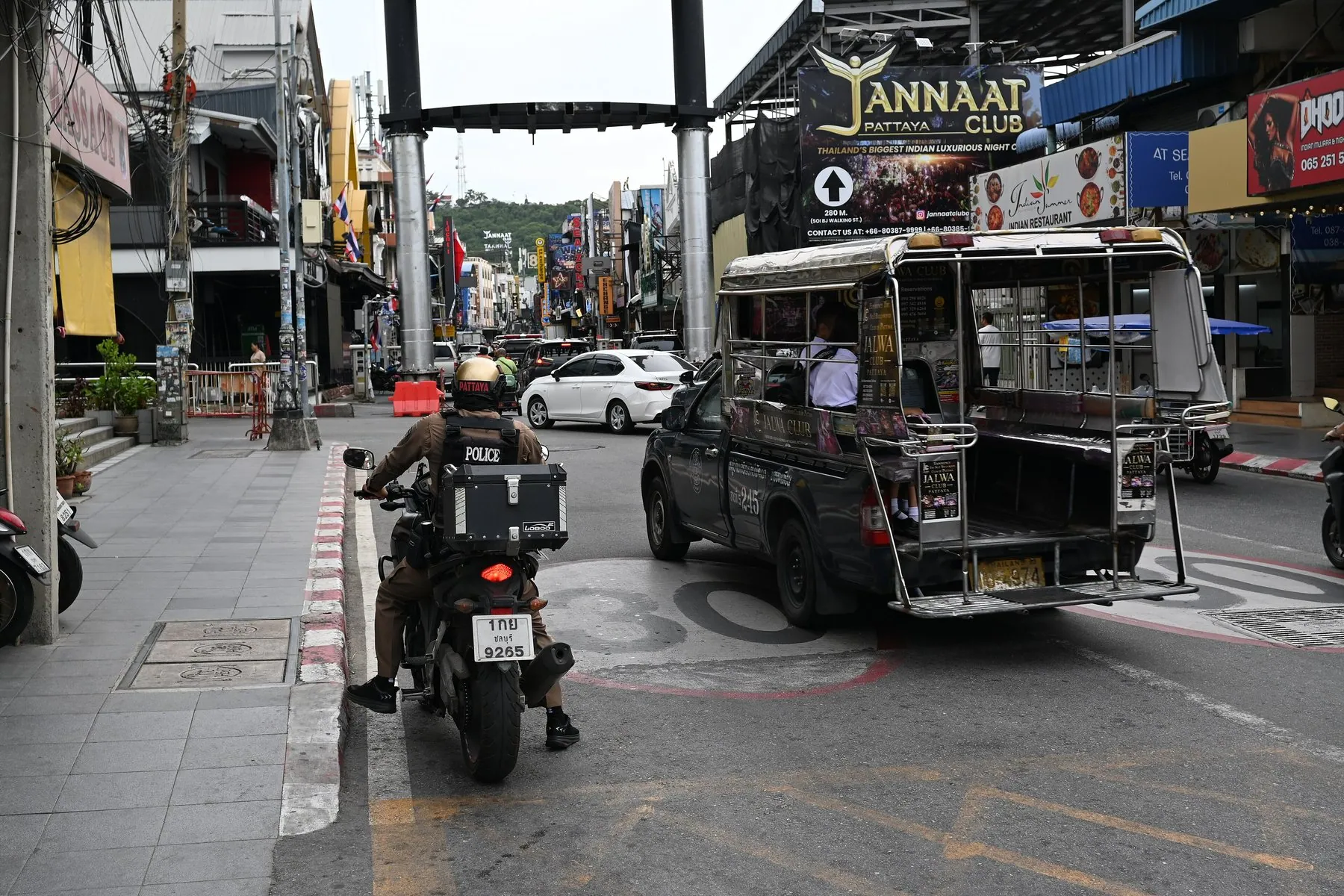
The other thing to absorb before you drive here is that the songthaews — the blue pickup trucks universally called baht buses — are not buses in any sense you are used to. They have no stops. They stop where a passenger raises a hand or knocks on the roof, in the live lane, without indicating, several times a minute. They are the dominant traffic on Beach Road and Second Road, and driving in Pattaya is largely a matter of anticipating them.
- Beach RoadOne-way southbound
- Second RoadOne-way northbound
- The through routeSukhumvit Road, inland and two-way
- Worst hoursLate afternoon, and Friday evening arrivals
The grid
Four roads run north to south, parallel to the shore and a few hundred metres apart:
- Beach Road (Thanon Hat Pattaya, sometimes called First Road), along the sand. One-way southbound.
- Second Road, one block inland. One-way northbound.
- Soi Buakhao, a narrow, extremely busy street between Second and Third, two-way and usually congested.
- Third Road, further inland and much quieter than the other three.
- Sukhumvit Road — Highway 3 — the coastal trunk road at the back of town, two-way, fast, and the route to everywhere outside Pattaya.
Three east–west roads tie them together: North Pattaya Road (Pattaya Nua), Central Pattaya Road (Pattaya Klang) and South Pattaya Road (Pattaya Tai). Each runs from Sukhumvit down to the beach and each is two-way. At the northern end of Beach Road sits the Dolphin Roundabout, which is where the one-way loop turns; at the southern end is Walking Street, which closes to vehicles in the evening.
That is the whole system. Learn those seven road names and Pattaya navigation is solved. Getting the numbering of the sois straight takes longer, and the logic behind Thai soi numbering is explained in one-way streets, sois and how Thai towns are laid out.
The through route is Sukhumvit, not the beach. If you are travelling from the north of Pattaya to Jomtien, or to anywhere outside town, go inland to Sukhumvit and come back in on the east–west road nearest your destination. Using Beach Road and Second Road as a through route costs you three times as long.
The baht buses
Pattaya's songthaews run a continuous loop: north along Second Road to the Dolphin Roundabout, then south the full length of Beach Road, then east along South Pattaya Road, and round again. Along Central, North and South Pattaya Roads they run both directions between Sukhumvit and the beach. There is no timetable and no route map on the vehicle; you flag one down and press the buzzer when you want out.
For a driver this means the nearside lane of Beach Road and Second Road is effectively unusable. A baht bus will pull in without indicating, sit for ten seconds while a passenger climbs down over the tailgate, and pull straight back out. The technique is to stay out of the kerb lane, leave a long gap, and treat every songthaew ahead of you as about to stop, because it is. The behaviour is described in detail in songthaews and how they stop without warning.
Passengers get out on the road side. A songthaew's exit is at the back, and passengers step down into the carriageway, often straight into the path of a filtering motorbike. If you are on two wheels, never pass a stopped baht bus closely. If you are in a car, expect a pedestrian to appear from behind one.
Where it goes wrong for visitors
Three recurring mistakes:
Entering a one-way road the wrong way. Beach Road and Second Road are signed, but the signs are easy to miss when you are looking for a hotel entrance, and the sois joining them are numerous. If the parked cars are all facing you, you are wrong. Turn into the next soi and go round.
Trying to turn right across Sukhumvit. Sukhumvit through Pattaya is a wide divided highway with fast traffic and few direct right turns. The movement is done at U-turn points, some of them with their own signals and some of them simply gaps in the central reservation where you have to judge a gap in three lanes of traffic travelling at highway speed. Take these seriously: they are the most dangerous manoeuvre in Pattaya. See U-turns in Thailand.
Underestimating Pratamnak Hill. The headland between South Pattaya and Jomtien carries a climb with tight bends and a steep descent on the Jomtien side. It is not a mountain road, but it is enough to catch out an overloaded scooter with tired brakes.
Parking
Pattaya parking is easier than most Thai resort towns, and the kerb-colour system is the same nationwide: red and white means no stopping, yellow and white means a brief drop-off only. Enforcement in Pattaya has been visibly stepped up in recent years, with alternate-day restrictions on some streets and wheel clamps applied to anything blocking a lane. Assume the markings mean what they say — parking rules in Thailand covers the detail.
The reliable options are the malls. Central Festival Pattaya Beach sits on Beach Road with a multi-storey car park; Terminal 21 Pattaya is on Second Road at the north end; Royal Garden Plaza is at the southern end of Beach Road. All have motorbike parking and the usual validation-against-purchase arrangement. Most hotels have their own parking, though the small ones in the sois off Second Road may have only a few spaces.
Do not plan to park near Walking Street in the evening. The street itself closes to vehicles and the surrounding sois fill completely.
Getting in and out
Pattaya's connection to Bangkok is Motorway 7, which runs from the eastern edge of the capital down to Chon Buri and on towards Pattaya, meeting Sukhumvit near the top of town. It is a toll road, it is fast, and on a Friday evening it is full of Bangkok escaping for the weekend. Coming the other way, Sunday evening northbound is the busy direction. Timings and tolls are in Thailand's expressways and motorways and toll roads in Thailand.
Sukhumvit south from Pattaya runs down the coast towards Rayong and eventually Trat, which is the road to the Koh Chang ferry — see the Koh Chang and Koh Samui vehicle ferries.
Car or scooter?
Pattaya is compact enough that a scooter covers everything, and cheap enough in baht-bus terms that many visitors never rent anything. Where a vehicle earns its place is Jomtien, Na Jomtien, Bang Saray and the beaches further south, which are a long, expensive songthaew ride away.
Two cautions if you are riding. Police checkpoints are a regular feature in Pattaya, more so than in most Thai towns — what happens at one is in police checkpoints in Thailand. And the combination of a late night, a rented scooter and an unfamiliar one-way system is exactly the one that fills the local hospital; the local rental market is covered in renting a motorbike in Pattaya.
Which way does Beach Road run in Pattaya?
Southbound only. Second Road, one block inland, runs northbound only. Together they form the one-way loop that the baht buses circulate on.
Is Pattaya easy to drive in?
Yes, by Thai standards. It is a grid, the roads are wide, and there are no hills to speak of within the town. The difficulty is the density of stopping songthaews and the U-turns on Sukhumvit.
Can I drive down Walking Street?
Not in the evening — it closes to vehicles. During the day it is open but there is nothing to be gained by driving down it.
Where should I park in Pattaya?
The shopping centres on Beach Road and Second Road, or your hotel. Street parking exists but the kerb markings are enforced and alternate-day restrictions apply on some streets.
How do I turn right off Sukhumvit?
You generally cannot. You continue to a U-turn point and come back. Judging the gap at an unsignalised U-turn on a fast divided highway is the single riskiest manoeuvre in the area — take your time and do not be hurried by anyone behind you.
Is a car worth renting in Pattaya?
Only if you plan to leave the immediate resort strip. Within Pattaya itself the baht buses are cheap and constant; for Jomtien, Bang Saray and the coast south, a vehicle transforms the trip.