A songthaew is a pickup truck with two benches in the back and a roof over them — the name means "two rows" — and in most Thai towns it is the local bus. It has no bus stops, no timetable and no fixed doors. It stops wherever a passenger raises a hand or presses the buzzer, which means it can stop anywhere, at any moment, in any lane, with no signal and no warning.
If you tailgate one you will eventually run into the back of it. That is the whole hazard in a sentence, and it is a common enough way for visitors to come off a scooter that it deserves a page of its own. The good news is that a songthaew about to stop is readable, once you know what to look for.
- What it isA converted pickup working as a shared local bus
- Where it stopsAnywhere a hand goes up
- Warning givenUsually none
How the system works, and why that produces the hazard
Songthaews run fixed routes but not fixed stops. You flag one down from the roadside, get in the back, and press a buzzer or bang on the roof when you want to get off. The driver stops immediately, wherever that is, and passengers step out into the road at the back.
Because the driver is paid per passenger, there is a strong incentive to stop for anyone who might be a fare. A songthaew is therefore constantly scanning the pavement, will slow to a crawl next to anyone standing near the kerb, and will cut across lanes to reach a raised hand on the far side. Its behaviour is driven by what is happening on the pavement, not by what is happening on the road — which is precisely why it is unpredictable to anyone watching only the traffic.
Different towns have their own variants. Chiang Mai's red rot daeng work more like shared taxis and will negotiate a destination rather than run a strict route. Pattaya's blue "baht buses" run a loop along the main roads. Phuket's larger wooden-bodied songthaews link the towns and beaches. The behaviour is the same everywhere.
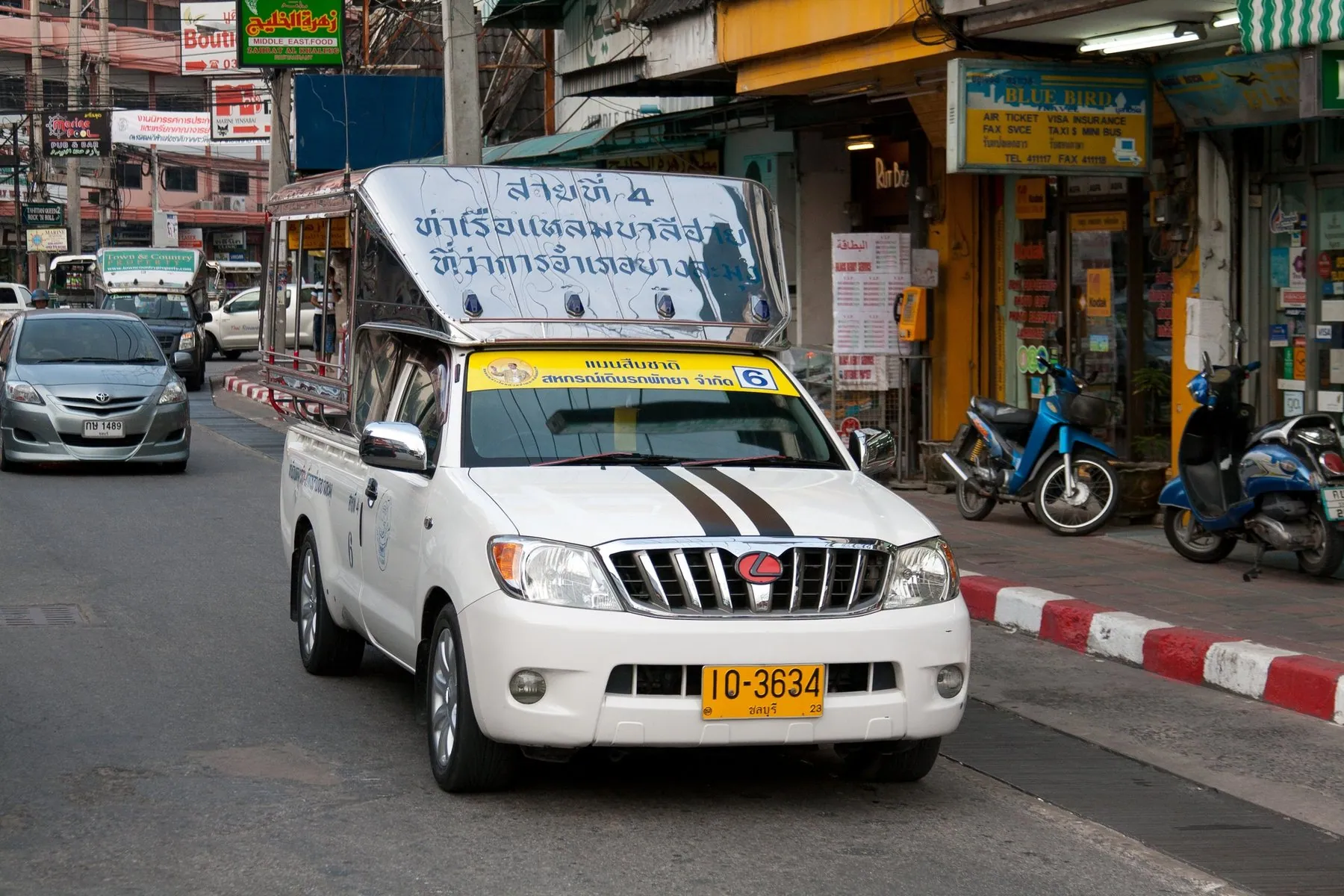
The tells: spotting one about to stop
| What you see | What it means |
|---|---|
| It drifts left and slows slightly, for no visible reason | The driver has seen someone on the pavement. It is going to stop. |
| A hand appears out of the side of the passenger area | A passenger signalling. Stop imminent. |
| You hear a buzzer or a bang on the roof | The stop request. On a scooter you will genuinely hear this. |
| Anyone standing at the kerb ahead, facing the traffic | A potential fare. The songthaew will slow for them. |
| Brake lights come on with no traffic in front | It is stopping, not slowing for something. |
| A passenger stands up in the back | Preparing to get off. Stop within seconds. |
| It is approaching a market, a school or a 7-Eleven | High-probability stop zone regardless of anything else. |
Watch the pavement, not the vehicle. This is the technique that makes the whole thing predictable. A songthaew stops because of a person at the roadside, so if you scan the kerb ahead — the way you would scan for a pedestrian about to cross — you will see the stop coming before the driver reacts to it. Anyone standing still, facing the road, is the trigger.
Riding behind one
The rule is simple: do not sit directly behind a songthaew, and never within your own braking distance of it. Either drop back far enough that a sudden stop is a non-event, or move out and pass it properly.
The specific trap on a motorbike is passing on the left. It feels natural — the songthaew is drifting left towards the kerb, there is a gap on the inside, and Thai riding practice puts you in the left-hand strip of the road anyway. But the left is exactly where the passengers get out, where the fare is standing, and where the songthaew is heading. Pass on the right, with a clear view ahead, or wait.
Passengers step down into the road at the back, not at the side. A songthaew has an open rear with a step. When it stops, people come out backwards, directly into the lane you are in, often carrying shopping and not looking. If you are close behind a stopping songthaew, the person appearing is at bumper height and you have no time. This is the collision this page exists to prevent.
Driving behind one in a car
The problem is less about impact and more about the traffic behind you. A car that has to stop suddenly for a songthaew is fine; the motorbike filtering up your left side is not. Build in space so that your stops are gradual rather than emergency ones, and use your mirrors before braking on any road where bikes are filtering.
The other issue is overtaking. A songthaew that has stopped is generally about to pull straight back out — no mirror check, no indicator, no gap assessment. Do not pass a stopped one closely. Give it width, and expect the pull-out.
The lane discipline problem
Songthaews on a multi-lane road move between lanes according to where the passengers are, not according to any lane logic. One in the outside lane that sees a fare on the left will cross two lanes to reach it; one that has just picked up on the left will pull straight back out to the middle. Never assume a songthaew will hold its lane, and never plan a manoeuvre that depends on it doing so.
Where it matters most
- Pattaya — the blue baht buses run continuously along Second Road and Beach Road, stopping constantly, on one-way roads busy with scooters. The highest-density songthaew environment in the country.
- Chiang Mai — the red rot daeng work the moat road and the old city, mixing stops with u-turns and unpredictable route changes.
- Phuket — the larger songthaews run between Phuket Town and the beaches, on hilly roads where a stop on a gradient is a genuine hazard.
- Beach and island roads — narrow, with no shoulder, so a stopped songthaew blocks the lane entirely and everyone goes round it into oncoming traffic.
Riding in one, and getting out of one
Most visitors will use a songthaew as well as ride around them, and the getting-out is the risky part. You step down into a live traffic lane with motorbikes filtering past on both sides. Look before you step, step onto the kerb side if there is one, and do not walk round the front of the vehicle. On the bench itself, hold on: drivers brake hard and take corners at speed, the benches are slippery, and there is nothing to stop you sliding out of the back.
A songthaew is a pickup with a canopy, and it inherits all the mass, blind spots and braking characteristics described in pickup trucks in Thailand and how they behave. What makes it a separate hazard is the stopping pattern, not the vehicle.
Cyclists get the worst version of this, because a bicycle is in the same left-hand strip, travels at a speed that keeps it perpetually in the vehicle's blind spot, and cannot accelerate out of trouble. The pattern that catches cyclists is being repeatedly passed by the same songthaew, which then stops in front of them, over and over along a route. Cycling safely in Thai traffic deals with how to position yourself so that this does not happen.
Frequently asked questions
Do songthaews indicate before they stop?
Sometimes, briefly, and often after they have already started braking. Do not rely on it. The reliable signals are the drift towards the kerb, brake lights with clear road ahead, and a person standing at the roadside.
Can I overtake a songthaew?
Yes, and you generally should rather than sitting behind one. Pass on the right with a clear view, get well past, and do not cut back in front of it — it may already be pulling out again for a fare you have not seen.
Why did it stop in the middle of the road rather than pulling in?
Because there is nowhere to pull in, or the passenger is getting out on that side, or simply because it is quicker. Stopping in a live lane is normal behaviour here and nobody around you is surprised by it.
Are they dangerous to travel in?
They are open-backed vehicles with bench seating and no restraints, so in a crash the outcome is poor. In practice they travel at low speeds on short urban routes, which limits the exposure. Sit down, hold the rail, and keep your limbs inside the canopy.
What is the difference between a songthaew and a tuk-tuk?
A tuk-tuk is a three-wheeler hired privately for a journey you negotiate; a songthaew is a shared vehicle running a route for a fixed low fare per passenger. Tuk-tuks stop suddenly too, and for the same reason, but they are smaller and noisier, so you tend to notice them.