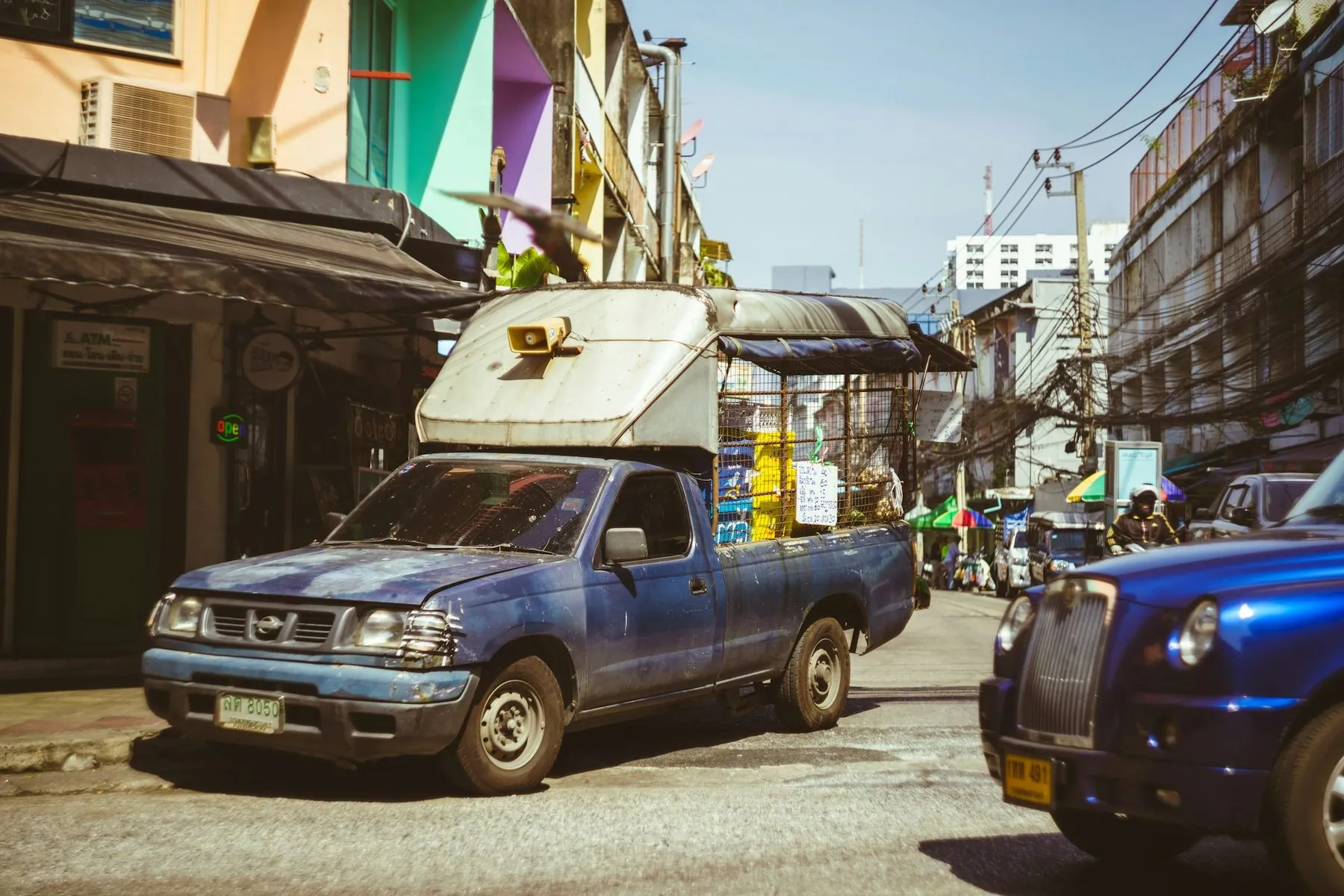
The pickup is Thailand's default vehicle. Not a niche choice for farmers and tradesmen but the ordinary family car, the taxi, the delivery van and the works bus, all at once — and there are more of them on a Thai highway than there are saloons. Understanding how they behave is not optional, because a large share of the traffic you interact with will be a one-tonne Toyota Hilux, Isuzu D-Max or Ford Ranger, and they do not drive like the cars you are used to.
- Share of the fleetThe most common vehicle type on Thai roads
- Typical loadAnything, and often people
- Key blind spotEverything alongside the load bed
Why they are everywhere
Thailand is one of the world's largest pickup manufacturing countries, and the one-tonne pickup has long been taxed far more favourably than an equivalent passenger car. It is cheaper to buy and cheaper to run than a saloon of the same size, and the four-door "double cab" that carries five people and a load bed is the standard family vehicle across most of the country.
That matters because the pickups around you are not commercial vehicles driven by professionals. They are family cars driven by everyone, in a vehicle with the mass, height and braking characteristics of a light truck.
What the vehicle does that a car does not
It cannot stop like a car
A loaded pickup carries substantially more mass than a saloon, on a chassis designed for load rather than handling, often on hard-compound tyres chosen for durability. Braking distances are longer, and much longer when loaded or wet. If a pickup is behind you it needs more room than you think.
It sits high and sees over you, but not around you
The driver has an excellent view of the road ahead over the top of every car in front. What they do not have is any view of the area immediately alongside and behind the load bed. A motorbike level with the rear wheel of a pickup, on either side, is invisible — the mirrors are set up to see the length of the vehicle and a trailer, not the rear quarter. This is the classic mechanism for a filtering motorbike being wiped out by a lane change.
It leans, and the load is not always secured
A high-sided vehicle with a lot of suspension travel rolls noticeably in a corner, and a loaded one rolls a great deal, which makes a pickup look slower through a bend than it is. Meanwhile the load bed carries whatever is going: sacks of rice, scaffolding poles, sheets of steel, a fridge, sugarcane, ice, a motorbike. Some of it is roped; a lot of it is balanced. Long items stick out beyond the tailgate, sometimes with a red rag tied to the end and sometimes not.
Never sit directly behind a loaded pickup on a highway. The thing on the back may not be tied down, the overhang may be longer than it looks, and if the load shifts you are the one it lands on. Move out to where you can see past it, or drop back until you can. On a motorbike, treat an unsecured load in front of you as an emergency and get out from behind it.
What the drivers do that catches visitors out
They overtake with commitment
Pickups do most of the overtaking on Thai two-lane highways, and the style is confident: pull out, complete the pass, expect oncoming traffic to move over. The convention that catches Europeans and Americans out is that an oncoming vehicle overtaking towards you is not necessarily an emergency — the expectation is that you shade left onto the hard shoulder to widen the road into three effective lanes. It works, but only if you know it is coming. Overtaking and undertaking on Thai roads covers the convention; the important reflex is to move left and keep going rather than brake hard.
They use the hard shoulder as a lane
Slow pickups run on the shoulder to let faster traffic past, and fast ones use it to undertake queued traffic. Combined with the fact that the shoulder is also where the motorbikes, bicycles and pedestrians are, it is the most contested strip of tarmac in Thailand. See lane discipline in Thailand for where you are actually supposed to be.
They turn late, and they stop anywhere
A pickup that wants a side road or a u-turn slot will often cut across from the outside lane at the last moment, or slow to a crawl in a live lane while it waits for a gap — u-turns in Thailand explains why so much of this happens at the u-turn slot. And a pickup will pull up at a roadside food stall, in the traffic lane, hazards on, and someone gets out. This is normal and nobody is annoyed. Build it into your following distance.
People in the back
You will see pickups with passengers standing in the load bed, sitting on the sides, on plastic chairs, or on a load of rice sacks — workers going to a site, families going to a temple fair, students going to school. It is deeply embedded in how the country works.
Do not tailgate a pickup with people in the back — a hard stop puts them onto your bonnet. Give a wide berth when passing, because a passenger can lose balance and put a hand or a leg over the side. And when a full load bed brakes, the driver is thinking about the people behind him, which sometimes means braking harder and sometimes means not braking at all.
Whether any of this is legal, and what the rules say about seatbelts for anyone in a pickup, is dealt with in seatbelt law in Thailand. As a visitor, the practical advice is not to travel in the back of one yourself: there is nothing between you and the road, and in a crash the outcome is comparable to coming off a motorbike.
Sharing the road with them
If you are on a motorbike
- Never sit alongside the rear quarter of a pickup. Either be far enough back that the driver sees you in the mirror, or clearly ahead.
- Do not filter up the inside of a pickup approaching a junction or a u-turn slot. It is the manoeuvre that produces the most left-turn collisions in the country.
- Assume you have not been seen. A driver looking over the roofs of the traffic is not looking down at the shoulder — see motorbikes, filtering and Thailand's left lane.
- Give up on the idea of racing one. Even a modest diesel pickup will out-accelerate a rental scooter from any speed.
If you are in a car
- Leave a bigger gap than feels necessary. You cannot see past a pickup, and the thing you cannot see is the reason it is about to brake.
- When one is overtaking towards you, move left, hold your speed and do not brake sharply. Braking closes the gap the overtaking driver is aiming for.
- Overtake decisively or not at all. A half-committed pass alongside a vehicle that is itself about to pull out is the worst place to be.
- Check your left mirror before every move left. On a Thai highway there is very often a pickup on the shoulder.
Where you will notice it most
Two-lane national highways are where pickup behaviour shapes the whole experience of driving — long straights, slow trucks, and a stream of pickups leapfrogging past them. Highway 4, Phetkasem, running the length of the peninsula, is hundreds of kilometres of exactly this. The one place they matter less is dense city traffic, where the vehicles to watch are the ones covered in buses and coaches on Thai roads.
Frequently asked questions
Should I rent a pickup myself?
For most visitors, no. They are large, thirsty, harder to park in a Thai town and less comfortable than an equivalent car, and the load bed is of no use on a holiday. The exceptions are a genuine need to carry things, a lot of unsealed road, or a large group with luggage.
Is it dangerous to ride in the back of one?
Yes. There is no restraint, no structure and nothing between you and the road. Thai families do it constantly, which does not make it safe — it makes it normal. If you are offered a lift in the back, the risk is comparable to riding a motorbike without a helmet.
What is the vehicle with the long tiller and the loud single-cylinder engine?
A rot i-taen, a home-built agricultural truck: extremely slow, often overloaded, frequently unlit and common on rural roads at dawn and dusk. Treat it as a stationary obstacle you are closing on quickly, especially at night.
Do pickups obey different speed limits?
Thai law does distinguish between vehicle categories on some roads, and the position for pickups is set out in speed limits in Thailand for every road type rather than here. What matters on the road is that a loaded pickup takes longer to stop than the car it looks like.
Why are so many of them modified?
Pickup modification is a large and enthusiastic culture here — lifted suspension, oversized wheels, heavy sound systems, extra lights. Practically, a lifted pickup has an even higher blind spot and worse braking than a standard one, and the auxiliary lights are frequently aimed badly, which becomes your problem after dark.