Phuket looks straightforward on a map — a small island, one main road down the middle, a handful of beaches on the west coast — and it is one of the more demanding places in Thailand to drive. The reason is topography. A spine of hills runs down the island, the beaches sit on the far side of them, and every journey from the airport or the main road to a west-coast resort involves a steep, twisting climb and an equally steep descent. Add heavy tourist traffic, minibuses, and a large population of visitors on scooters they cannot ride, and you have an island with a genuinely serious crash record.
None of that makes a car a bad idea here. Phuket is spread out, the songthaews are slow and the taxi fares are high, so a vehicle pays for itself quickly. It does mean that this is not the island on which to learn to ride a motorbike.
- Main spineHighway 402, Thepkrasattri Road, north to south
- The hill everyone meetsRoute 4029 over Patong Hill
- Airport to PatongAround 40 minutes without traffic
- Worst hoursAirport arrivals bank, and 16:00–19:00 island-wide
How the island is arranged
Phuket is joined to the mainland by the Sarasin Bridge at its northern tip. From there, Highway 402 — Thepkrasattri Road — runs the length of the island southwards, past the airport turn-off, through the middle, and into Phuket Town in the southeast. It is the island's artery, it is dual carriageway for much of its length, and it is the road you will spend most of your time on.
Everything else hangs off it. The west-coast beaches — Kamala, Patong, Karon, Kata — sit behind the hills on the other side, reached by a small number of connecting roads that all climb. In the south, roads run down from Phuket Town through Chalong towards Rawai and Nai Harn. A bypass route skirts Phuket Town for through traffic. There is no coastal road running the length of the west side; the route from one beach to the next involves going over a headland or back inland.
That single fact — that the beaches are not connected by a flat coast road — shapes every journey on Phuket. A hotel in Kamala and a restaurant in Kata are 20 km apart and can take an hour.
Patong Hill
The road over Patong Hill is Route 4029, Phra Barami Road, and it is the only major road linking Kathu — and therefore the rest of the island — with Patong. It is steep, it is a sequence of tight bends, and it carries everything: coaches, articulated lorries, minibuses, hire cars and hundreds of scooters. Its slopes are unstable enough that a section of it has collapsed after heavy rain in recent years.
Descending Patong Hill is where brakes fail. Heavy vehicles coming down with the brakes on continuously have caused repeated serious crashes here, and the same physics applies to a hire car with a nervous driver riding the pedal. Select a low gear — in an automatic, use the manual or L position — before you start down, and let the engine hold the speed. If you smell hot brakes, pull over and let them cool. Do not try to descend a long hill on the brakes alone.
Going up is a different problem, and it is mostly a scooter problem. A 110cc or 125cc automatic with two adults on it will struggle, and struggling means slowing to walking pace in the middle of a bend with a coach behind you. If you are two-up in Phuket, hire something with a bit more engine — the reasoning is in 110cc or 150cc: choosing a rental scooter.
A tunnel between Kathu and Patong has been discussed and planned for years. It does not exist. Plan around the hill.
The other hills
Patong Hill gets the attention, but it is not the only one. The road between Patong and Karon climbs over a headland with a viewpoint at the top and hairpins on both sides. The road north from Patong towards Kamala is steep and exposed. The stretch between Kata, Nai Harn and the Promthep Cape viewpoint includes some of the sharpest gradients on the island; a runaway truck that lost its brakes on one of these descents has previously ended up in a resort wall in Kata.
The pattern is the same across all of them: short, steep, tightly curved, and often covered in a film of sand and grit washed down from the verges. See sand and gravel on Thailand's coastal roads.
Junctions, circles and the underpasses
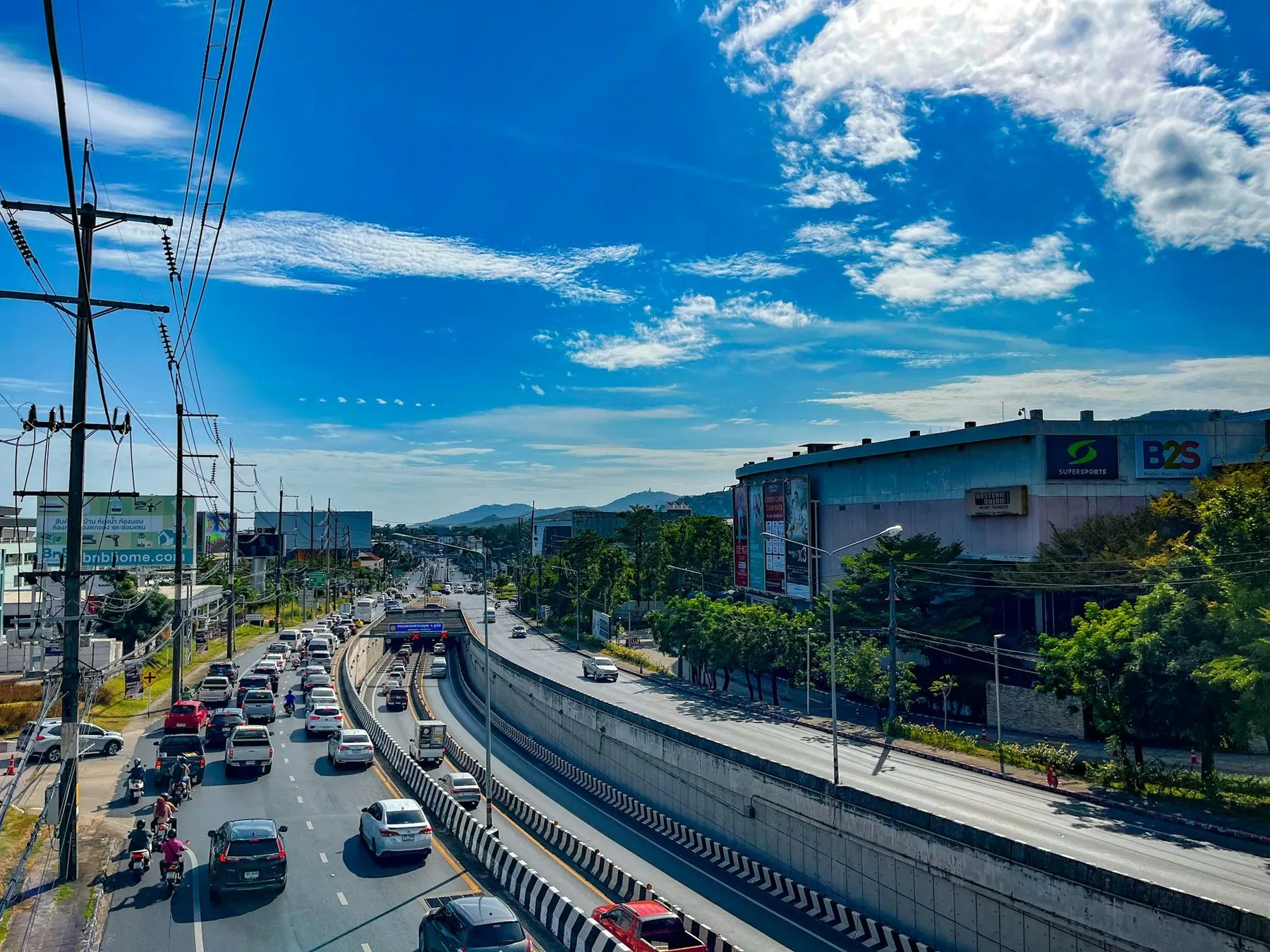
Phuket has spent the last two decades building grade-separated underpasses at its worst junctions, and they have helped. The ones you will meet are:
| Underpass | Where | What it fixes |
|---|---|---|
| Chalong | Chalong Circle, between Wiset Road and Chao Fa West | The island's busiest roundabout, on the route to Rawai and the pier |
| Darasamut | By Central Festival, outside Phuket Town | The retail and bypass junction |
| Samkong | North of Phuket Town on the 402 | The Kathu and Patong turn |
| Bang Khu | North of Phuket Town | Through traffic on the spine |
| Sanam Bin | By the airport | The airport approach |
The thing to understand about a Thai underpass junction is that the tunnel carries the straight-ahead movement and everything else happens on the surface roundabout or signals above it. If you need to turn, you must not be in the tunnel lane, and the decision point comes earlier than you expect. Get in the correct lane well before the ramp, and if you get it wrong, go through, turn round further on and come back — do not attempt anything at the last moment.
Chalong Circle deserves its own mention. It is where the roads from Phuket Town, Rawai, Kata and the pier converge, it is busy at all hours, and it has a reputation among residents as one of the island's difficult junctions even with the underpass in place. Approach it slowly and expect scooters on every side of you.
Traffic, and when
Phuket does not have a conventional commuter rush hour so much as a set of overlapping surges. Highway 402 loads in the late afternoon and evening. The airport road congests in waves as arrivals land. Patong Hill backs up in both peaks and authorities have at times asked drivers to avoid it at those hours entirely. Around Phuket Town the school run bites at the same times it does everywhere else in Thailand.
The rainy season, roughly May to October, changes the calculation. Surface water on the hill roads, poor visibility, and the standing water that collects at the foot of every descent all make the island harder. The rainy season and flooded roads covers the technique.
Parking
Parking is straightforward by Thai city standards. Central Festival, Central Phuket, Jungceylon in Patong and the big supermarkets all have proper car parks with motorbike areas. Most resorts have their own parking. In Patong itself, on-street space is scarce in the evening and the kerb rules are enforced — the colour code is the same nationwide and is explained in Thai road markings and kerb colours. In Phuket Town's old quarter the streets are narrow, several are one-way, and a car is more trouble than it is worth for an evening's wandering.
Scooters left overnight outside beach bars in Patong and Karon go missing more often than they do elsewhere in Thailand. Use the disc lock the shop supplies, park where there is light and an attendant, and photograph the machine and its surroundings when you leave it — the same discipline as what to photograph before you drive away.
Is driving in Phuket worth it?
For a car, usually yes. The island is 50 km long, the alternatives are expensive, and a car makes the difference between being trapped at one beach and seeing the place. For a motorbike, be honest with yourself. Phuket's combination of steep hills, heavy traffic and inexperienced riders produces a steady stream of injuries, and the common accident is not exotic — it is a first-time rider losing the back wheel on a gritty downhill bend. If you have not ridden before, this is not where to start; see the biggest risk factors for visiting drivers and, if you are renting anyway, renting a motorbike in Phuket.
The reward for having a vehicle is the mainland. Over the Sarasin Bridge and up Highway 4, Khao Lak is 90 minutes away and Khao Sok not much more — the drive north from Phuket is one of the better day trips in the south.
Is it safe to drive in Phuket?
In a car, yes, with normal care. The island's poor safety record is driven overwhelmingly by motorbike crashes, and disproportionately by visitors riding for the first time on steep, unfamiliar roads.
How steep is Patong Hill really?
Steep enough that heavy vehicles regularly suffer brake failure descending it, and steep enough that a small automatic scooter carrying two people will slow to walking pace going up. Treat it as a mountain road, not a town road.
How long does it take to get from the airport to Patong?
Around 40 minutes with clear roads, and comfortably over an hour when the airport road and Patong Hill are both busy. Allow more than the map suggests.
Do I need a car in Phuket?
If you are staying at one beach and not moving, no. If you want to see more than one part of the island, a car or a scooter is close to essential — the public alternatives are slow and the taxis are expensive.
What are the underpasses for?
They carry straight-ahead traffic beneath the island's busiest junctions. Choose your lane early: if you need to turn, you must stay on the surface, and the split comes sooner than you expect.
Can I take a hire car to Koh Yao or Phi Phi?
No. Those are passenger-ferry islands. Vehicle ferries in Thailand serve a small number of islands only, and rental contracts commonly forbid ferry crossings — see taking a car or motorbike on a Thai island ferry.