Only a handful of Thai islands take vehicles, and the process on those that do is refreshingly low-tech: you drive to the pier, buy a paper ticket at a kiosk, join a queue on the tarmac, and a man with a whistle waves you up a steel ramp. There is no online booking, no reservation system for cars on most routes, and no card machine. Bring cash and bring patience on a public holiday.
The bigger question is whether you should. Taking a vehicle to an island costs money, eats an hour or three at each end, and on many islands leaves you with a car you cannot park. And if the vehicle is a hire car, the answer may simply be no — most Thai rental agreements restrict or prohibit taking the vehicle off the mainland, and the ones that allow it want to know in advance.
- BookingAlmost never possible in advance; turn up and queue
- PaymentCash at the pier kiosk, per vehicle plus per passenger
- Main crossingsAo Thammachat–Koh Chang; Don Sak–Samui and Phangan; Ban Hua Hin–Koh Lanta Noi
- Hire carsRestricted or prohibited by most rental contracts
Which islands you can drive to
| Island | Crossing | Roughly | Vehicles |
|---|---|---|---|
| Phuket | Sarasin Bridge, Highway 402 | — | No boat at all |
| Koh Chang | Ao Thammachat – Ao Sapparot | 30–40 min | Cars and bikes |
| Koh Samui | Don Sak – Lipa Noi or Nathon | About 90 min | Cars and bikes |
| Koh Phangan | Don Sak – Thong Sala | Longer again | Cars and bikes |
| Koh Lanta | Ban Hua Hin – Koh Lanta Noi, then bridge | Minutes | Cars and bikes |
| Koh Tao, Phi Phi, Samet, Lipe | Passenger boats only | — | No vehicle service |
Phuket is the outlier: joined to Phang Nga province by the Sarasin Bridge, so you simply drive on. Koh Lanta is nearly there — the Siri Lanta Bridge has linked Lanta Yai to Lanta Noi since 2016, but Lanta Noi is still reached by a short vehicle ferry from the mainland at Ban Hua Hin, and a longer bridge to replace it has been talked about for years without arriving.
A few smaller islands, Koh Yao Yai among them, are served by landing-craft boats that will carry a vehicle when they are running. Services are infrequent and informal; confirm locally on the day rather than planning round them.
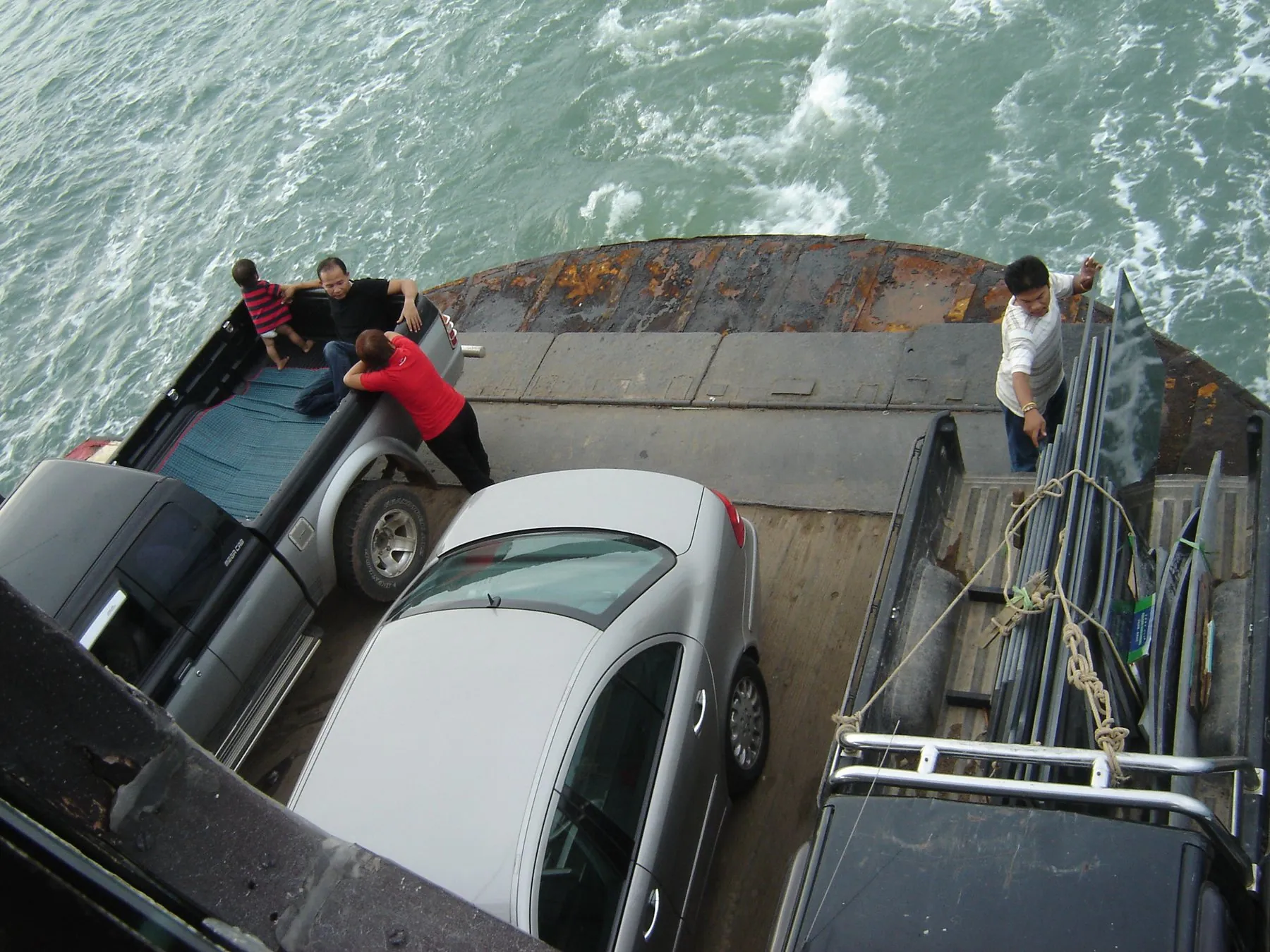
How a Thai vehicle ferry actually works
The routine is the same at every pier.
- Arrive early. Especially at weekends, on Thai public holidays and at the start of school breaks, when vehicle queues at the Koh Chang and Don Sak piers can run to an hour or more.
- Buy at the kiosk, not on the boat. There is a booth beside the approach road. You pay a vehicle fare based on size and a separate fare for each person, in cash. The vehicle ticket goes on the windscreen or is handed to the marshal.
- Join the vehicle lane. Motorbikes usually queue separately and are loaded first or last, depending on the boat.
- Follow the marshal exactly. Thai vehicle decks are packed to the centimetre. You will be waved into a space with about a hand's width either side and you are expected to take it.
- Handbrake on, in gear or in park, engine off. On the short crossings you can stay with the car; on the longer ones passengers go up to the deck, and you should take valuables and your phone with you.
Watch the ramp angle at low tide. The steel bow ramp on these ferries can be steep, and a low-slung car will ground its front bumper if you take it straight on. Approach at a slight angle and go slowly — the crew will wave you through it, and they do this a hundred times a day.
What it costs
Not much, and not enough to be the deciding factor. On the short Koh Chang crossing a car costs in the low hundreds of baht each way, a motorbike a small fraction of that, and each passenger a modest sum on top. The much longer Don Sak to Samui crossing costs several times more for a car. Fares are set by the operators, are revised from time to time, and are cash only at the pier.
What actually costs you is time. Budget an hour either side of a Samui crossing for queueing, loading and unloading, on top of the ninety minutes at sea.
Can you take a hire car?
This is the question that gets asked at the pier, by which point it is too late. The honest answer is that it depends entirely on the rental agreement, and that many Thai rental companies say no.
The reasons are not arbitrary. Insurance cover typically applies to the vehicle on public roads in Thailand, and a vehicle deck is neither. The rental company loses control of a vehicle that is now on an island, with a recovery problem if it breaks down. And the crossings have a history of damage claims — salt spray, scrapes from tight loading, and the ramp incidents described above.
Do not simply put a hire car on a ferry and hope. If the contract forbids it and something happens — damage on the deck, an accident on the island, a breakdown — you are outside the terms of your cover and paying for everything yourself. Get written permission before you book anything, and see taking a hire car on a ferry in Thailand for what to ask and how the firms differ.
Some companies do allow it, sometimes with a supplement or a specific insurance endorsement. Rental desks in Surat Thani, which exist largely to serve the island traffic, are the most likely to have a settled policy either way. The general position across the industry is covered in our renting section.
When to leave the vehicle behind
On most Thai islands, a car is a liability. Koh Samui has a ring road and enough traffic to justify one if you are staying in a villa up a hill; Koh Chang, with its steep west-coast road, is a reasonable case for four wheels. Almost everywhere else — Phangan, Lanta, Tao — the sensible move is to leave the car in secure parking at the mainland pier and hire a scooter on arrival, which is cheaper, easier to park and far less trouble if it gets scratched.
The island rental market has its own hazards, particularly around damage claims and deposits. Read renting a motorbike on Koh Samui, renting on Koh Chang and renting a scooter on Koh Tao before you hand over a passport as a deposit.
Weather and cancellations
Gulf crossings stop in bad weather. The northeast monsoon, roughly October to January, can suspend the Don Sak services for a day or more, and vehicles queue up on both sides waiting for the boats to run again. If you have a flight to catch off the back of a ferry, build in a spare day — see driving in southern Thailand for how the two monsoons work.
Frequently asked questions
Can you book a car onto a Thai ferry in advance?
Rarely. Vehicle space on the main crossings is sold at the pier on the day, cash, first come first served. Passenger-only tickets can be bought online for many routes, but that is a different product.
Which Thai islands can you drive to?
Phuket by bridge; Koh Chang, Koh Samui, Koh Phangan and Koh Lanta by vehicle ferry. Koh Tao, Koh Phi Phi, Koh Samet and Koh Lipe have no vehicle service — for Koh Lipe the drive ends at Pak Bara pier, and leaving the vehicle there is its own small problem.
Can I put a rented scooter on the ferry?
Physically, yes — bikes cross constantly. Contractually, the same restriction applies as to a car, and island rental shops generally want their bikes to stay on the island. Ask the shop, and get the answer in writing on the rental sheet.
Do I have to stay with my vehicle during the crossing?
No, and on the longer crossings you are usually asked not to. Take your valuables up to the passenger deck and leave the vehicle locked.
What happens if the ferry is cancelled?
You wait. There is no alternative route to an island, and no compensation scheme. This is the main practical argument for leaving the car on the mainland and travelling as a foot passenger.
Is there a car ferry to Koh Phi Phi or Koh Tao?
No. Both are served by passenger catamarans and speedboats only, and neither has a road network that would justify a car.