Phuket has more scooter rental shops per kilometre than almost anywhere in Thailand, and you will not struggle to find one. The clusters are along Rat-U-Thit 200 Pee Road and Nanai Road in Patong, the beach roads in Karon and Kata, the strip through Rawai and Chalong, and around the guesthouses in Phuket Town. Almost every hotel front desk will also arrange one, usually from an agency rather than from the hotel itself.
What the shop will ask for, what a deposit should look like and how damage claims work nationally are covered in our guide to renting a motorbike in Thailand — none of that changes on Phuket. What does change is the island's geography. Phuket is hilly, it has one congested north–south spine, and the single road linking Patong to the rest of the island is a steep, twisting climb that catches out new riders every week of the year.
- Typical daily rateRoughly 200–350 baht for a 125cc automatic in low season; 300–500 baht in high season and over New Year
- TerrainHilly. Steep climbs between every west-coast beach
- Best vehicle125–160cc automatic. Avoid the smallest 110s if you are riding two-up
- Hardest roadPatong Hill, between Kathu and Patong
Patong Hill is the road that matters
Patong sits in a bowl. The only major road connecting it to Kathu and the rest of the island climbs over the ridge on Route 4029 — Phra Baramee Road, universally called Patong Hill. It is a steep two-lane road with sharp bends, very little shoulder, and a constant stream of minibuses, tour coaches and delivery lorries grinding up and coasting down. The surface has been polished by that traffic and becomes genuinely slippery in rain. The provincial authorities have resurfaced sections of it specifically to reduce accidents, and the road has been closed outright in the past after landslip damage undermined its foundations.
If you are staying in Patong and you want to go anywhere else on the island, you are going over that hill. Ride it in daylight, in the dry, before you ride it at night in the wet. Use engine braking rather than riding the brake lever the whole way down — a small automatic's rear brake will fade if you drag it for two kilometres of descent. Our guide to mountain roads and hairpin bends covers the technique properly.
Do not learn to ride a scooter on Phuket. Several of the island's roads — Patong Hill, the climb south out of Karon, the road up to Karon Viewpoint and down to Nai Harn — are steep enough that a rider who has never used a twist-throttle before will get into trouble. If this is your first time on two wheels, the flat lanes around Rawai or Phuket Town are where to find out whether you can do it, not the hill.
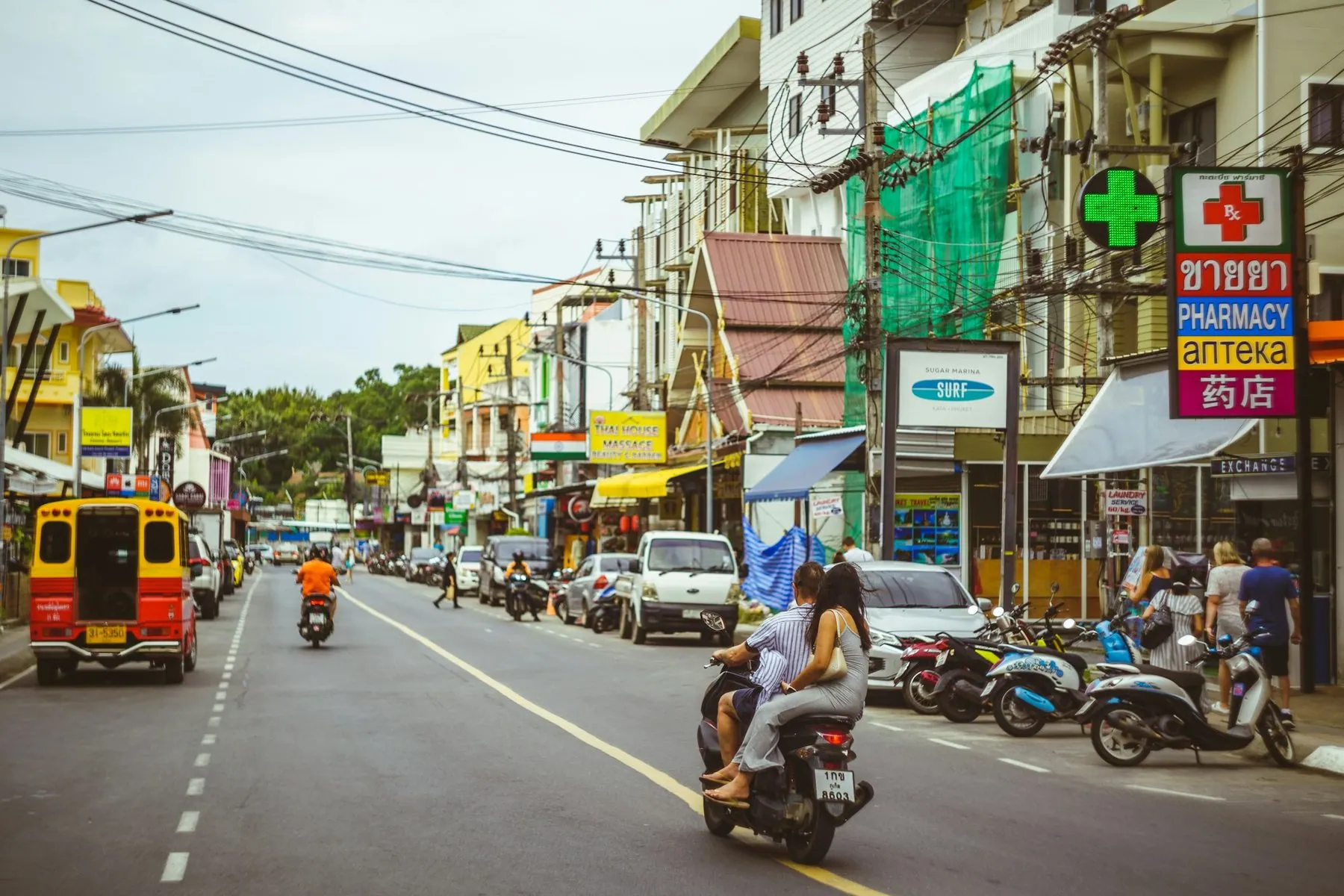
The rest of the island's roads
Phuket runs on Route 402, Thepkrasattri Road — the north–south spine from the Sarasin Bridge and the airport down to Phuket Town, and where the island's traffic concentrates. It is wide, fast and multi-lane with U-turn cuts, and the airport is about 45 minutes from Phuket Town in normal conditions. Riding a small scooter in its outside lanes alongside pickups and coaches is unpleasant; stay left, and read motorbikes, filtering and Thailand's left lane.
The west-coast beach roads — Patong to Karon to Kata, and the long run south to Nai Harn and Rawai — are the ones visitors actually ride. They are scenic, hilly, and patchy underfoot. Sand blown onto corners near beach access points is a recurring cause of low-speed falls; see sand and gravel on Thailand's coastal roads. In the wet season, roughly May to October, downpours arrive fast and hard: riding a motorbike in tropical rain. For the island's traffic generally, see driving in Phuket.
Checkpoints: what riders report
Phuket is one of the most heavily policed places in Thailand for two-wheelers, and roadside checks are a routine part of riding there. Travellers and local English-language media consistently report stops around Chalong Circle during the morning, on the bypass road, on approaches to Patong including the hill road, and near Bangla Road late at night. Enforcement operations targeting foreign riders are reported periodically — Patong police have publicised sweeps in which dozens of foreign riders were stopped in a single shift.
That is what is widely reported, not a statement of law. What the police can ask you for is set out in police checkpoints in Thailand. Before you ride, be clear on which licence you can use in Thailand and on Thailand's helmet law — the two things these stops most often turn on.
Wear the helmet on the hundred-metre trip too. The most commonly reported stops are not on open road but at junctions in Patong, Karon and Chalong, catching riders who nipped out to the 7-Eleven bare-headed. The shop helmet is usually poor — rental helmets in Thailand explains when to go and buy a better one, which on Phuket is a reasonable thing to do for a fortnight's stay.
Where to rent, and what it costs
Roughly speaking, Phuket has three tiers. Established shops with a physical premises, a printed contract and a fleet of newer bikes sit at the top; these are the ones to use. Beach-front stands and agency desks that fetch a bike from somewhere else are the middle; you are renting from a middleman and may not know who owns the machine. Hotel front desks vary enormously. Hotel desks or street shops explains how to tell which you are dealing with.
Phuket's prices swing more than most of Thailand. In the quiet months a 125cc automatic can be had for around 200–250 baht a day (roughly £5 / US$6); over Christmas and New Year the same bike in Patong may be quoted at double that, and the good shops sell out. Weekly and monthly rates fall away sharply — see scooter rental prices in Thailand and, for longer stays, monthly motorbike rental.
Phuket also has a real reputation for damage claims, particularly around Patong and the Kata–Karon beach roads. The defence takes three minutes: film the bike before you ride it (how), and never leave your passport as security (why).
Choosing the bike
On Phuket the engine size question is not academic. A 110cc step-through with two adults aboard will struggle on Patong Hill and on the climbs around Kata Noi, and a bike that is struggling uphill is also a bike that is unstable coming down. A 125cc automatic is the sensible minimum for one rider; 150–160cc if you are two-up. See choosing a rental scooter and riding two-up.
Frequently asked questions
Is Phuket a good place for a first-time scooter rider?
One of the harder places in Thailand to start: real hills, fast main roads, high traffic density. If you are determined to learn, do it on the flat quiet roads around Rawai first and stay off Patong Hill until you are comfortable.
Can I take a rented Phuket scooter to Phi Phi or Krabi?
Not to Phi Phi — no vehicle ferry, and effectively no roads. Krabi is reachable by road, but most Phuket agreements restrict the bike to the island. See taking a vehicle on a Thai island ferry.
What is the deposit on a Phuket scooter?
Most shops ask for either a cash deposit of a few thousand baht or your passport. Take the cash option, always. Rental deposits in Thailand explained sets out what each kind of security actually puts at risk.
How bad is Patong Hill really?
A steep, busy, twisting climb with poor sightlines and a polished surface — not exceptional by mountain-road standards, but harder than most visitors expect on a rented 125. The usual failures are overheated brakes on the descent and cutting a bend wide on the climb.
Are there police checkpoints on the way to the beaches?
Stops are widely reported around Chalong Circle, on the bypass and on the Patong approaches, more frequent in high season. See police checkpoints in Thailand.
What do I do if I drop the bike?
Photograph everything before you move it, then read what happens if you drop a rented scooter and, if anyone is hurt, accident in a rental car or scooter.