Hiring a scooter in Thailand is about as difficult as hiring a deckchair. In any tourist town there is a shop within two minutes' walk that will take a few hundred baht, hand you a key and a helmet, and let you ride away without asking a single question you would be asked at home. That ease is the whole problem. The commercial transaction and the legal entitlement to ride are completely decoupled in Thailand, and nobody at the counter has any reason to tell you so.
This page covers all of it: what a rental costs, what shops ask for, what your licence needs to say, what insurance is really on the machine, how deposits work, and what happens when a bike comes back marked. If you take one thing away, take this — whether you are entitled to ride is decided by what is written on your licence, not by what a shop was willing to hand over.
- Typical daily rateRoughly 150–350 baht for a 110–160cc automatic; higher on the islands and in high season
- What shops ask forOften a deposit and nothing else; sometimes a photo of a licence
- What the law asks forMotorcycle entitlement. A car licence does not cover a scooter
- HelmetCompulsory for rider and passenger; maximum fine 2,000 baht
What it costs
Scooter hire is cheap enough that price is rarely the deciding factor. A 110–125cc automatic — the Honda Click, Yamaha Mio, Honda Scoopy class of machine — typically runs somewhere between 150 and 300 baht a day (roughly £3.50–£7 / US$4.50–US$9) on the mainland, and 200–350 baht on the popular islands. A 150–160cc machine costs a little more. Rates soften markedly by the week, and a monthly deal is usually a fraction of thirty daily rates. All of these are typical figures, and they move with the season: the weeks around Christmas, New Year and Songkran are the dearest, and the wet months are the cheapest. Scooter rental prices in Thailand goes through the seasonal pattern properly.
Fuel barely registers — a small scooter will do a couple of hundred kilometres on a tank. The real costs of a rental in Thailand are the deposit you might not get back and the repair bill you might be handed.
A quote well below everyone else's is information, not a bargain. The shops that undercut the street rate most aggressively are, in the pattern travellers report over and over, the shops most likely to find damage on return.
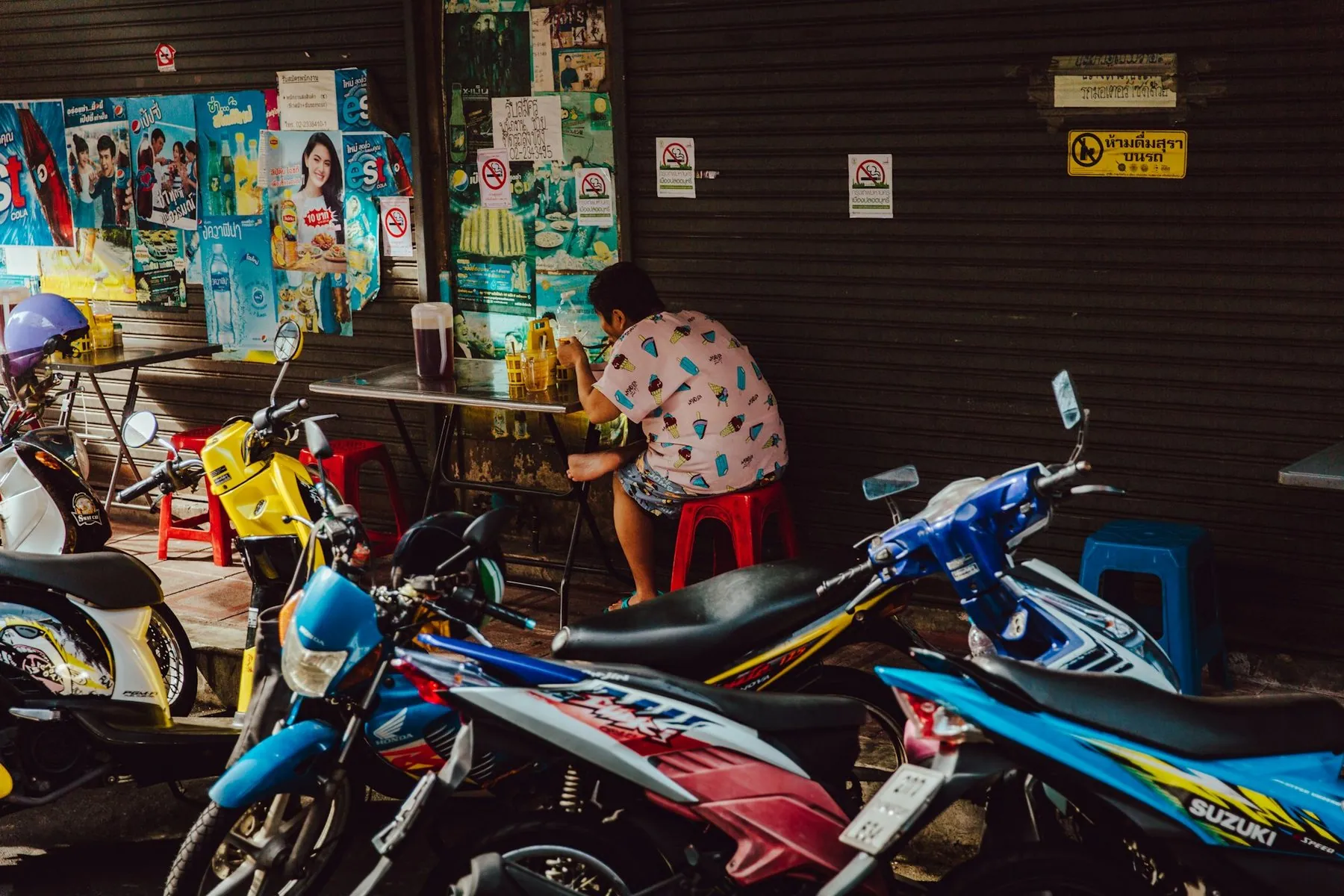
What the shop will ask for — and what it will not
Many Thai rental shops ask for very little: a deposit, a name, sometimes a phone number, often a photograph of a passport page taken on a phone. A minority — the larger operators, and almost always anyone renting a machine above 300cc — will genuinely look at your licence and refuse you if it is wrong.
You will also, at many shops, be asked to leave your passport as security. Do not. It is the single decision that determines how a dispute plays out later, and it has its own page: passport as deposit for motorbike hire in Thailand. Offer a cash deposit and a photocopy instead, and if the shop will not take that, walk to the next one.
What almost no shop does is verify that you are legally entitled to ride the thing. That is not an oversight; it is simply not their problem. The consequence falls on you, later, in an insurer's claims department.
The licence question, which is the one that matters
Thailand issues a private car licence and a private motorcycle licence as two separate documents. Holding one does not give you the other. That is the same structure most countries use, and it is the reason the familiar argument — "it is only a 110cc automatic, my car licence is fine" — does not work here.
What the treaties actually say
Thailand is a party to both the 1949 Geneva and the 1968 Vienna conventions on road traffic. Under both, motorcycles sit in category A, defined as "motor cycles with or without a sidecar, invalid carriages and three-wheeled motor vehicles with an unladen weight not exceeding 400 kg". There is no small-engine sub-category. Cars are category B. On top of that, Thailand lodged a declaration with the UN treaty depositary under Article 54(2) stating that, for the purposes of the Convention, it treats mopeds as motorcycles. There is no lighter tier to fall into.
So a driver whose licence covers cars only has category B and no category A. There is no category A to print on their international driving permit, and therefore no motorcycle entitlement for Thailand to recognise. Engine size does not change this. Automatic transmission does not change this. The shop handing over the key certainly does not change it. Which licence can I use in Thailand? works through it by document type, and the Thai motorbike licence and engine sizes covers the Thai side.
The permit itself is a second question, and the answer depends on your nationality rather than on Thailand. Thailand is bound by the 1968 Convention towards British, German, Nordic, Dutch and French drivers, and by the 1949 Convention towards American, Australian, Irish, Canadian, New Zealand and Japanese ones — so the correct booklet is not the same for everyone, and your own country can only issue the type it is a party to. Do not let anyone tell you there is one universal IDP. The international driving permit for Thailand explains which one you need and where to get it, and it must be got before you travel.
The chain that actually costs you money
Follow it through in order, because each link is boring on its own and the sequence is not.
- Entitlement. Your home licence either covers motorcycles or it does not. This is a fact about a plastic card, not an opinion.
- The permit. An IDP is a certified translation of that entitlement. It cannot create one — it "shall be issued only to the holder of a domestic permit", in the Convention's own words. If there is no category A on the licence, there is none on the permit.
- Cover. Travel policies condition motorcycle cover on holding the right licence. One Australian insurer whose wording we have read requires the rider to hold a home licence valid for the class and "a licence valid for the country that you are riding in", and adds the words "regardless of the local laws" — meaning the insurer applies its own test even if no Thai officer ever stopped you. Policies differ, and you have to read your own motorcycle clause.
- The claim. This is where it surfaces. Nobody checks any of the above until you are in a hospital with a broken collarbone and a bill, and then somebody checks all of it at once.
The UK government puts it plainly: "If you drive a car or ride a motorcycle in Thailand without a valid licence, it could invalidate your travel insurance and you'll be unable to claim if you have an accident or injury." A serious motorcycle injury in Thailand means a private hospital and, often, an air ambulance home. The fine is trivial. The uncovered bill is not. See what voids your motorbike cover in Thailand.
There is a second, quieter consequence. Thailand's lower blood-alcohol limit of 0.02% applies not only to under-20s and provisional licence holders but to anyone driving a category of vehicle their licence does not cover, and to anyone with no licence at all. Ride a scooter on a car-only licence and you are on an effectively zero-tolerance limit, whatever your age. Thailand's drink-driving limits has the detail.
If your licence does not cover motorcycles and you are going to ride anyway, read renting a motorbike without a licence in Thailand before you do, so at least you know what you are choosing.
What insurance is actually on a rented scooter
Start from the assumption that there is very little, and make the shop prove otherwise in writing.
Every registered vehicle in Thailand should carry compulsory third-party cover, Por Ror Bor. It attaches to the vehicle rather than the driver, and it covers people, not property — it will not repair anybody's bike, including the one you are sitting on. The figures are modest: preliminary medical payments of up to 30,000 baht per person without waiting for fault to be established, and up to 80,000 baht of medical expenses once liability is settled. A head injury treated at a private hospital in Phuket can pass 80,000 baht in a day. Por Ror Bor explained sets out the full schedule.
Voluntary cover is the part that would repair a vehicle, and it comes in classes. Only Class 1 covers a single-vehicle accident — the low-side on gravel, the wet corner, the sandy bend — which is exactly the crash a visiting rider is most likely to have. The "plus" classes cover your own machine only when another identified vehicle is involved. A hire scooter is very rarely on Class 1, and we could not obtain rental operators' terms we would rely on, so this site will not tell you what your shop's cover includes. Ask, and ask for it on paper. Thai insurance classes 1, 2+, 3+ and 3 explains each one.
One more thing the UK government flags and almost nobody mentions: "Motorcycles and scooters for hire in tourist areas are often unregistered and cannot be used legally on a public road." A machine that cannot legally be on the road cannot be legally ridden by anyone, whatever your licence says — a solid reason to prefer a shop with real premises over a table on the pavement.
Deposits, and how the money is held
Thai scooter shops secure the machine in one of three ways: a cash deposit, a card hold, or your passport. Cash is the normal and sensible one — typically a few thousand baht, returned when the bike comes back.
The reason to refuse the passport is structural rather than moral. A shop holding cash can only argue about the cash. A shop holding your passport controls whether you get on a boat, a plane or a bus, and every disputed damage claim in the traveller literature turns on that leverage. Rental deposits in Thailand explained compares the three, and rental insurance excess in Thailand covers what you can be liable for on top.
The handover: five minutes that decide everything
Almost every rental argument in Thailand is an argument about whether a mark was already there. The way you win that argument is to have filmed it, out loud, before you rode away.
- Film a slow, narrated walk-round in daylight, naming each existing scratch. How to film the inspection video gives the order.
- Photograph the odometer, the fuel gauge, the underside of the plastics and both wheel rims.
- Test both brakes rolling, at walking pace, before you leave. Check the tyres for tread and cracking.
- Read the agreement for what happens on damage or theft, and what it says about unsurfaced routes.
- Photograph the agreement, and the shop's frontage so the location and time are obvious.
- Confirm what is included: helmet, second helmet, lock, and who pays for a puncture.
Our printable rental handover checklist covers the same ground in a form you can hold in one hand, and what to photograph before you drive away lists the exact shot set.
Helmets
Thai law requires a helmet for the rider and for the passenger, and a rider commits a separate offence by carrying an unhelmeted passenger. The maximum fine has been 2,000 baht since September 2022, and helmets are on the Royal Thai Police list of offences singled out for strict enforcement from April 2026. See Thailand's helmet law.
What the shop gives you is a different question. The standard rental helmet is a thin open-face shell with a perished strap, frequently the wrong size. It satisfies a checkpoint; whether it protects a face at 40 km/h is another matter, and buying your own for a few hundred baht is one of the cheapest upgrades available to a visitor. Rental helmets in Thailand covers how to judge the one you are handed; choosing a helmet that actually protects you covers what to buy.
Which machine, and where not to take it
For most visitors a 125cc automatic is right: light enough to manage, quick enough for town, capable of most island roads with one rider. A 150–160cc is worth the extra if you are two-up, carrying luggage, or heading anywhere with real gradients. Choosing a rental scooter works through the sizes; riding two-up explains what a passenger changes.
Two hard limits. Motorcycles are banned from Thailand's motorways and expressways at every engine size, with a fine of up to 1,000 baht. And on ordinary multi-lane roads the Act puts motorcycles in the leftmost lane — a rule that is universally ignored and still the one an officer can quote at you. Motorbikes, filtering and Thailand's left lane has both.
Still deciding between two wheels and four? Our scooter or car tool asks the questions that decide it, and is it safe to drive in Thailand? gives the honest risk picture.
When something goes wrong
Most rental incidents are not crashes. They are low-speed drops on gravel, in sand, or in a wet car park, and the damage is plastics, a mirror, a lever and some paint. What happens if you drop a rented scooter sets out the sequence and what the parts genuinely cost. If the shop's number is much larger than that, motorbike rental damage claims in Thailand explains how a claim escalates, and the rental damage claim playbook is the step-by-step response.
If there is another vehicle, an injury, or any suggestion of police involvement, this stops being a rental question. Go to accident in a rental car or scooter in Thailand, and remember that the tourist police hotline on 1155 gets you an English-speaking officer.
Renting for a month or longer
Staying more than a couple of weeks? Ask for a monthly rate. The difference is large and the contract terms tend to be more explicit about servicing and repairs — see monthly motorbike rental in Thailand. Beyond about six months, buying and reselling starts to compete on cost: buy or rent long-term in Thailand?
Frequently asked questions
Can I rent a scooter in Thailand with just a car licence?
A shop will very often let you, but that is a commercial decision, not a legal one. A car licence carries category B, not the category A that motorcycles sit in, and Thailand has declared that it treats mopeds as motorcycles — so there is no small-engine exemption to fall back on. The exposure is at the insurance claim, not the counter.
Do I need an international driving permit to hire a motorbike?
Shops rarely ask. The reason to carry one is that it is a certified translation of your entitlement, it removes an argument at a checkpoint, and it answers the "a licence valid for the country you are riding in" wording that appears in motorcycle travel-insurance clauses. Which booklet you need depends on your nationality — see the IDP guide — and you must get it before you travel.
What should I pay per day?
Typically 150–300 baht for a 110–125cc automatic on the mainland, 200–350 baht on the busy islands, more in the peak weeks and less by the week or month. Treat a much lower quote as a reason to look harder at the shop rather than as a saving.
Is the rented bike insured?
Assume only the compulsory Por Ror Bor cover, which pays for injured people and never for vehicle damage. Anything more has to be shown to you in writing. Damage to the machine you are riding is, in almost every Thai scooter rental, yours.
Should I let the shop keep my passport?
No. Offer a cash deposit and a photocopy. Plenty of shops accept that, and several advertise a no-passport policy. A shop holding your passport holds the outcome of any argument that follows.
What happens if I drop the bike?
Usually a bill for plastics, a mirror, a lever and paint. Photograph the damage where it happened, before you move the bike, and again at the shop. Do not agree a figure standing at the counter with a ferry to catch.
Can two of us ride on one scooter?
Legally a pillion is allowed where the vehicle's registration permits it, and both of you must wear helmets. Practically, a 125 with two adults and a rucksack brakes and climbs very differently — riding two-up on a rented scooter covers what changes, including the passenger's own insurance position.