The helmet handed over with a rental scooter in Thailand is usually the cheapest object in the shop: an open-face shell with a thin liner, sun-baked, worn by hundreds of previous customers, and often two sizes wrong. It will satisfy a police officer at a checkpoint. That is what it is for, and it is not the same job as protecting your skull.
A helmet that actually works costs roughly ฿1,500–4,000 in Thailand — about £35–90 / US$45–115 / €40–100 — and takes twenty minutes to buy. This page is about protection: how a helmet works, what to check physically, and what to buy here. The law is Thailand's helmet law, and we do not repeat the penalties.
- Decent full-face, bought hereAbout ฿1,500–4,000
- Market or petrol-station lidOften under ฿500 — avoid
- The part that does the workThe thick polystyrene liner
- Correct fitSnug enough to move your scalp
How a helmet actually works
A helmet has two protective layers. The outer shell — moulded thermoplastic, or fibreglass and composites on better lids — spreads impact force and stops sharp objects penetrating. It is not the safety component people assume. The inner liner, the thick layer of dense expanded polystyrene between shell and comfort padding, is what saves you: it crushes on impact, and by crushing it slows your head over a few extra milliseconds. That is the whole mechanism.
Three consequences follow immediately.
- A thin liner is a thin helmet. The novelty lids sold at markets and petrol stations — the ones shaped like a bicycle helmet or a hard hat — have almost no crushable material in them.
- A helmet is single-use. Once the liner has crushed it does not come back, even if the shell looks fine. That is why a rental helmet with an unknown history is a gamble.
- It has to stay on your head. A crushable liner is irrelevant if the helmet leaves at first contact. Fit and retention are not comfort issues.
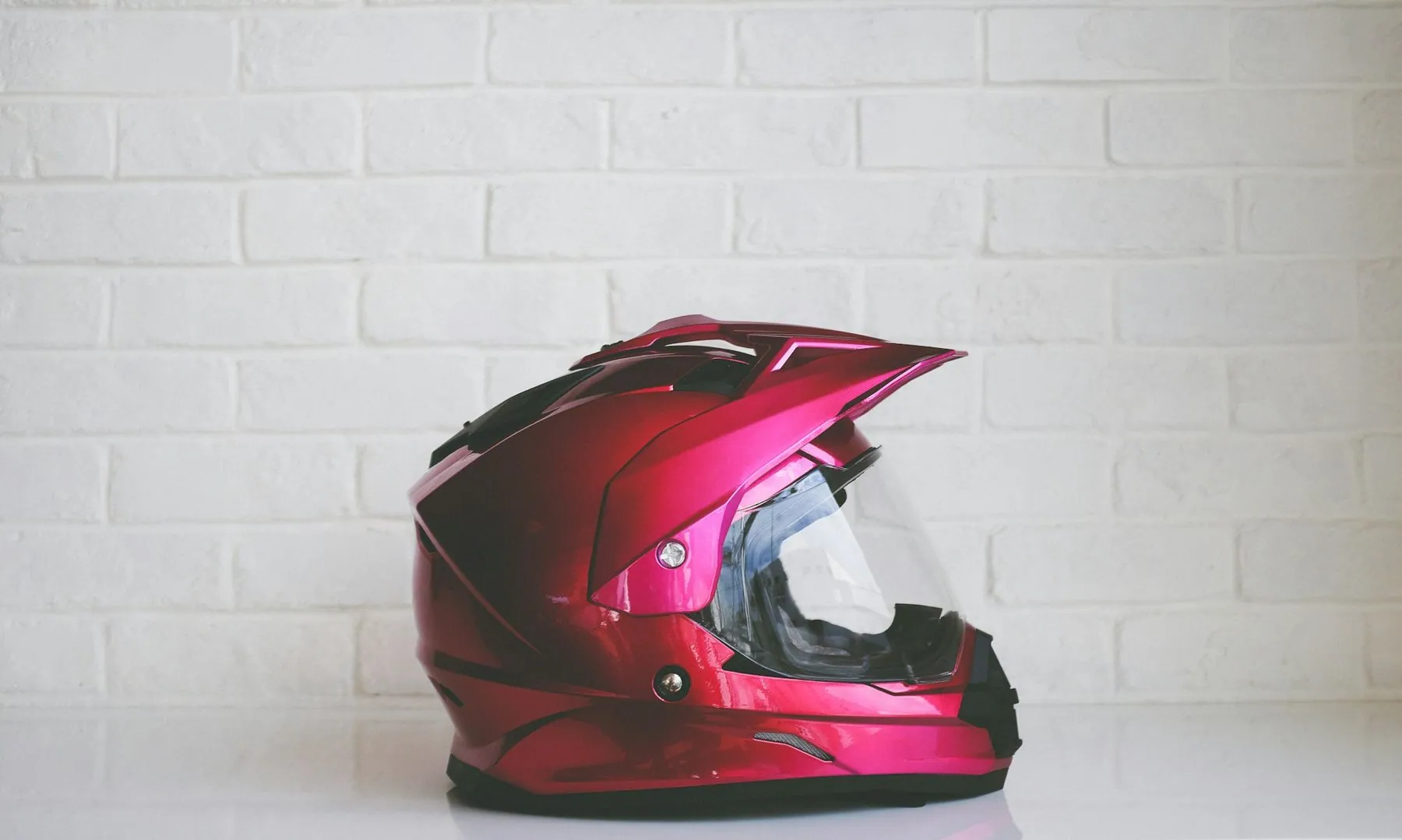
Standards markings, honestly
Thai law does set a helmet specification, prescribed by ministerial regulation. We could not retrieve the current regulation, so we are not going to summarise what the Thai standard requires in test terms. Thailand's standards body is the Thai Industrial Standards Institute, whose mark appears as TIS or, in Thai, มอก. — the same body referenced in the rules on child restraints. On helmets sold here you may also see European, American or Japanese approval labels, sewn to the chinstrap or moulded into the back of the shell.
Rather than claim a precision we cannot source: an approval label of any recognised kind means a manufacturer submitted the design to somebody; its absence means nobody did. A helmet with no marking, no manufacturer name, no size label and no date stamp is not a serious product. But do not buy on the sticker alone — marks are counterfeited, and a genuine mark on a badly fitting helmet does not help you. The physical checks below are more reliable, and take five minutes in the shop.
The physical checks, in order
Full-face, or at least a proper visor
A large share of motorcycle impacts land on the chin bar area, which is exactly what an open-face helmet does not have. The counter-argument is heat, and it is real — a full-face standing still in Bangkok traffic at 35 degrees is genuinely unpleasant. The compromise most riders here settle on is a well-ventilated full-face or a modular, visor cracked open in slow traffic. If you will not wear one, an open-face with a visor still beats the visorless style the rental shops hand out, because grit, rain and insects in your eyes matter more here than most places. What you should not buy is a half-shell because it is cooler. It protects almost nothing.
Squeeze the liner
Push a thumb hard into the inside, past the soft padding. You should feel a thick, firm, unyielding layer underneath. If your thumb sinks all the way to the shell, the helmet is decoration.
Check the retention system
A double-D ring — two metal loops you thread the strap through — is the most secure and is what better helmets use. A micrometric ratchet, a toothed tongue clicking into a buckle, is quick and perfectly acceptable. The cheap seatbelt-style buckle with a sliding adjuster is the one to be suspicious of, because the adjuster slips and riders leave it slack. Whatever the type, you should be able to slide no more than a finger or two between the strap and your jaw.
Fit: the two tests that matter
- The scalp test. Helmet on, strap done up, hands either side, try to rotate it. Your scalp should move with the helmet — you should feel the skin of your forehead shift. If it turns freely on your head, it is too big.
- The roll-off test. Strap fastened, grab the back and try to roll it forwards off your head, then backwards. If it comes off, or exposes your forehead, it is the wrong helmet — and that is exactly what happens in a crash.
- Cheek pads should be tight at first. Pads compress with use; a helmet that is comfortable on day one is often loose by week three.
- Wear it for five minutes in the shop. A hot spot on the forehead means the shell shape is wrong for your head, and no amount of padding fixes it — try another make in the same size rather than going up one.
Age and condition
Manufacturers commonly recommend replacement after about five years, and the tropics are hard on helmets: UV, sweat, heat and humidity degrade liner and strap webbing faster than a temperate climate does. Most helmets carry a date of manufacture inside the shell or under the lining. On a used or rental lid, look for a crumbling or yellowed liner, stiff shiny strap webbing, a visor scratched enough to starburst in oncoming headlights, and any crack or deep gouge.
The rental helmet: what it is and is not
A rental helmet is a legal-compliance item supplied free with the bike. It has typically been worn by a great many people, stored outdoors, dropped repeatedly, and never checked for fit against the person wearing it. Its impact history is unknown and unknowable.
That does not make every one worthless. Some larger operators in Phuket and Chiang Mai keep decent stock and will find you a size — ask for the best they have, do the scalp and roll-off tests in the shop, and reject anything that spins on your head. Rental helmets in Thailand covers what shops stock. If you are travelling with someone, the shop will often supply only one by default, and the second helmet is a separate duty on the rider.
Buying your own in Thailand
| Price band | What you get | Verdict |
|---|---|---|
| Under ฿500 | Market and petrol-station lids: half shells, novelty shapes, minimal liner | Avoid. This is where the rental helmet comes from |
| ฿700–1,500 | Basic Thai-brand open-face with a visor, or a very basic full-face | A real step up. Fine for short island trips if it fits |
| ฿1,500–4,000 | Thai and Asian-brand full-face and modular helmets, proper liner, decent venting, replaceable pads | The sweet spot. Buy here for a two-week trip |
| ฿5,000 and up | Imported European and Japanese brands, composite shells, better venting and optics | Worth it if you ride often or live here |
Buy from a motorcycle shop rather than a market stall, try several on, and take the fit tests seriously. A shop that lets you wear a helmet for five minutes and swaps sizes without complaint is the one to buy from. Bringing one from home is perfectly reasonable and the fit will be better — just bring a clear visor as well, because a dark tint bought for a European summer is too dark for a tropical dusk and useless if rain keeps you out after dark.
Do not buy a second-hand helmet. You cannot see whether the liner has already been crushed, and the seller may not know either. A ฿400 used helmet with an impact in its history is the same as no helmet, and looks identical to one that is fine.
Frequently asked questions
Is the free rental helmet legal?
It will normally satisfy a helmet check, which is what it is there for. Whether it meets the specification set by ministerial regulation is a different question and not one you can answer in a rental shop. The legal position is Thailand's helmet law; the protection position is that fit and liner thickness matter more than the sticker.
Full-face or open-face in this heat?
Full-face if you can tolerate it — the chin bar covers an area that takes a large share of impacts. The realistic compromise is a well-vented full-face or a modular with the visor open in slow traffic. A half-shell is not a compromise, it is a much lower level of protection.
How tight should the strap be?
Tight enough that you can fit no more than a finger or two between the strap and your jaw. If you can open your mouth wide without feeling it tighten, it is too loose. A slack strap is the commonest failure on Thai roads and it is invisible until the helmet comes off.
Does a helmet make any difference at 30 km/h?
Yes, substantially. A head striking tarmac from riding height at low speed is more than enough for a serious injury, and Thai crash data consistently records most crashes on straight roads at ordinary speeds. The short, slow trip is the one people ride bare-headed.
Will my travel insurer care whether I wore one?
Very likely. Most policies condition motorcycle cover on complying with local law, and riding without a helmet breaches it — see what voids your motorbike cover in Thailand.
Do children need their own helmets?
Yes, and adult helmets do not work on children — an oversized helmet rotates, obscures vision and adds mass to a small neck. Correctly sized children's helmets need buying. Children on motorbikes in Thailand deals with the whole question.