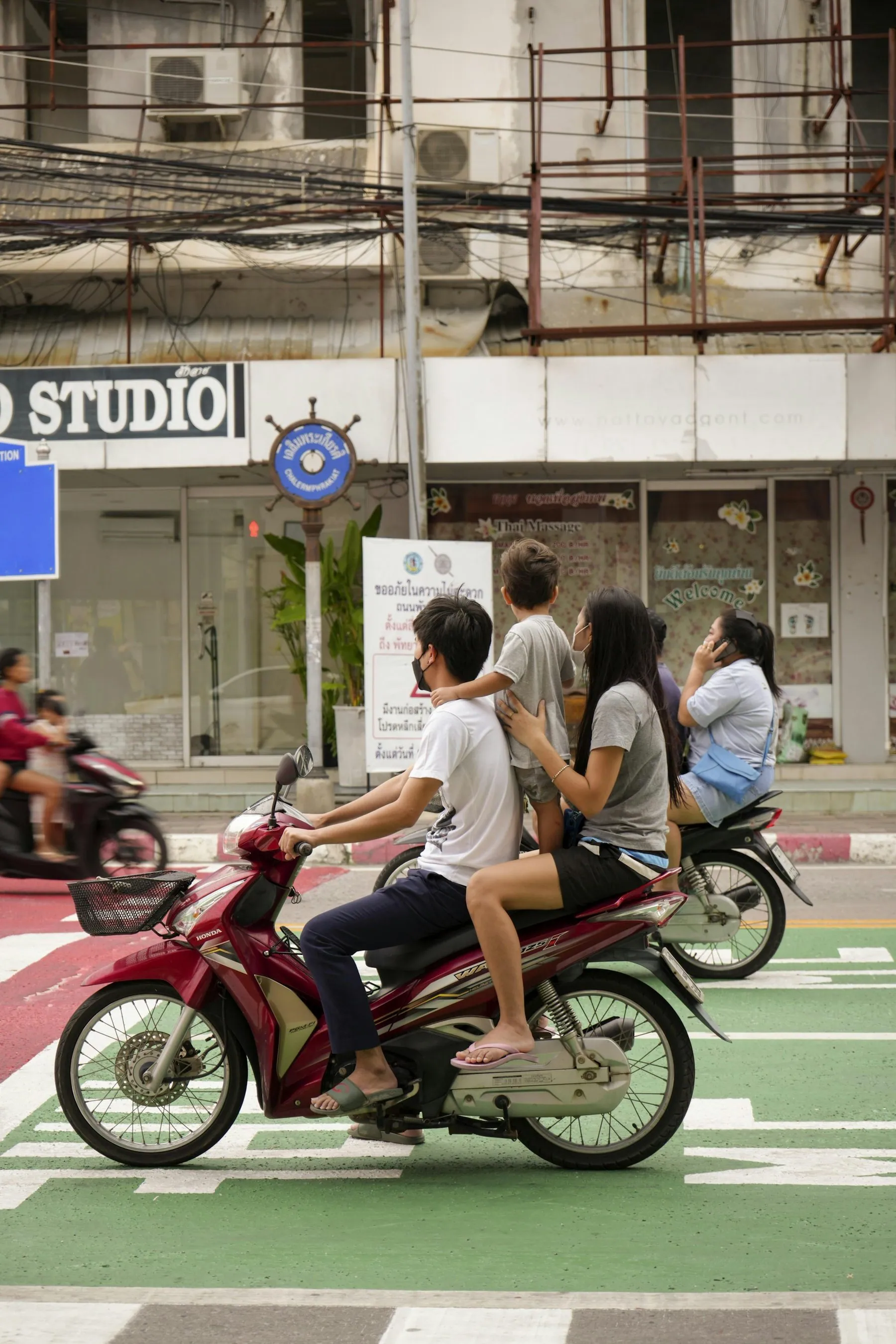
You will see it within an hour of landing: a family of four on a 110cc scooter, a toddler standing on the footboard between the rider's knees, an older child asleep against a parent's back, nobody in a helmet. It is normal, it is how a large part of Thailand gets to school and work, and it is not a model to copy on a two-week holiday. Thai law requires a helmet for every person on a motorcycle, and Thai families riding without them are breaking the same rule you would be.
The honest summary is short. Carrying a child on a scooter here is legal if they are helmeted and seated properly on the pillion; it is not safe in the way a car is safe; and the practical difficulty for a visitor is equipment rather than law, because rental shops do not stock helmets that fit children and an adult helmet on a child is close to useless.
- HelmetRequired for every person on the bike, at any age
- Where a passenger sitsBehind the rider, on the pillion seat
- Child helmets in rental shopsRarely stocked — buy one
- Motorcyclists' share of Thai road deaths, 202183.8% (WHO)
What the law actually says
Two provisions matter, and neither carries a children's exception.
The helmet requirement applies to both the rider and the passenger, and it makes the rider separately responsible for carrying an unhelmeted passenger. The only exemptions written into it are for monks, novices and other religious adherents wearing a traditional turban, plus anyone prescribed by ministerial regulation. There is no age below which a passenger stops needing a helmet. Thailand's helmet law covers the penalties, which we do not restate here.
The seating rule is the second. A motorcycle passenger must sit behind the rider, on the pillion seat or in a sidecar, and may be carried at all only if the vehicle's registration permits it. A child standing on the footboard in front of the rider — the commonest arrangement you will see here — does not comply with that.
Do not confuse this with the car rule. Thailand's child-restraint requirement, which brings in child seats for under-sixes and applies to private cars, pick-ups and minivans, became operative on 17 August 2023 after being announced in 2022 and then deferred. It has nothing to do with motorcycles. The detail, including which vehicles are exempt, is in child car seats in Thailand.
Why local practice is not a guide
A Thai family riding three-up to a school two kilometres away, on roads they have used daily for years, at 30 km/h, is making a rational decision inside constraints most visitors do not have — for many of them the alternative is not a car, it is not going. A visitor doing the same thing is on an unfamiliar machine, on unfamiliar roads, often on an island with steep descents, frequently having never ridden before, and the alternative genuinely is a taxi costing a few hundred baht. The two situations look identical and are not.
The background number is worth holding onto: WHO records that 83.8% of Thailand's road deaths in 2021 were motorcyclists. That statistic is what the whole of Thailand's road death statistics comes down to, and it applies to your children as much as to you.
If you are going to do it anyway
Plenty of families ride short distances on a scooter in Thailand and get on with their holiday. If that is you, these are the things that make a material difference.
- A helmet that fits the child. Not negotiable, and the hardest item to arrange. Buy a properly sized children's helmet from a motorcycle shop and do the same fit checks you would for your own — see choosing a helmet that actually protects you for the scalp and roll-off tests.
- Can they hold on for the whole journey? The real test is not size but whether the child can keep their feet on the pegs, hold on unaided and stay alert for the entire ride. A child who cannot reach the footpegs is one whose legs swing into a moving rear wheel or a hot exhaust.
- One child, on the pillion, behind you. Not on the footboard, not in front, not two.
- Covered legs and closed shoes. The exhaust sits at calf height on the right and gets hot enough to cause a deep burn in a second. Children collect these constantly — road rash and exhaust burns explains why they are worse than they look.
- Short, slow, familiar routes only. The beach and back. Not a day trip, not the hill road, not after dark.
- Brief them first. Feet stay on the pegs. Hold on here. Lean with me. Do not get off until I say.
The exhaust burn is the injury you should expect. A child's leg swinging against a scooter's exhaust while parked or pulling away produces a deep burn on the calf or ankle in about a second, and in this climate those wounds infect readily. It is the commonest scooter injury to a child in Thailand by a wide margin and it happens at walking pace.
Why an adult helmet on a child is worse than it looks
A helmet protects by staying in position and crushing on impact. An oversized one does neither: it rotates, so the impact lands where the shell was not designed to take it, or it turns and the child cannot see. It comes off in a fall. And a heavy adult helmet on a small neck adds leverage in exactly the wrong place. A child in an adult helmet is not "partly protected" — the protection is largely notional, and the sense of having solved the problem is the dangerous part.
Children's helmets are sold in Thai motorcycle shops and larger department stores, from a few hundred baht for something basic up to ฿2,000 or so — roughly £45 / US$58 / €50 — for a decent full-face. If you are riding with a child more than once, buy one on day one.
The alternatives, which are cheaper than you think
The reason this article is not a lecture is that Thailand makes the alternative genuinely easy. Grab and metered taxis run in Bangkok, Chiang Mai, Phuket and most tourist towns for a fraction of what the same journey costs in Europe or Australia; songthaews cover the islands and the northern towns for a few tens of baht a head; and if you are travelling as a family, a hire car for the whole trip often works out cheaper than two scooters plus taxis and removes the question entirely. Scooter or car? works through the trade-off for a specific trip.
One practical warning about taxis with children: taxis and public vans are exempt from Thailand's child-restraint rules, airport taxis do not carry child seats, and a hire car can usually supply one but it must be booked in advance and is often a poor example. That is not a reason to put a small child on a scooter; it is a reason to book the seat early.
Teenagers riding themselves
A simpler question. Thailand's minimum age for a motorcycle licence is 15 on a restricted basis, with full entitlement at 18. A visiting teenager without motorcycle entitlement at home holds nothing Thailand recognises, and a rental shop handing a scooter to a 16-year-old does not change that. The consequence is not mainly the fine: a rider with no valid entitlement sits on Thailand's 0.02% blood-alcohol limit regardless of age, and a family travel policy will almost certainly decline a claim for an unlicensed rider — see riding without a licence in Thailand.
Frequently asked questions
Is it illegal to carry a child on a motorbike in Thailand?
No, provided the child wears a helmet and sits behind you on the pillion seat, and the bike is registered to carry a passenger. What is not compliant is a child standing on the footboard in front of the rider, or anyone on the bike without a helmet — the helmet requirement applies to passengers at any age.
Will the rental shop give me a child's helmet?
Usually not. Rental stock is adult sizes, often only one helmet per bike, and a child-sized one is unusual. Ask, but plan to buy.
Everyone here rides with their kids. Why shouldn't I?
Because you are doing a different thing that looks the same. Thai families ride short, familiar, low-speed routes on machines they know, and for many the alternative is not travelling. A visitor is on an unfamiliar bike, on unfamiliar roads, often riding for the first time, with a cheap taxi available. The risk is not the same and neither is the choice.
What about a child seat or a harness for a scooter?
You will see both in Thailand. We have found no Thai standard covering either and no independent testing to point to. A harness stops a sleeping child falling off, which is a real problem on longer rides; it does nothing about the crash itself. Treat them as convenience items, not safety equipment.
Can my child ride pillion with me on a hired bike?
Check the rental agreement — some restrict who may be carried, and riding outside the agreement can affect any damage claim. The bigger question is your travel insurance, which may condition a passenger's own cover on the licence held by whoever is riding. Carrying a passenger on a scooter covers how a pillion changes the way the bike behaves.
What do I do about an exhaust burn?
Cool it under running water for a good twenty minutes, cover it loosely with something clean and non-fluffy, and do not apply ice, butter or toothpaste. Any burn on a child that blisters, is larger than the palm of their hand, or is on a joint should be seen at a hospital the same day — burns in this climate infect quickly and heal badly if they are not cleaned properly.