Thailand requires a child under six travelling in a car to be in a child seat or a suitable specialised seat, and requires any passenger under 135 cm tall to wear a seatbelt or use a specialised seat. The requirement is part of the 2022 amendment to section 123 of the Land Traffic Act, and the maximum fine is 2,000 baht.
The date matters more than usual here, because most sources get it wrong. The rule was announced for 5 September 2022, publicly deferred, and then became operative on 17 August 2023. And there is a large exemption that shapes the whole subject for a visiting family: public vehicles, including buses and public vans, are outside the rule entirely. The most common way a family travels from a Thai airport to a hotel is not covered by it.
- Child seat requiredChildren under 6
- Belt or specialised seatAny passenger under 135 cm
- In force from17 August 2023
- Vehicles coveredPrivate cars, pick-ups and minivans
- Maximum fine2,000 baht
What the rule requires
Two limbs, which are easy to conflate and should not be:
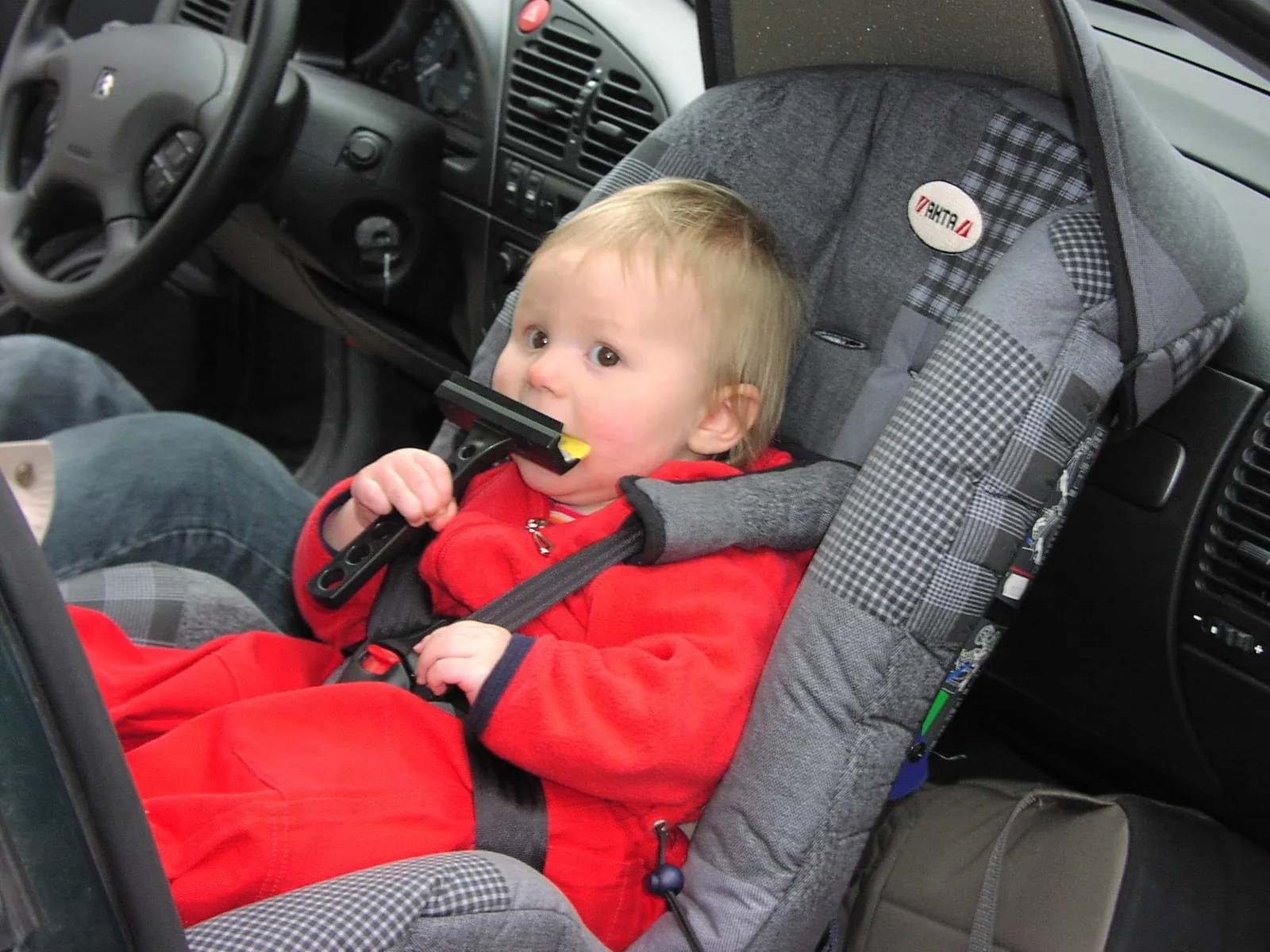
Under six. A child under six travelling in a covered vehicle must be in a child seat or a suitable specialised seat — a booster, in ordinary language. The seat must meet the standard of the Thai Industrial Standards Institute.
Under 135 cm. A passenger below that height must wear a seatbelt or use a specialised seat. This limb is about height rather than age, and it catches older children who have outgrown a child seat but not the adult belt geometry.
The concession where no child seat is fitted
Where the vehicle has no child seat, the reported rule is that the child must sit in the rear seat — in a pick-up, in the front passenger seat, and never in the load bed — must be restrained by the belt across the lap, and the vehicle must keep to the leftmost lane and travel at reduced speed. It is a fallback, not an alternative to be chosen.
The three dates, and which one is right
This is the rule most often reported wrongly, because it was legislated, then deferred, then quietly commenced.
| Date | What happened |
|---|---|
| May 2022 | Land Traffic Act (No. 13) B.E. 2565 published in the Royal Gazette |
| 5 September 2022 | The Act came into force — but the child-restraint requirement was deferred, because the police had not defined what alternative restraint equipment counted and the Department of Land Transport had not defined which vehicles were covered |
| 17 August 2023 | The seatbelt and child-restraint changes to section 123 became operative |
If you see 5 September 2022 given as the date child seats became compulsory in Thailand, that is the date they were supposed to become compulsory. Enforcement was pushed back at the time, with police saying it might not begin until December and the deadline being extendable by a further 90 days. The date it began to bite is 17 August 2023.
Enforcement is the weakest of any rule on this site
Two things make this requirement unusually soft in practice, and we would rather say so than pretend otherwise.
First, the exemption. Public vehicles, including buses and public vans, are outside the rule. Airport taxis do not carry child seats, are not required to, and will not have one waiting because you asked at the rank. A family arriving at Suvarnabhumi or Phuket with a toddler and taking a metered taxi to their hotel is not breaking the law.
Second, availability. Child seats are not universal in Thai family cars, TISI-standard seats are not what a rental desk automatically produces, and the fallback in the law — rear seat, lap belt, left lane, reduced speed — is written for a country where a great many cars do not have a seat fitted.
We are not going to tell you that taking a taxi without a child seat is illegal, because for a public vehicle it is not. What we will tell you is that the exemption is about the vehicle's legal category, not about physics. A 20 kg child on a lap is a 20 kg child on a lap at 90 km/h whatever the rule says.
Getting a seat with a hire car
Hire companies in Thailand can usually supply a child seat, and it needs to be booked in advance rather than requested at the counter. Expect a daily charge, expect the range of sizes to be limited, and expect the condition to be variable — worn straps, missing instruction labels, and seats that have clearly been fitted and refitted many times.
- Book the seat when you book the car, and state the child's age, weight and height rather than just "toddler seat".
- Confirm it by email and take the confirmation with you. A booked seat that is not at the desk is a common complaint.
- Fit it yourself and check the belt path. Do not let it be fitted for you and then drive off without looking.
- Check the vehicle actually has usable rear belts — see the belt checks in the car rental handover inspection.
- If the seat is visibly damaged, refuse it and ask for another. You are not being difficult.
What else the rental company will ask for and supply is in what you need to rent a car in Thailand, and the wider picture is in renting a car in Thailand.
Bringing your own
Families who are here for more than a few days, or who are doing any inter-city driving, increasingly bring their own seat. Most airlines carry a child seat free of charge as an additional item, and the advantages are real: you know its history, you know how to fit it, and it works in a taxi as well as in the hire car.
The disadvantage is that it is a bulky thing to move around a country where a lot of the travelling is done by minivan and boat. If you are doing one long drive and otherwise staying put, hiring the seat with the car is the sensible compromise. If you are touring, bring it.
An inflatable or folding booster is a reasonable middle option for an older child in the 135 cm band. It packs into a day bag, works in a taxi, and fixes the specific problem that adult belts sit across a child's neck. It is not a substitute for a proper seat for a child under six.
Where the risk actually is
For most visiting families the car is not the dangerous part of the trip. The dangerous part is the scooter — children carried on the fuel tank in front of a parent, or standing on the footwell, usually without a helmet, is an everyday sight in Thailand and it is the highest-risk configuration on the road. That has its own page: children on motorbikes in Thailand.
The second risk is the load bed of a pick-up, which is not what the restraint rules address and is dealt with in seatbelt law in Thailand. And if your children will be cycling, cycling with children in Thailand covers the traffic they will meet.
Frequently asked questions
Is a child seat compulsory in a Thai taxi?
No. Public vehicles, including buses and public vans, are exempt from the requirement, and taxis are not obliged to provide a seat. That is a statement about the law rather than a recommendation.
What age can a child stop using a child seat?
The requirement for a child seat or suitable specialised seat is written for children under six. The separate 135 cm rule then continues to apply until the child reaches that height, requiring either a belt or a specialised seat.
Does Grab supply child seats?
Availability of child seats through ride-hailing in Thailand is not something we can state reliably, and it varies by city and vehicle. Ask in the app before you rely on it, and have a fallback.
Will I be fined at a checkpoint for a child without a seat?
It is possible — the maximum is 2,000 baht — but enforcement of this rule is the lightest of any in this section. Do not use that as a planning assumption for anything except budgeting.
Does the seat have to be a Thai-standard one?
The reported requirement is that it meets the Thai Industrial Standards Institute standard. Whether a seat certified to a European or Australian standard is accepted in practice is not something we found an official answer on. A properly certified seat correctly fitted is the thing that protects the child either way.
Can a child sit in the front seat of a car in Thailand?
The fallback rule for a vehicle with no child seat puts the child in the rear seat — except in a pick-up with no rear seating, where the front passenger seat is specified, and never the load bed. Where a car has a rear seat, that is where the child belongs.