Thailand's roads are genuinely dangerous, and the statistics that say so are genuinely confusing. The most widely quoted figure — the World Health Organization's estimate of 18,218 road deaths in 2021, a rate of 25.4 per 100,000 people — is not the figure Thai agencies publish, does not refer to the same year, and is not counted the same way. Articles that pick one number and drop the year and the source are wrong in a way the reader cannot check.
So here is the honest version. Thailand has at least three incompatible road-death counts, and they disagree by a wide margin. All of them are high. And the single most useful number on this page is not a death total at all: it is that 83.8% of Thailand's road deaths in 2021 were motorcyclists. That is WHO's figure, it is a share of deaths rather than of crashes, and it is the empirical reason almost everything else in this section says what it says.
- WHO estimate, 202118,218 deaths
- WHO rate, 202125.4 per 100,000 people
- WHO ranking9th of 175 countries
- Motorcyclists' share of deaths, 202183.8%
- Thai national data, 202417,447 deaths
Three counts, and why they disagree
There is no single Thai road-death number, because there is no single Thai road-death counting system. There are three, and they measure different things.
Police-reported deaths record people who die at the scene or very shortly afterwards. This is the narrowest definition and the lowest figure.
The "three-base" integrated count merges police records, compulsory-insurance claims from the Road Accident Victims Protection company, and Ministry of Public Health death certificates, and counts deaths within 30 days of the crash. Because it catches people who die in hospital days or weeks later, it is materially higher. The running national counter Thai media quote draws on the insurance side of this system.
WHO's estimate is a model: reported data adjusted for known under-reporting, which is why it is higher again than either Thai count for the surrounding years.
The Asian Transport Observatory, which compares the sources side by side, states the spread plainly: for 2021 and 2022, country statistics, WHO and the Global Burden of Disease study give figures ranging from roughly 7,000 to 22,000 deaths for the same country in the same period. That is a factor of three — not a scandal, just what happens when different systems define "road death" differently, but it does mean a bare figure with no year and no source tells you nothing.
| Figure | Year | What it counts | Source |
|---|---|---|---|
| 18,218 deaths | 2021 | Modelled estimate, adjusted for under-reporting — about 50 a day | WHO, fifth Global Status Report on Road Safety |
| 25.4 per 100,000 | 2021 | Death rate per head of population; 9th highest of 175 countries | WHO |
| 83.8% of deaths | 2021 | Share of road deaths who were motorcyclists — deaths, not crashes | WHO |
| 17,447 deaths | 2024 | Thai national data; 14,144 of them involved motorcycles | ThaiRSC / Thai national road-safety data |
| 14,737 deaths | 2022 | Thai national data | ThaiRSC / official data |
| Roughly 7,000–22,000 | 2021–22 | The full spread across all available sources for the same period | Asian Transport Observatory |
| 272 deaths | 30 Dec 2025 – 5 Jan 2026 | New Year campaign week only; crashes reported through the campaign system | Road Safety Operations Centre (DDPM) |
| 242 deaths | 10–16 April 2026 | Songkran campaign week only, same narrow basis | Road Safety Operations Centre (DDPM) |
Never compare across rows of that table. A WHO modelled estimate and a Thai national count are not the same measurement, so subtracting one from the other produces a meaningless trend. If you see a site claiming Thai road deaths "fell" or "rose" by comparing a WHO figure for one year with a national figure for another, it is not telling you anything about Thailand.
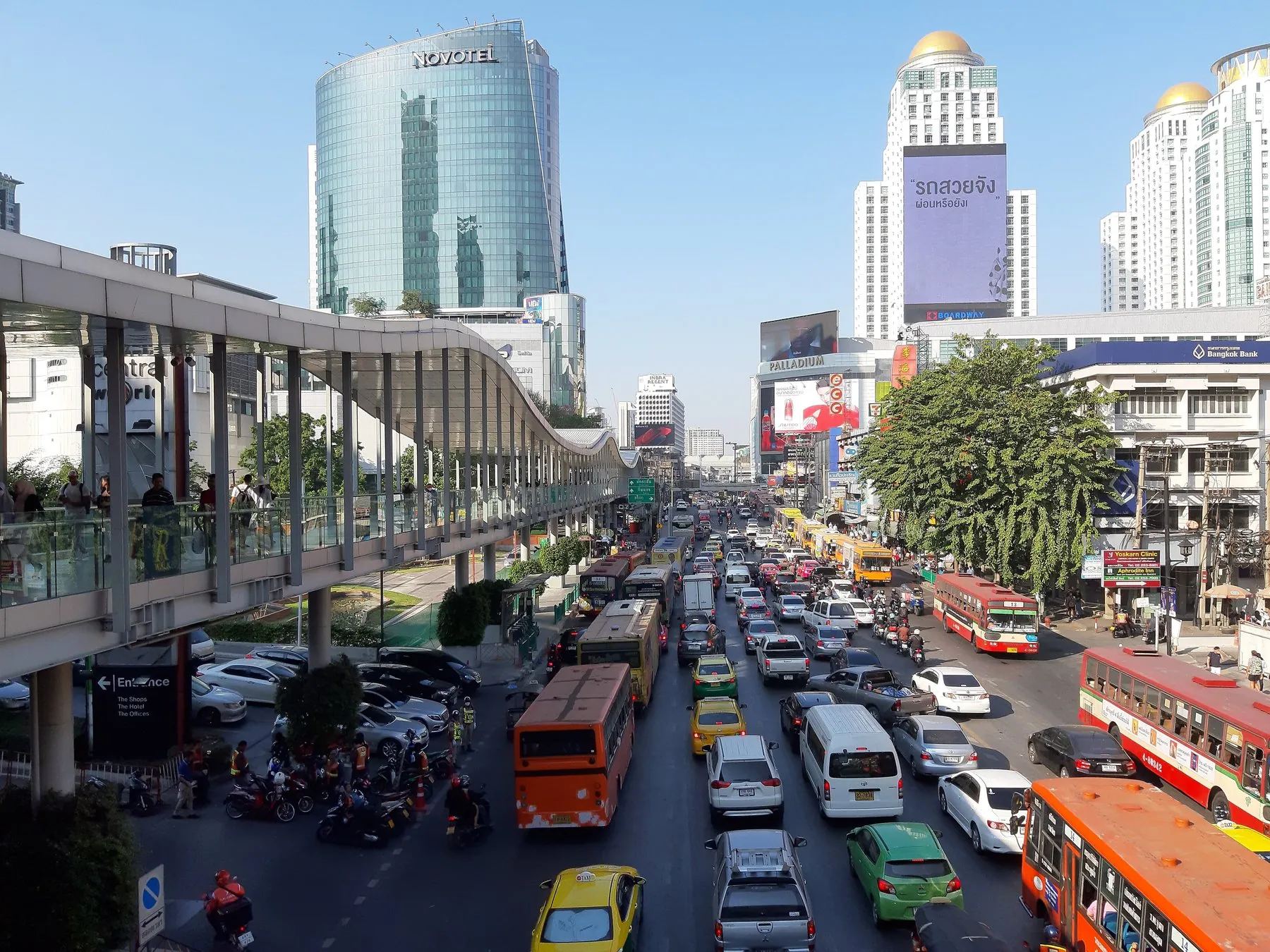
What the WHO numbers actually say
The 2021 estimate is 18,218 deaths, an average of about 50 a day, at a rate of 25.4 deaths per 100,000 people. That places Thailand ninth out of the 175 member states WHO monitors — a ranking by death rate per head of population, not by absolute numbers, which is why a country of 70 million appears high on a list containing far larger ones.
Two other framings answer different questions. Thailand records roughly 44 deaths per 100,000 registered vehicles and 31 deaths per 1,000 km of road. The per-vehicle figure is the one that matters if you are trying to understand exposure rather than population.
The direction of travel is better than the level: the rate per 100,000 was 45.8 in 2010 and 25.4 in 2021, a fall of about 44%. Thailand's road safety has improved substantially and is still bad by international standards. Both halves of that sentence are true. The cost is measured too — in 2022 the economic cost of road crashes was put at ฿531,058 million, about US$15.51 billion, equal to 3.06% of GDP.
Who dies
The composition of the toll is more useful to a visitor than its size. In 2021, 83.8% of road deaths were motorcyclists, and pedestrians and cyclists together accounted for about 2%. Thai national data for 2024 records 14,144 of that year's 17,447 deaths as involving motorcycles — a different measurement from a different source, pointing the same way.
This is the number that should shape a decision. It does not mean motorcycling here is safe if you are careful; it means that in a country where two-wheelers dominate the traffic mix, they also dominate the mortuary. If you are choosing between a scooter and a car for your trip, that single statistic is the whole of the safety argument, and no amount of care changes the exposure difference between sitting inside a steel box and sitting on top of a 110cc engine.
A common error worth naming. The 83.8% is a share of deaths. It is frequently reported as motorcycles being "involved in more than 80% of road accidents", which is a different claim and is not what WHO measured. The crash-share figures published by the Thai holiday campaigns run in the 64–69% range, and they refer only to crashes recorded during those campaign weeks.
The "seven dangerous days" are widely misreported
Twice a year, over New Year and Songkran, Thailand runs an intensified road-safety campaign known as the seven dangerous days (เจ็ดวันอันตราย). Enforcement is stepped up and the Road Safety Operations Centre publishes daily crash, death and injury counts for the campaign window. English-language coverage reliably treats the result as evidence that Songkran is the deadliest week on Thai roads. The published figures do not support that.
| Campaign | Period | Crashes | Deaths | Injuries | Deaths per day |
|---|---|---|---|---|---|
| New Year 2026 | 30 Dec 2025 – 5 Jan 2026 | 1,511 | 272 | 1,464 | about 39 |
| Songkran 2026 | 10–16 April 2026 | 1,242 | 242 | 1,200 | about 35 |
| Songkran 2025 | 11–17 April 2025 | 1,538 | 253 | 1,495 | about 36 |
Thai national data recorded 17,447 deaths in 2024, which is an average of roughly 48 a day across the whole year. Every campaign week in the table above ran below that daily rate. The holiday weeks are not, on the face of the published numbers, disproportionately deadly per day.
There is a further catch that cuts the same way. The campaign figures are narrower than the annual count by construction: they cover crashes reported through the campaign system and deaths recorded inside the campaign window, so somebody who dies in hospital three weeks after a Songkran crash is not in them. The campaign numbers therefore understate, which is precisely why they cannot be used to argue the campaign weeks are worse than average. You cannot take the lowest-counting system in the country and use it to prove a peak.
The percentage falls are measured against a three-year average, not last year. The Songkran 2026 figures were reported as crashes down 35.59%, injuries down 37.53% and deaths down 9.70% — all against a rolling three-year average. A headline that reports those as year-on-year improvements is comparing the wrong things.
None of this means the holiday weeks are a good time to drive. They are busier, drink-driving enforcement is at its most visible, and during Songkran, water thrown at a moving rider is a real and specific hazard. That is the honest reason to plan around them, and driving during Songkran and New Year covers what actually changes on the roads. "The deadliest week of the year" is not the reason, because the numbers do not say it.
What the campaign data is genuinely good for
The campaign reporting is granular in a way the annual counts are not, and consistent enough between years to be worth something. Across Songkran 2026, speeding was the leading recorded cause at 40.65%, followed by cutting in at 25.20%; motorcycles accounted for 64.55% of crashes; 87.80% happened on straight roads rather than bends; the peak periods were 09:01–12:00 and 15:01–18:00; and the worst-affected age group was 20–29, at 22.14% of casualties. New Year 2026 showed the same shape: speeding first at 39.44%, motorcycles 68.53% of crashes.
The straight-road finding is the one worth carrying away. The mental image of a Thai crash is a hairpin in the mountains; the recorded reality is a straight piece of road in daylight with speed involved.
Foreign visitors: there is no official series
This is the question this page gets asked most, and the answer is unsatisfying. No Thai government agency publishes an annual count of foreign nationals killed or injured on Thai roads that we have been able to find.
The only figure available is a six-week snapshot: insurance-claims data covering 1 January to 15 February 2023 recorded that of 2,099 road deaths in that window, 75 were foreigners, alongside 2,886 foreigners injured. It was reported by a news outlet, drawn from a compulsory-insurance claims database rather than a government casualty count, and covers about one-eighth of a year.
Do not annualise that figure, and be suspicious of anyone who has. Multiplying a six-week insurance-claims snapshot by eight and presenting the product as "foreigners die on Thai roads every year" is a fabrication with a citation attached. There is also no published breakdown of foreign casualties by nationality, or by whether the vehicle was hired or owned. If a site gives you one, ask where it came from.
What can be said with confidence comes from the reader's own government rather than from a casualty count. The UK Foreign, Commonwealth and Development Office states that Thailand has a high number of road traffic accidents, particularly involving motorcycles, and that WHO ranks Thailand among the world's deadliest countries for motorcycle fatalities. It also warns of two specific things a visitor can act on: that motorcycles and scooters hired in tourist areas "are often unregistered and cannot be used legally on a public road", and that riding without a valid licence "could invalidate your travel insurance and you'll be unable to claim if you have an accident or injury".
That combination is more useful than any casualty count, and unlike a national statistic it is within your control. Whether your travel insurance covers driving in Thailand is the question to settle before you land.
What the numbers mean for your trip
Strip the arithmetic out and four things survive.
- The exposure is real and it is concentrated on two wheels. Choosing a car over a scooter is the single largest change any visitor can make to their risk, and it is the only one supported by a hard number.
- Most of the risk is behavioural and therefore reducible. Speed, alcohol, helmets and night riding recur in every dataset that exists. The biggest risk factors for visiting drivers takes them one at a time.
- The dangerous road is a straight one. The campaign data puts the great majority of crashes on straight roads at ordinary times of day, not on famous mountain bends at night.
- The financial exposure is separate from the physical one. Thailand's compulsory motor insurance is a floor rather than a safety net, and medical evacuation and repatriation is where an uninsured crash becomes financially catastrophic rather than merely painful.
If you are riding anyway — and most readers of this site are — the two pages that change outcomes most are choosing a helmet that actually protects you and driving at night in Thailand.
Frequently asked questions
How many people die on Thai roads each year?
There is no single answer, and any site giving you one without a year and a source is guessing. WHO estimated 18,218 deaths in 2021. Thai national data recorded 17,447 in 2024 and 14,737 in 2022. Across all available sources for 2021–22 the range is roughly 7,000 to 22,000. The counts define "road death" differently and cannot be compared with one another.
Does Thailand have the most dangerous roads in the world?
No. WHO's ranking puts Thailand ninth out of the 175 member states it monitors, by deaths per 100,000 population, for 2021. You will also see claims that Thailand is second in Asia, or sixteenth in the world; those figures are not traceable to a source we could verify, so we use the WHO ranking and say what it measures.
Is Songkran really the deadliest week on Thai roads?
The published campaign figures do not show that. Songkran 2026 recorded 242 deaths over seven days, about 35 a day, against a national daily average of roughly 48 implied by 17,447 deaths in 2024. New Year 2026 recorded 272, about 39 a day. Both are below the annual daily average, and the campaign system counts more narrowly than the annual one. The holiday weeks are busier and more heavily policed, which is why they are heavily reported.
How many tourists die on Thai roads?
Nobody publishes it. The only figure that exists is a six-week window from early 2023 taken from an insurance-claims database, and it should not be multiplied out into an annual number. Treat any annual "foreign road deaths in Thailand" figure you see as invented until someone shows you the government series it came from.
Are motorcycles involved in 80% of Thai road accidents?
No — that is a garbled real statistic. Motorcyclists were 83.8% of road deaths in 2021, per WHO. Crash shares from the holiday campaigns run around 64–69%, and only for those weeks. Different denominators.
Are Thai roads getting safer?
By rate, yes. Deaths per 100,000 population fell from 45.8 in 2010 to 25.4 in 2021, about 44%. That is a genuine improvement from a very high base, and it still leaves Thailand ninth of 175 countries.
Should these numbers stop me driving in Thailand?
That is your call, and this site does not make it for you. What the numbers support is a narrower claim: a visitor on a motorbike is in the category that accounts for the overwhelming majority of Thai road deaths, and a visitor in a car is not. Is it safe to drive in Thailand? puts that in the context of an actual trip.