Thailand has two holiday periods when the roads become measurably more dangerous, and the country is unusually frank about it. Around Songkran in April and around the New Year turn from December into January, the authorities designate a seven-day window, publish a daily casualty count through it, and run a national enforcement and prevention operation. Those windows are known, without euphemism, as the "seven dangerous days".
If you are in Thailand at those times you do not need to stay off the roads entirely. You do need to understand what changes, because it is not one thing but four at once — more traffic, longer journeys, more alcohol, and in Songkran's case a road surface covered in water and a stream of people throwing more of it at you.
- SongkranThai New Year, 13-15 April, with travel either side
- New YearThe turn of 31 December into 1 January
- Enforcement windowA designated seven-day period around each
What actually changes on the road
Everyone travels at once
Both holidays are family occasions, and Thailand's economy pulls millions of people from the provinces into Bangkok and the industrial estates for work. At Songkran and New Year they all go home, and then they all come back — two enormous tidal flows on the same handful of trunk routes, compressed into a couple of days at each end.
The pressure points are predictable. Highway 2, the Mittraphap road into Isaan, carries the bulk of the northeastward flow and can be solid for hours. The northern route towards Chiang Mai, the southbound routes down the peninsula, and every approach to Bangkok on the return day are the others. Anyone driving Bangkok to Chiang Mai in that window should double their estimate and take food and water.
Tired drivers on long journeys
The traffic itself is not the danger; what the traffic does to drivers is. A journey that normally takes six hours takes twelve. People set off late, drive through the night to avoid the queues, and arrive exhausted. A large share of holiday crashes are single-vehicle events on straight roads in the small hours, which is the signature of a driver falling asleep. If you are covering distance in these periods, plan shorter days and stop more often than you would at home.
Alcohol
This is the factor that dominates every official analysis of the holiday casualty figures. These are drinking festivals as much as family ones, the drinking is spread across several days, and a great deal of it happens in villages where the journey home is a short one on a motorbike — precisely the trip people convince themselves is safe.
The countermeasure is a large-scale checkpoint operation, described on drink-drive checkpoints at Songkran and New Year. For your own position, the drink-driving limits are the page you want. The practical point here is simpler: at these times, a much higher proportion of the vehicles around you have a driver who has been drinking, at all hours rather than just late at night.
The riskiest journey of the whole period is the short one. Not the long drive to the province — the ten-minute ride back from a family gathering or a beach party, on a motorbike, without a helmet, in the early evening, having had a few drinks. That trip accounts for a very large share of the holiday casualties, it is overwhelmingly a motorbike trip, and it is the one visitors join in with most readily.
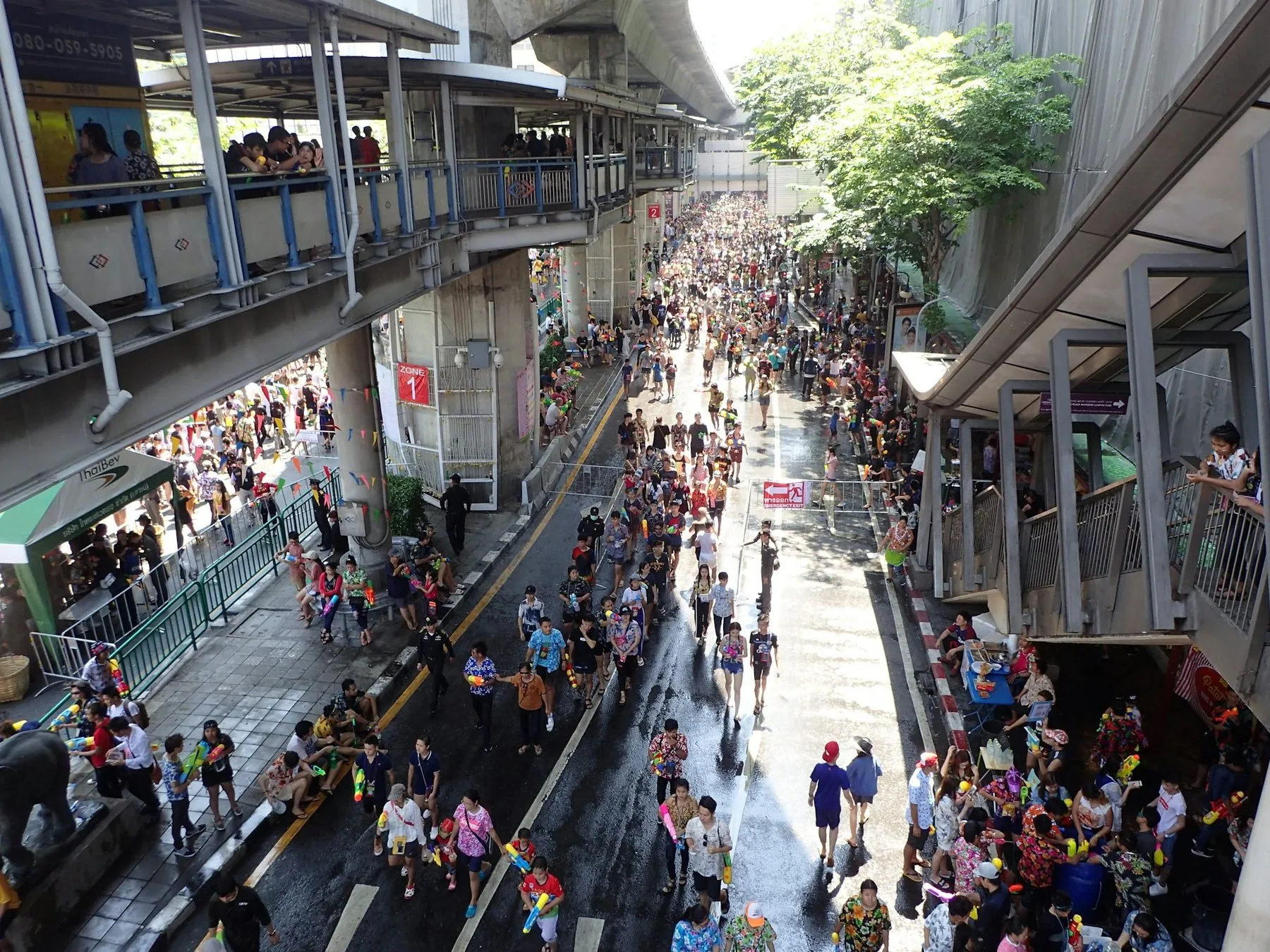
Songkran specifically: the water
Songkran's water-throwing is the part visitors know about and the part that changes the driving experience most obviously. From the roadside, from the back of pickups, from the front of every shophouse, people throw water at passing vehicles. It is done in high spirits and without malice, and getting soaked is part of it. As a road user, these are the consequences:
- You will be hit without warning. A full bucket into the side of a helmet at road speed is a genuine shove, and it will make you flinch. On a motorbike, flinching is a steering input.
- The water is often iced. A shock of cold water in the face is briefly disabling.
- Some of it comes from moving pickups. A load bed full of people with buckets, weaving through traffic, is its own hazard.
- Talcum paste on the face and visor. Smeared white paste on a wet visor is effectively opaque.
- The road stays wet for days in festival areas.
- Pedestrians in the carriageway. Children run into the road to throw water. In festival streets, assume the road belongs to people, not vehicles.
If you must ride through a water zone, ride it like a pedestrian area. Walking pace, visor down, both hands on the bars, no sudden corrections when you get hit, and phone and documents in a sealed bag under the seat. Better still, park the bike and walk. In the festival streets of Chiang Mai, Bangkok's Silom and Khao San, or Pattaya, a vehicle is a liability rather than an asset.
Planning around it
The good news is that all of this is scheduled. Unlike weather, you know exactly when it is happening.
| Phase | What is happening | What to do |
|---|---|---|
| The two days before | The outbound exodus. Trunk roads gridlocked from mid-afternoon. | Do not travel long distance. If you must, leave before dawn. |
| The festival days | Local traffic, water-throwing, heavy drinking, town centres effectively closed. | Stay local, walk, use taxis. Do not ride at night. |
| The last day and the day after | The return flow. Worst congestion of the year on approaches to Bangkok. | Travel a day late rather than a day early. The roads clear fast afterwards. |
| The week after | Everything back to normal, roads quiet, prices down. | The best time of all to drive. |
Rental demand spikes at both holidays and availability collapses. Book well ahead if you need a vehicle, and expect to pay peak rates — the seasonal pattern is set out in car rental prices in Thailand by season. It is also the period when the least roadworthy scooters in a shop's fleet come out, because everything else is hired.
Songkran officially runs 13 to 15 April, but the water-throwing starts earlier and finishes later in some places — Chiang Mai runs longer than most. Assume a week rather than three days when planning. The New Year period is more compact, with the travel crush either side of 31 December and 1 January.
If you are riding through it anyway
- Helmet with the visor down, always, in a water zone.
- Cover your skin. Wet skin slides further, and a spill on a wet road in shorts is nasty.
- Documents, phone and cash in a sealed bag. Everything you carry will get soaked.
- Ride in the middle of the day, and be off the road before the evening drinking begins.
- Expect roadblocks, and have your licence and vehicle documents with you.
- Do not ride after drinking, at all, on any day of it. This sits at the top of the biggest risk factors for visiting drivers for good reason.
What the daily figures do and do not tell you
Through each seven-day window the government publishes a running tally of accidents, injuries and deaths, and it is widely reported. It is worth understanding what that reporting is: an operational count from a specific campaign, over a specific period, on a specific definition. It is not directly comparable with an annual road-death rate, and comparing one year's holiday count with another's tells you about the weather and the calendar as much as about road safety.
What it does reliably show, year after year, is the shape of the problem: motorbikes dominate, alcohol and speed dominate the causes, and most crashes happen on ordinary local roads rather than on the big highways everyone worries about. What Thailand's road-death figures actually show unpacks the numbers properly.
Frequently asked questions
Should I avoid driving in Thailand during Songkran altogether?
Avoid long-distance driving on the travel days at each end, and avoid riding a motorbike in the evenings throughout. Driving locally in the mornings, outside festival streets, is manageable. If your trip is built around a road journey, moving it by a few days is the single best decision available to you.
Are the checkpoints worse at these times?
They are much more numerous, and they are specifically looking for alcohol, helmets and licences. Expect to be stopped, have your documents to hand, and be polite. The operation is covered on drink-drive checkpoints at Songkran and New Year.
Will my insurance cover me during the holidays?
Nothing about the date changes your cover. What does change it is riding without a helmet, without the correct licence, or after drinking — all more common at these times and all standard exclusions. Read what voids your motorbike cover in Thailand before, not after.
When exactly are the dangerous seven days?
They are set each year by the road safety centre and announced in advance, spanning the holiday plus the travel days either side. For Songkran that is typically the middle of April; for New Year it spans the turn of the year. The precise dates shift, so check the announcement for the year you are travelling.
Is the New Year period as bad as Songkran?
Both are serious and both are treated the same way by the authorities. New Year lacks the water and the pedestrians in the road; the drinking, the exodus and the night-time risk are comparable.