Thailand's rainy season does not make the roads permanently wet. What it does is deliver an hour of extraordinary rainfall onto a road network that cannot drain it that fast, usually in the afternoon, usually with very little warning, and then clear up. The driving problem is not "it rains a lot" but "for forty minutes the road is a river, and then it is not".
Learn the pattern for the part of the country you are in, learn what standing water does to a vehicle, and learn the depth at which you turn round. Most flood damage happens to people who decided the water looked shallow enough.
When it rains, and where
Thailand has two monsoons and they do not cover the country at the same time. The southwest monsoon runs from around mid-May to mid-October and brings the main wet season to most of the country — Bangkok, the central plains, the north, Isaan and the whole Andaman coast. The northeast monsoon takes over from around mid-October to February, bringing the dry, cooler season to most of Thailand while driving moisture straight across the Gulf onto the east-facing coast of the southern peninsula.
The practical consequence catches a lot of visitors out: the two coasts of southern Thailand have their wet seasons at opposite ends of the year.
| Region | Wettest period | Peak |
|---|---|---|
| Bangkok and the central plains | Roughly May to October | September |
| North (Chiang Mai, Chiang Rai, Mae Hong Son) | Roughly May to October | August-September |
| Isaan / the northeast | Roughly May to October | August-September |
| Andaman coast (Phuket, Krabi, Khao Lak, Ranong) | Roughly May to October | September |
| Gulf coast and islands (Samui, Phangan, Tao, Nakhon Si Thammarat) | Roughly October to December | November |
| Eastern seaboard (Pattaya, Rayong, Koh Chang) | Roughly May to October | August-September |
This is why November is such a strange month to plan a driving trip around: the Andaman side is coming into its best weather while Koh Samui is in the wettest weeks of its year. If your itinerary crosses the peninsula, check both coasts separately rather than assuming "southern Thailand" behaves as one place.
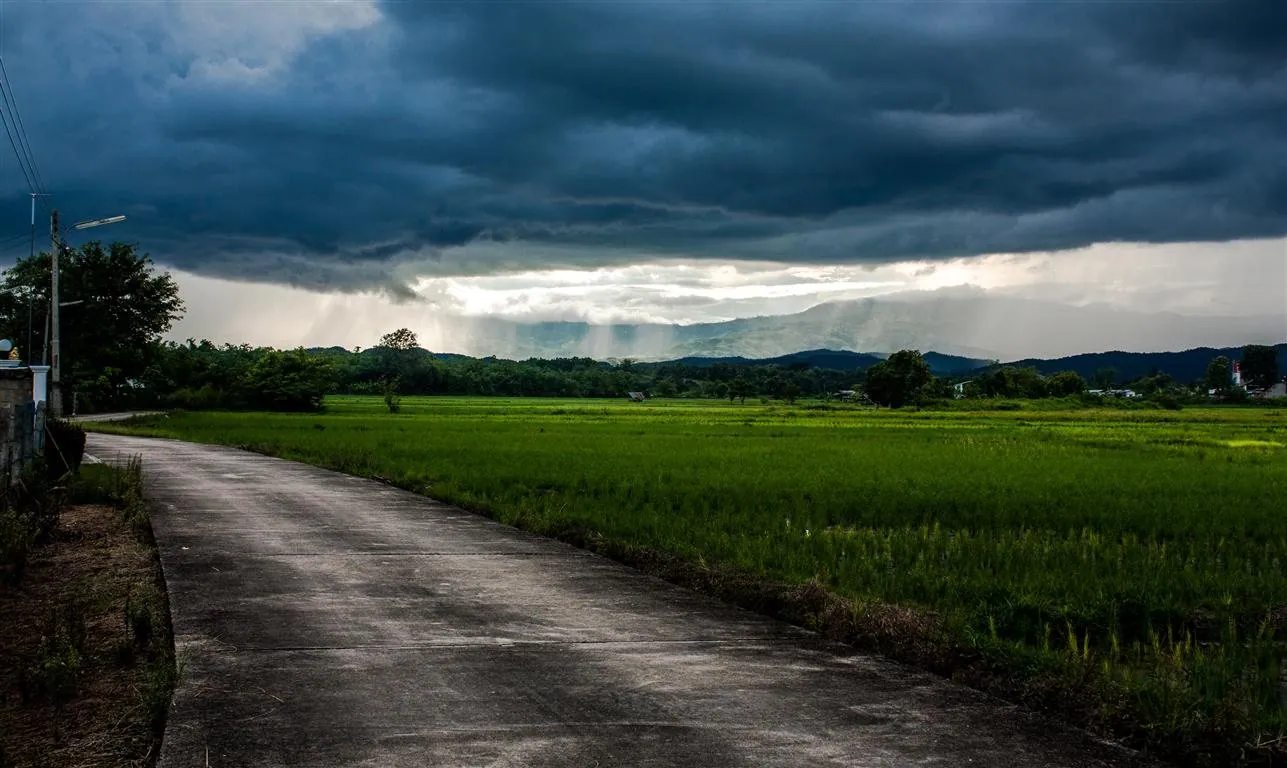
In most of the country, mornings are clear or lightly overcast, heat builds through the day, and the storm arrives between two in the afternoon and early evening. It is intense — visibility down to a few car lengths — and often over within an hour. That pattern is a gift if you use it: drive in the morning, which is the same conclusion driving at night in Thailand arrives at from a different direction. The exception is the tail of the season, when a tropical depression can park over a region and rain for days. That is when the serious flooding happens.
The first five minutes are the most slippery
The most dangerous stretch of any rainstorm is its opening. Weeks of dry weather leave a Thai road coated in diesel, oil, rubber and dust, all sitting in the surface texture until water lifts them. The first rain floats that film off the tarmac and spreads it as a thin, greasy emulsion — you can often see it, a faint rainbow sheen in the wheel tracks. Grip in those minutes is dramatically worse than it will be half an hour later, and it is worst at junctions, roundabouts and the painted areas at traffic lights, where the oil accumulates.
If it has just started raining, stop. Not eventually — now. Pull under a bridge, into a petrol station forecourt or under a shop awning and give it ten minutes. This costs nothing and removes the worst of the risk. On a motorbike it is close to mandatory; see riding a motorbike in tropical rain for what to do when you cannot stop.
What heavy rain does to a car
Visibility collapses
Thai rain at its heaviest overwhelms wipers on any setting. Add spray from trucks, dark film on the glass, and the fact that a proportion of the traffic will not have switched its lights on, and it deteriorates fast. Get your headlights on — dipped beam, not just daytime running lights, which do nothing at the back of the car. If you genuinely cannot see, get off the road properly: stopping on the hard shoulder in heavy rain, where nobody can see you either, is one of the more dangerous things you can do. The interaction between rain and dark glass is covered in tinted windows and visibility problems.
Aquaplaning and slippery surfaces
Standing water at speed lifts the tyres off the surface and you lose steering and braking together. The warning signs are a sudden lightness in the steering and a change in tyre noise; the response is to come off the accelerator smoothly, hold the wheel straight, and neither brake nor steer until the tyres bite again. Rutted highways collect water in the worn wheel tracks, so on a badly rutted road sit slightly offset from them. Wet concrete, steel expansion joints, manhole covers and thermoplastic road paint are all noticeably more slippery than wet asphalt — a minor loss of grip in a car, and on two wheels the difference between staying up and not.
Flooded roads: the decision
Thai towns flood readily because the drainage is designed for a normal storm rather than an exceptional one. Bangkok floods; so do Chiang Mai, Hat Yai, Ubon Ratchathani and dozens of other places. Usually it drains within hours.
- Still waterTurn round if it reaches the bottom of the doors
- Moving waterTurn round, full stop
- Water you cannot see the bottom ofTurn round
Water deep enough to reach the air intake destroys an engine instantly and expensively, and on a low saloon the intake is lower than people assume. But hydraulic failure is only the obvious risk:
- You cannot see the road. Floodwater here is opaque brown, and Thai roads frequently have a deep concrete monsoon drain along the edge with removable slabs over it. A missing slab, an open ditch or a collapsed edge is completely invisible, and the car goes in nose-first.
- Moving water floats vehicles. Surprisingly shallow flowing water will lift a car sideways off the road. This is the mechanism behind most flood fatalities involving vehicles anywhere in the world.
- Wet brakes do not work. After a deep wade, dry them by driving slowly with light pressure on the pedal before you need them properly.
- Your insurance may not care that you meant well. Flood damage from driving into standing water is commonly excluded or contested — see what rental insurance in Thailand does not cover.
Watch what the small cars do. A pickup or an SUV going through tells you nothing about whether your hire car will. A small saloon going through slowly, without a bow wave, tells you a great deal. If nothing is coming the other way at all, that is your answer.
If you do decide to go through — shallow, still, visible bottom, clear exit — use the lowest gear the vehicle will hold, steady low revs, no gear changes, and keep moving at a walking pace so the bow wave stays in front of you. Do not stop in the middle, and wait for any vehicle coming the other way rather than meeting it, because its bow wave will push water into your engine bay.
On a motorbike the threshold is much lower. Water reaching the exhaust outlet risks drowning the engine, water reaching the footboard means you cannot put a foot down, and floodwater hides exactly the kerbs, holes and drain covers that put scooters down. Find another route or wait. If you have already stalled in water, do not keep pressing the starter — that draws more in.
Regional flooding worth planning around
Low-lying stretches of highway in the central plains go under in a bad September. The northern rivers around Chiang Mai and Chiang Rai can burst in late August and September, and on mountain routes including the Mae Hong Son loop the risk is landslides on steep cut slopes rather than standing water. The southern provinces around Nakhon Si Thammarat, Songkhla and Narathiwat flood in November and December, and rural routes there do get closed for days — relevant if you are driving in southern Thailand then.
The Department of Highways runs a 24-hour information line on 1586 for the state of the national network. For the road in front of you, live traffic layers in the mainstream navigation apps are quicker, because they show a closure as soon as the traffic stops moving.
Frequently asked questions
Is it a bad idea to drive in Thailand during the rainy season?
No. Most rainy-season days include a lot of dry driving, the countryside is at its best and the roads are quieter. What it requires is a looser schedule: shorter days, morning driving, and the acceptance that some afternoons you will sit out an hour of rain somewhere.
Are mountain roads dangerous in the rain?
Yes, and for a different reason: landslides and debris on the carriageway, plus mud and gravel washed onto bends. Mountain roads and hairpin bends covers the technique; in the wet, add a large margin.
What about cycling in it?
Workable, but the visibility problem is severe, because you are small, low and hard to see through a wet tinted windscreen. Cycling in Thailand's rainy season covers the timing, the kit and which roads to avoid.