The rainy season is not a write-off for cyclists, and for a lot of people it is better riding than the hot season. Thai monsoon rain usually arrives as a heavy, concentrated downpour rather than the all-day grey drizzle a northern European expects — an hour or two in the afternoon, often violent, then it stops and the road dries. What it costs you is grip, visibility and brake performance, and it makes the roadside surprises more surprising.
This one is mainly for the touring cyclist planning around the calendar, though the grip section is worth reading if you are hiring a bike for a wet-season afternoon in Krabi or on Koh Lanta. The single most useful thing to know is that the first ten minutes of rain after a dry spell are the most dangerous surface conditions you will ride on in Thailand.
- Southwest monsoonRoughly June to October
- Typical patternHeavy afternoon downpours, not all-day rain
- Wettest for touringSeptember and October
- Gulf coast exceptionWettest roughly October to December
When it actually rains, and where
Thailand's conventional three seasons are a cool season from about November to February, a hot season from March to May, and the rainy season under the southwest monsoon from roughly May or June through October. That works well for most of the country, but the peninsula splits in two and this trips up a lot of trip planning.
| Region | Wettest period | Cyclist's note |
|---|---|---|
| North (Chiang Mai, Mae Hong Son) | August–September | Landslides and washouts on mountain roads; green and beautiful |
| Central plains and Bangkok | September–October | Urban flooding; low-lying roads stand in water for hours |
| Isaan (northeast) | Roughly July–September | Short, hard storms; drainage is generally good |
| Andaman coast (Phuket, Krabi, Khao Lak) | Roughly May–October | The classic southwest monsoon pattern |
| Gulf coast (Samui, Chumphon, Surat Thani) | Roughly October–December | Out of step with the rest of the country |
The practical planning conclusion: if you want to tour Thailand in September and October, go to the Gulf side; if you want to be in the north or on the Andaman coast, aim for November onwards. Anyone routing a longer trip should also read what the southern roads are like and driving in northern Thailand, which cover the same regions from behind a windscreen.
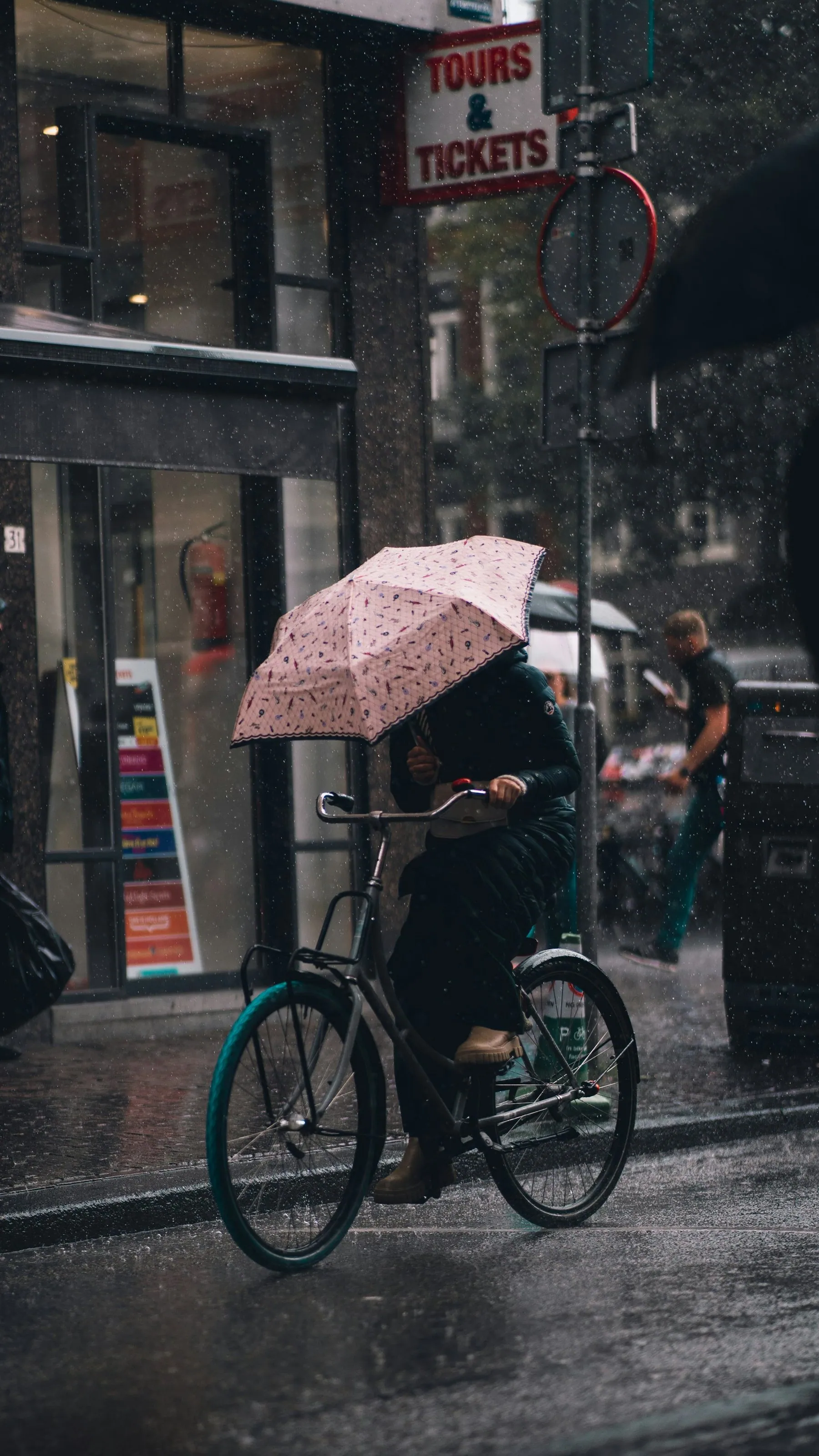
Grip: the first ten minutes
Roads collect oil, rubber and dust through a dry spell. The first rain lifts all of it into a film that sits on the surface until enough water arrives to wash it away. That window — the first ten to fifteen minutes of a downpour — is the slipperiest riding in Thailand, and it catches out experienced riders because the sky has only just changed.
Some Thai surfaces are much worse than others when wet:
- Painted lines and arrows. Thai road paint on a hot climate surface polishes up. Treat every white line as ice, and never brake or turn on one.
- Polished concrete. Village lanes, temple forecourts and some bridge decks are smoothed concrete that becomes genuinely treacherous.
- Steel drain covers and expansion joints. Common in Bangkok. Cross them upright and unbraked.
- Diesel at junctions. Where heavy vehicles brake and pull away, there is oil. Look for the rainbow.
- Mud and rice straw. Farm vehicles drag both onto the road in Isaan and the central plains, and it turns to grease.
- Fallen leaves and blossom. Northern mountain roads in the shade after rain stay wet and slick for hours.
Brake earlier and in a straight line. Rim brakes on a wet Thai descent take a full wheel revolution to bite and then bite unpredictably; disc brakes are far better but still need earlier inputs. On the mountain descents around Pai and Mae Hong Son this is not a small margin — see mountain roads and hairpin bends.
Visibility, both ways
In a heavy Thai downpour you can lose most of your forward vision, and so can everyone else. Windscreen wipers on a pickup at full speed do not clear tropical rain properly, and many Thai vehicles have heavy window tint that makes it worse from the driver's side — the issue is set out in tinted windows and visibility problems. From the driver's seat, a cyclist in the shoulder in heavy rain is close to invisible until they are on top of you.
The right response is not to press on more carefully; it is to get off the road. Thai roadside architecture is built for this — every shop, bus shelter, petrol station and temple gate is somewhere you can stand for twenty minutes, and nobody will find it odd. Shelter, drink something, and set off when the road has visibly started to drain.
If you must ride in it: two rear lights, both on, one steady and one flashing. Reflective material on your ankles, which reads as a cyclist far better than anything static. Ride further from the edge than usual, because the shoulder is where the water pools and hides the holes.
Standing water and flooding
Standing water hides potholes, open drains and missing kerbs, and after a serious storm it hides worse. A pothole deep enough to stop a bicycle dead is invisible under 15 centimetres of brown water. Ride around standing water rather than through it, and if you cannot, walk. In Bangkok and the central plains, roads flood routinely and predictably in the wettest weeks; the rainy season and flooded roads covers where and how badly.
In the north, the mountain hazard is different: landslips, washed-out shoulders, and gravel spread across a bend by runoff. Roadworks appear suddenly and are frequently unsigned, so treat every blind mountain corner in the wet as though there is a hole or a heap of grit behind it. See roadworks and unmarked hazards.
The bike and the kit
Wet season is hard on equipment, less from the rain itself than from the grit that the rain carries into everything.
- Full mudguards if your frame will take them — the difference in comfort over a fortnight is enormous
- Chain lube for wet conditions, and clean and re-lube far more often than at home
- Wider tyres at lower pressure for grip; slick or lightly treaded is fine, tread does not help on tarmac
- Dry bags inside panniers, not just waterproof panniers — nothing here is truly sealed after a fortnight
- A zip-lock bag for the phone, plus a second one for documents
- Brake pads inspected weekly; wet grit destroys them fast
Do not bother with a waterproof jacket. In 30-degree rain you will be as wet inside it as out, and it stops you cooling. Most experienced riders here get wet, keep moving and dry off in twenty minutes. What you do need is a way to keep your sleeping and electronics dry, and a warm layer for the north in the cool season, where an evening descent after rain is genuinely cold. More on this in cycling gear for a hot-climate tour.
What the rainy season gives you
It is worth saying the other side. Wet-season Thailand is dramatically greener, the rice terraces in the north are at their best, the air is washed clean of the hot-season haze, guesthouses are cheaper and half-empty, and the temperature after a storm is the most comfortable riding you will get outside December. Morning rides are frequently dry — the big rain usually comes later in the day — which fits the early-start pattern you should be riding to anyway for heat reasons.
The tourers who have a bad time in the wet season are the ones who planned hot-season distances and then lost afternoons to rain. Plan shorter stages, start earlier, and build in the possibility of stopping at lunchtime, and the season works.
Frequently asked questions
Can I still cycle tour in Thailand during the monsoon?
Yes. Ride early, expect to shelter for an hour or two most afternoons, and pick your region — the Gulf coast is dry when the rest of the country is wet, and the reverse is true from October. The one thing to avoid is committing to long mountain stages in the north in August and September, when landslips close roads.
Which is worse for cycling, the hot season or the rainy season?
Most experienced riders here say the hot season, comfortably. March to May combines extreme heat, high humidity and, in the north, burning haze. Rain is an inconvenience; heat is a physiological ceiling.
Do I need waterproofs?
For your gear, yes. For yourself, generally no — a jacket in tropical rain traps more sweat than it keeps out water. Riders who want something usually choose a very light windproof for cool-season descents rather than a rain shell.
What about lightning?
Thai storms produce a lot of it, and open rice plains and paddy roads are exactly the wrong place to be. If the storm is overhead, get off the bike and into a building. This is one of the few weather situations where stopping is not optional.
Are the islands rideable in the wet season?
The Andaman islands are wet from May to October and the Gulf islands from October to December, so there is almost always somewhere dry. Ferry services are more likely to be disrupted in rough weather, which matters if you are travelling with a bike — see cycling on Thailand's islands and taking a vehicle on a Thai island ferry.
How does the rain affect the dogs?
Favourably, on the whole. Village dogs are much less inclined to chase anything in a downpour, and they will be sheltering rather than lying at the roadside. It is one of the small compensations. The rest of the picture is in dogs and cyclists in Thailand.