Roadworks in Thailand are not always signed the way you expect, and sometimes they are not signed at all. The warning may be a line of car tyres painted white, a bamboo pole across a lane, a branch cut from a tree and laid on the tarmac, or a single plastic cone twenty metres before a trench you could lose a wheel in. On a big highway contract you will get proper signage, cones and lighting. On a local job you may get a man with a torch, or nothing.
Once you understand the improvised vocabulary, the works themselves become manageable. What remains dangerous is the second category: the hazards that never get a warning of any kind, because nobody has decided they are anybody's job.
The improvised warning system, decoded
| What you see | What it means | How much room it gives you |
|---|---|---|
| Tree branch or palm frond on the carriageway | Broken-down vehicle, hole, or crash ahead. The universal Thai warning triangle. | Sometimes a few metres, sometimes a hundred. Assume very little. |
| Stack of old tyres, often painted white or red | Permanent hazard: a hole, a narrowing, a bad edge, a blind junction. | It marks the hazard itself, not a distance before it. |
| Oil drum, sometimes with a lamp on it | Works or an obstruction. Drums are often empty and get knocked out of position. | Treat as marking the edge of the hazard, not a lane closure. |
| Bamboo pole or rope across a lane | The lane or road is closed. Take it seriously even if it looks flimsy. | None. It is at the closure. |
| Red or orange cloth tied to something | Overhanging load or a protruding obstruction. | Marks the extremity of the object. |
| Row of plastic cones with no signs | A lane taper, which may begin abruptly. | Frequently only a few car lengths. |
| A man in a hi-vis vest with a flag or torch | Stop-and-go control; single-lane working ahead. | Watch his hands, not the traffic. |
| Freshly dug earth or a spoil heap at the verge | There is an open trench nearby, possibly across the road. | None. Slow down and look. |
None of it reflects. This is the point that matters most. A branch, a tyre stack, a bamboo pole and an unlit oil drum are all invisible in a headlight beam until you are almost on them, and completely invisible in rain. Combine that with the fact that works often continue after dark and you have the most dangerous situation in this article. If you are covering distance in the evening, read driving at night in Thailand first.
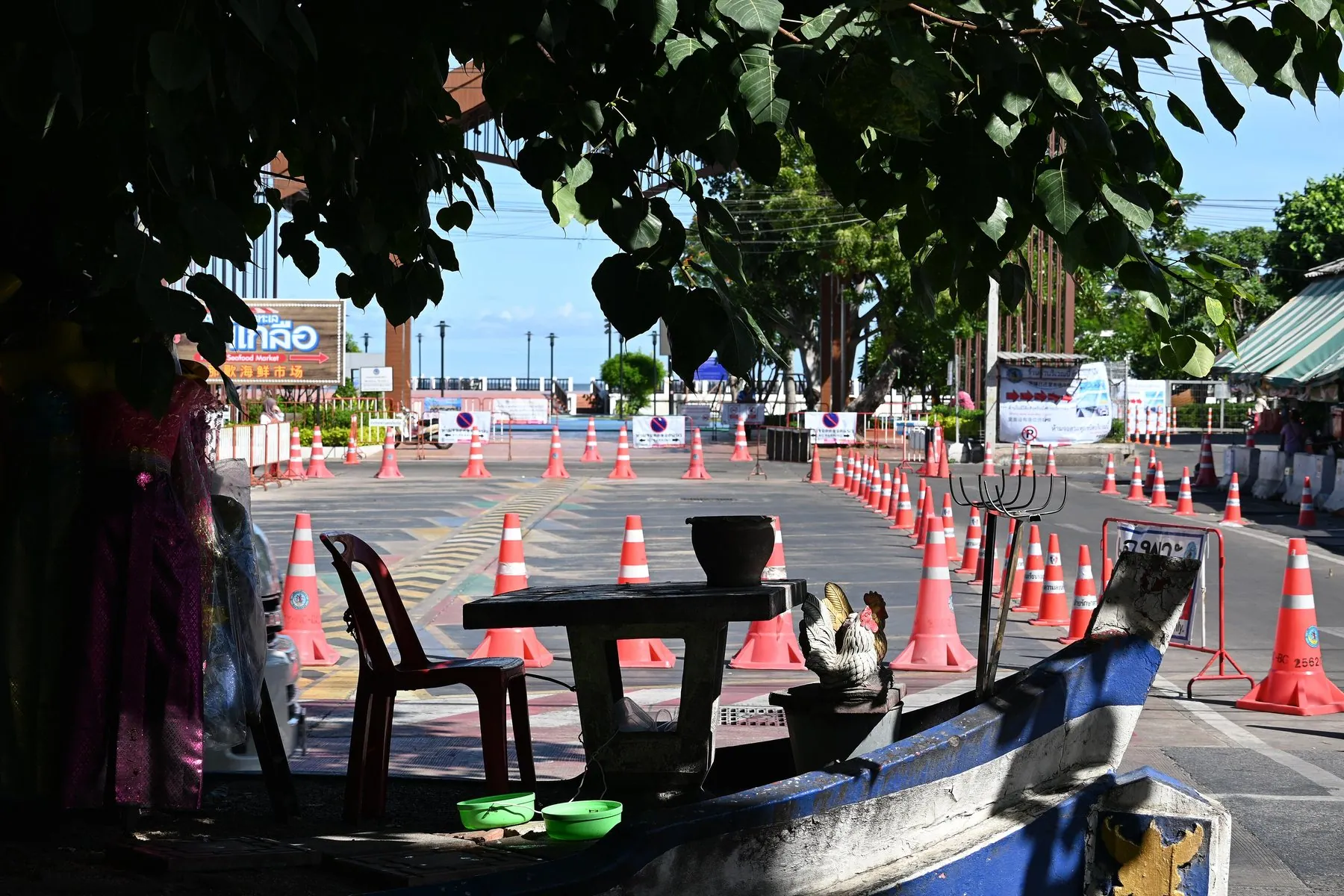
What Thai roadworks do to the road
Milled surfaces. Before resurfacing, the old asphalt is planed off, leaving a ridged, grooved surface across a whole lane. In a car this is noisy and slightly vague under the tyres; on a motorbike the grooves tramline the front wheel and the bike weaves as the tyre follows the ridges. Hold the bars loosely, keep the bike upright, do not fight it, and cross onto or off the milled surface square rather than at a shallow angle. The lip at the edge of the milled area is the real hazard: a hard step running along your direction of travel.
Steel plates. Trenches are covered with plates so traffic can pass. They are slippery in the dry, considerably worse in the wet, they have a lip at each edge, and they sometimes move under a vehicle. Cross them upright, straight, and off the brakes.
Loose chippings. Surface dressing — spraying bitumen and covering it with stone for the traffic to bed in — leaves loose gravel across the full width of the road for days. This is one of the highest-risk surfaces there is on two wheels, and it behaves exactly like the sand described in sand and gravel on Thailand's coastal roads. Slow down, stay upright, and increase your following distance, because thrown chippings crack windscreens and visors.
Contraflows and lane switches. On a divided highway under reconstruction, traffic is regularly switched onto the opposite carriageway, sometimes with a very short taper and sometimes at night with minimal lighting. The critical moment is the crossover, where you are briefly travelling on the wrong side of a road that still has old markings pointing the other way. Follow the cones and the vehicle in front rather than the paint.
The hazards that never get a sign at all
This is the second category and in practice the more dangerous one, because there is no warning system to read.
- Unmarked speed bumps on rural roads, village high streets, and inside resorts and car parks, frequently unpainted and sometimes very aggressive — see speed bumps and unmarked hazards on Thai roads.
- Missing drain covers. Thai roads have deep concrete monsoon drains at the edge, covered with removable slabs. A broken or missing slab leaves a slot that will take a wheel or a leg.
- Dropped edges. Where the asphalt ends and the dirt shoulder begins there is often a step of several centimetres. Riding off it at speed, or trying to get back up onto it at a shallow angle, is a classic single-vehicle crash.
- Cables and hoses across the road. Temporary power leads and water hoses run from a building site across the carriageway. Small, dark and effectively invisible.
- Wet markets and street food setting up in the carriageway. A whole lane can disappear under stalls at a predictable time each day, with no advance warning.
- Unmanned level crossings, serious enough to have their own page: level crossings in Thailand.
- Vehicles parked in a live lane with nothing behind them but hazard lights, or a branch.
Follow the traffic's line, not the paint. Where a road is under repair or a hazard exists, Thai traffic will already have worn a line around it. If the vehicles ahead of you are all drifting to the right in the same place, there is a reason, and going where they go is more reliable than reading the markings — which may date from before the hole.
Reading a hazard early
Most of these hazards are visible; the problem is that people look at the vehicle in front rather than through and past it. Lift your eyes to the far point of the road you can see, and let your peripheral vision handle the immediate. The earliest warning of anything is a chain of brake lights well up the road, and on a motorbike you have the height and sightlines to see it. Treat any unexplained change in traffic behaviour — slowing with no visible cause, vehicles moving out of lane, a queue on an open road — as a hazard, and slow down before you find out what it is.
Do not trust a navigation app on new construction, either. Map data lags reality by months on a road that is actively being built, and a diverted route may still be shown as a through road. Navigation apps in Thailand covers which ones handle Thai conditions best; none of them handle "the bridge is not finished".
Where you meet the most of it
Thailand builds and rebuilds roads continuously. Major highway widening projects run for years at a time on trunk routes — long stretches of Highway 4 down the peninsula have been under some form of works for as long as anyone can remember. Ring roads and motorway extensions around Bangkok are permanently under construction. Town centres get repeated utility trenching. And after the rainy season, repair crews are out everywhere at once, patching the damage described in potholes and road surfaces in Thailand.
If an unmarked hole or trench brings you down, treat it as you would any other crash: get clear of the traffic first, then deal with the vehicle and the paperwork. Photograph everything — the hazard, the absence of signage, the position of the vehicle — before anything is moved. What to do after a road accident in Thailand sets out the sequence.
Frequently asked questions
Why is a tree branch left in the road?
It is the standard improvised warning triangle. Someone has broken down, had a crash, or found a hazard, and a branch is what was available. When you see one, something is wrong within the next few metres — slow immediately rather than working out what it means.
Do roadworks run at night?
Frequently, particularly in cities where daytime lane closures are impossible. Night works are usually better lit than daytime ones, but the approach to them often is not.
What do I do at a single-lane stop-and-go?
Stop when the flagger stops you and go when he waves. Do not follow the vehicle in front through a closing gap, and do not assume the far end has been stopped just because you have been let through. On a motorbike, do not filter to the front of a stopped queue at a contraflow; you will meet the opposing traffic head-on.
Is loose gravel really that dangerous?
On two wheels, yes — it is one of the few surfaces that can take the front wheel away with no warning and no chance to correct. Treat a newly surface-dressed road as a genuine hazard for several days, and the answer is speed, not skill.
How do I know a road is closed before I set off?
For national highways, the Department of Highways runs a 24-hour information line on 1586. For anything smaller, live traffic layers in a mapping app will show a closure faster than any official channel, because they show it the moment traffic stops moving.