The hazard that unseats riders in Thailand is not the one with a sign on it. It is the unpainted speed bump on the exit of a petrol station, the missing drain cover in the left lane, the four-inch step where a resurfacing job stopped, and the excavation left open overnight with a branch stuck in it. None of these is signed, none of them is lit, and on a small-wheeled scooter each of them is capable of putting you on the ground.
There is no fixing this at a national level from where you are sitting. What you can fix is your speed, your following distance and where you are looking — and on Thai roads that means looking at the surface immediately in front of you far more than you would at home.
Speed bumps and humps
Thailand uses several kinds of vertical deflection and they vary enormously in severity.
| Type | What it is | Danger |
|---|---|---|
| Painted hump | Broad asphalt hump with black and white or yellow stripes | Low. You can see it |
| Unpainted hump | The same thing, paint worn away, same colour as the road | High. Invisible in flat light or after dark |
| Sharp bump or bar | Steep, narrow, often at a car park entrance, resort gate or private access | High on a motorbike. Enough to bottom out a suspension |
| Rumble strips | Runs of raised transverse bars before a village or junction | Unsettling on two wheels, particularly in the wet |
| Improvised bump | Rope, hose or bolted steel bar laid across a private road or village lane | High. No warning of any kind |
Speed bumps cluster in predictable places, and knowing them is most of the defence: entrances and exits of petrol stations, 7-Elevens and supermarkets; resort and hotel driveways; village lanes; hospital and school grounds; and car parks everywhere. Anywhere you are leaving a road for a private property in Thailand, assume a bump.
The classic scooter incident is at a petrol station exit. You have filled up, you are looking right for a gap in traffic, and you accelerate over an unpainted bump you never saw with your weight on the bars and your eyes elsewhere. Slow to walking pace at every forecourt entrance and exit, and look at the ground before you look at the traffic.
How to cross one on a motorbike
Slow before it, not on it. Braking on the face of a bump compresses the front suspension at exactly the wrong moment and can push the front wheel out from under you.
Get your weight back slightly and off the bars, keep the bike upright, and cross square. Approaching a bump at an angle — which happens when you are turning into a driveway — loads one side of the suspension and is how a scooter gets thrown sideways. Do not cross a bump while leaning.
Small wheels make all of this worse, and rental scooters mostly have small wheels, tired shock absorbers and whatever tyre pressure the last hirer left. The motorbike rental inspection video is where you catch a bike whose suspension has given up.
The unmarked hazards
Missing and sunken drain covers. Metal grates and covers sit in the left-hand lane and in the gutter line — exactly where a motorbike rides. Some are missing entirely, leaving an open hole. Some sit two or three centimetres below the road surface. Both will take a front wheel.
Resurfacing steps. Where a new asphalt layer has been laid over part of a road, there is a vertical step at the edge of the new surface, sometimes several centimetres high, running the length of the works. Crossing it at a shallow angle on two wheels is a reliable way to lose the front.
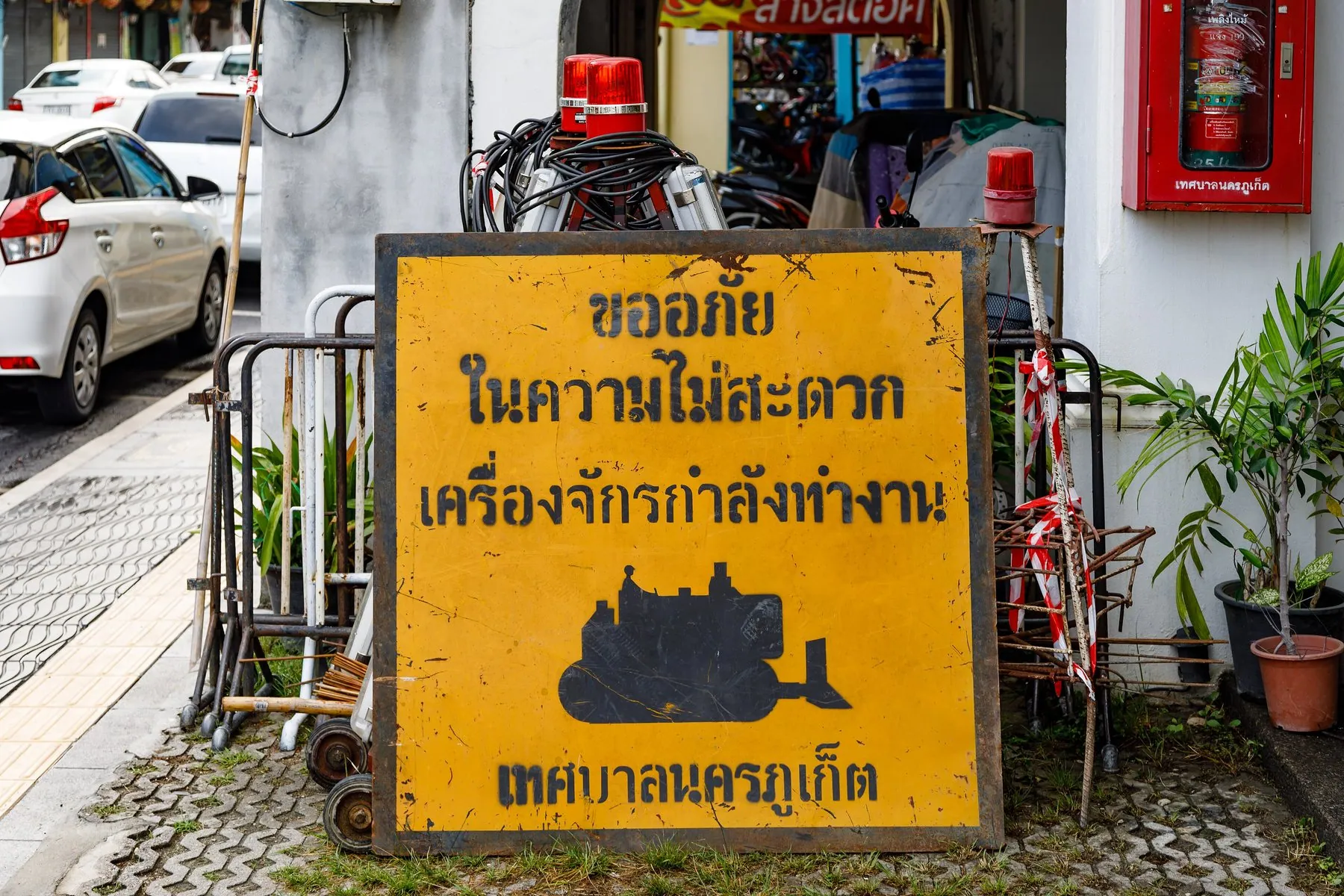
Open excavations. Utility works are frequently left open overnight, marked with a branch, an old tyre, a plastic chair or nothing at all. This is the hazard that most justifies not driving fast at night on unfamiliar roads. Roadworks and unmarked hazards in Thailand covers what you will meet.
Sand and gravel. On coastal roads, sand blows across the asphalt and collects on the inside of bends. On roads near quarries and construction, gravel drops off lorries. Both behave like ball bearings under a front wheel. See sand and gravel on Thailand's coastal roads.
Diesel and oil. Concentrated at junctions, roundabout entries, bus stops and outside workshops. The first rain after a dry spell lifts it off the surface and produces the slipperiest conditions of the year — see riding a motorbike in tropical rain.
Fruit and market debris. Near markets, the road surface may carry crushed fruit, water and vegetable waste. It is exactly as slippery as it sounds.
Ride or drive in the wheel tracks of the vehicles ahead rather than in the centre of the lane or the gutter line. The wheel tracks are where the surface is cleanest and where debris, oil and standing water have been displaced. It is a small adjustment and it removes a surprising number of problems at once.
Where the law sits on this
There is no bit of the Land Traffic Act that will help you with an unpainted bump. What the Act does is put the responsibility on you: section 43(4) prohibits driving without regard for the safety of others, and section 70 requires you to reduce speed at defined points on the road. If you hit something and lose control, the question afterwards is whether you were driving at a speed appropriate to the conditions.
What the law says
Section 43(4): no person shall drive a vehicle without regard for the safety of others. Since the 2022 amendment, driving without regard for the safety of others carries up to one year's imprisonment and/or a fine of 5,000 to 20,000 baht.
Section 70: a driver must reduce speed on approaching a junction, a pedestrian crossing and other defined points on the road.
Section 15: where a load projects beyond the vehicle, it must carry a red light at night or a red flag by day, visible at not less than 150 metres. Section 61: a parked vehicle that is not clearly visible at 150 metres must show parking lights.
The last two matter here because unlit stationary obstructions and unmarked projecting loads are among the hazards you will meet, and the Act does at least require the people creating them to light them. That the requirement is widely ignored is precisely why your own speed is the only variable you control.
Speed and sight distance
The arithmetic is unforgiving and it is the whole argument for driving slower here than the sign allows.
At 90 km/h you cover 25 metres a second. On a dipped headlight beam that illuminates perhaps 50 metres of road, an unlit obstruction becomes visible about two seconds before you reach it — which is roughly your reaction time, with nothing left for braking. That is the mathematics behind every piece of advice on driving at night in Thailand, and it applies just as much to a pothole as to a parked truck.
In daylight the numbers are better but the principle holds: your safe speed on an unfamiliar Thai road is set by how far ahead you can see a surface defect, not by the posted limit. The limits themselves are in speed limits in Thailand for every road type.
If you hit something
On a hire vehicle, a wheel or tyre damaged by a pothole is a rental dispute in waiting. Photograph the hazard and the damage at the scene, note the kilometre post, and tell the rental company before you return the vehicle rather than after. Motorbike rental damage claims in Thailand and disputing a rental charge in Thailand cover how those conversations go.
If you come off, the priority is medical rather than mechanical, and the insurance position is worth understanding before you need it — see what to do after a road accident in Thailand.
Frequently asked questions
Are Thai speed bumps marked?
Often, but not reliably. Paint wears off, and an unpainted asphalt hump is the same colour as the road and effectively invisible in flat light or after dark. Assume a bump at every petrol station, shop, resort and car park entrance whether or not you can see one.
How should I cross a speed bump on a scooter?
Slow down before it rather than on it, keep the bike upright, cross square rather than at an angle, and take your weight off the bars slightly. Never brake on the face of a bump, and never cross one while leaning into a turn.
What is the most dangerous unmarked hazard in Thailand?
For riders, missing or sunken drain covers in the left-hand lane and gutter line, because that is exactly where motorbikes travel. For drivers, unlit stationary obstructions at night — a parked truck or an open excavation with no warning.
Are roadworks signed in Thailand?
Sometimes minimally and sometimes not at all. A lane closure marked by a pile of branches or an old tyre is entirely normal. Treat any unexplained obstruction as the start of unmarked works and slow down.
Who is liable if I hit a pothole?
In practice, you — the Act puts the duty to drive at a speed appropriate to the conditions on the driver. On a hire vehicle, photograph the damage and the hazard, note the kilometre post and tell the rental company straight away rather than at the return desk.
How fast should I actually drive on rural Thai roads?
Slower than the posted limit, and slow enough to stop within the distance you can see a surface defect. On an unfamiliar road at night that is a good deal below 90 km/h. The posted limit is a legal ceiling, not a recommendation.