A great many Thai railway level crossings have no barrier. A significant number have no lights and no bell either — just a painted line, a sign, and a set of rails. Some are not official crossings at all, but places where a track or a lane has been cut across the railway over the years and never formalised. Thailand's railways run at grade through towns, villages and farmland for most of their length, and the crossing you meet on a minor road may have nothing protecting it but your own attention.
The rule to drive by is simple and it is the one the State Railway of Thailand itself pushes after every serious collision: never enter a crossing until you can see that your exit from it is clear. Most fatal level-crossing collisions are not vehicles racing a train. They are vehicles that entered a crossing and then had nowhere to go.
- BarrierOften absent, especially on minor roads
- Overtaking near a crossingBanned within 30 metres (s.46)
- TrainsQuieter and faster than they look
- PriorityAlways the train
What you will actually meet
| Type | What it has | Where |
|---|---|---|
| Full barrier crossing | Automatic or manually operated barriers, lights, bell | Main roads and busier urban crossings |
| Half barrier or lights only | Flashing lights and a bell, no barrier or only half | Secondary roads |
| Sign only | A warning sign and a painted line. Nothing active | Minor roads and rural lanes |
| Unofficial crossing | Nothing at all — a track worn across the rails | Farmland, village access, industrial sites |
The last two categories are the ones that kill people, and they are common. Thailand's own rail-safety reporting has repeatedly identified several hundred crossings with no protective equipment, plus a further large number of unauthorised crossings that were never designed as crossings and are not on any official list. Successive governments have promised programmes to close or upgrade them; progress is real but slow, and the network is long.
Absence of a barrier is not evidence that a line is disused. Thailand's railways carry freight and long-distance passenger services on single track through open country, and a line that looks abandoned — rusted rail heads, weeds between the sleepers, no traffic for an hour — may carry four trains a day at 90 km/h. Judge by the sign, not by the state of the ballast.
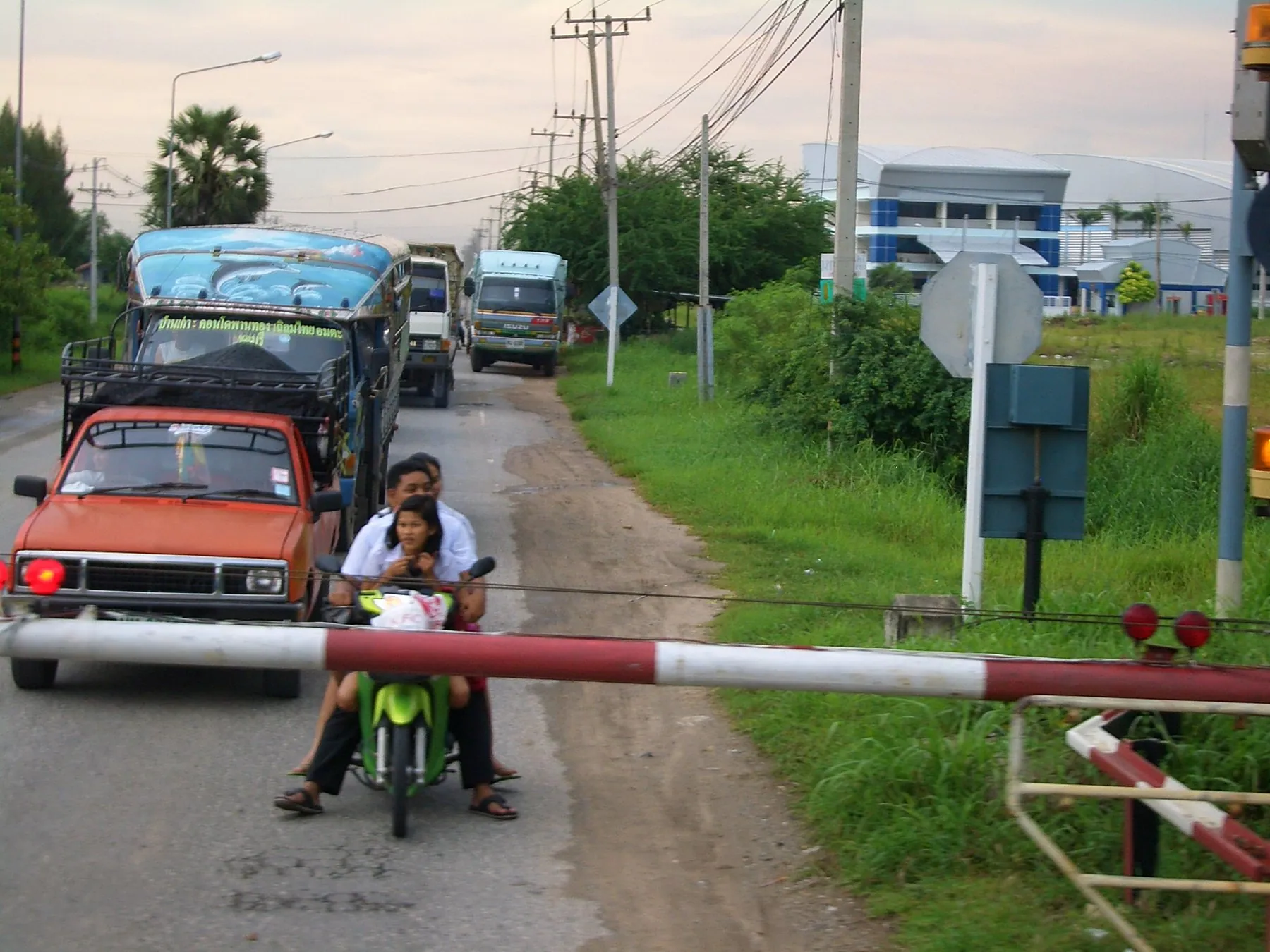
Why the trains catch people out
Three things make a Thai train harder to detect than drivers expect.
They are quieter than you think. A diesel locomotive approaching on continuous welded rail, with a car's windows up and the air conditioning on, is not audible until it is close. On a motorbike with a helmet on and traffic noise around you, the same applies. Do not rely on hearing.
Sightlines are frequently blocked. Vegetation, shophouses built right up to the boundary, stacked goods, parked vehicles and vendors' stalls sit directly beside rural crossings. You often cannot see along the track until you are already on it.
Closing speed is deceptive. A train approaching head-on gives almost no impression of movement until the last few seconds. This is a well-documented perceptual problem and it applies everywhere; it just has more opportunities to matter in Thailand.
How to cross
- Slow right down on approach, every time, at every crossing, regardless of what equipment it has.
- Check that the far side is clear before you move onto the rails. If traffic ahead is queuing, wait behind the crossing until there is space for your whole vehicle beyond it.
- Look both ways along the track, and look again — the second look is when you see the train that the first look missed behind a pole or a tree.
- Cross in a low gear and do not change gear on the rails. Stalling on a crossing is exactly the scenario you are protecting against.
- Do not overtake near the crossing. Section 46 prohibits overtaking within 30 metres of a level crossing.
- Do not stop on the crossing to let a passenger out, take a photograph, or read a map.
What the law says
Section 46 prohibits overtaking within 30 metres of a railway level crossing, as it does near junctions, roundabouts, traffic islands and pedestrian crossings. Section 70 requires a driver to reduce speed at defined points on the road. Section 43(4) prohibits driving without regard for the safety of others, an offence which since the 2022 amendment carries up to a year and a fine of 5,000 to 20,000 baht.
On a motorbike
Rails are the problem before the train is. Steel rail set into asphalt is slippery in the dry and dangerously slippery in the wet, and Thai crossings frequently have a lip, a rut or a gap between rail and road surface where the asphalt has broken away.
Cross the rails as close to a right angle as you can manage. Approaching at a shallow angle — which happens where a road runs diagonally over the line — invites the front wheel to slide along the rail rather than over it, and that puts you down instantly. Slow before the rails, keep the bike upright, do not brake on the metal, and roll across. In the wet, do all of that more.
The same principle applies to painted markings, manhole covers and steel plates over roadworks — see riding a motorbike in tropical rain and potholes and road surfaces in Thailand.
Where you will meet them
The southern line runs down the peninsula more or less alongside Highway 4, and the crossings between Hua Hin and Chumphon are numerous and varied in quality. The northern line to Chiang Mai crosses roads throughout the central plains. The northeastern line into Isaan crosses a great many rural lanes on the flat, where sightlines are good but speeds are high and warning equipment is sparse. The eastern line towards Aranyaprathet does the same.
Bangkok's urban crossings are a different problem: heavy traffic, short gaps and vehicles routinely stopped on the rails because the queue ahead has not moved. This is the situation behind the most serious recent urban collisions, and it is exactly the one the "do not enter unless your exit is clear" rule addresses. In city traffic the temptation to creep forward is strong and it must be resisted. Driving in Bangkok covers the broader question of queuing discipline.
In stop-start traffic, treat a level crossing exactly as you would a yellow box junction: do not enter it until you can leave it. If the vehicle in front has not cleared the far rail, stay put — even if the barriers are up, even if the driver behind is beeping, and even if the gap looks like it will open in a second.
If your vehicle stops on a crossing
Get everybody out of the vehicle first and away from the line, in the direction the train would be coming from, at an angle away from the track. Do not try to restart, retrieve belongings or push the vehicle with people inside. A vehicle is replaceable and a rental deposit is a manageable problem; a struck vehicle is not.
Once clear, look for a phone number on the crossing equipment or at the nearest signal, and call the emergency services. If you are on a hire vehicle, the rental company comes second — after everybody is off the track. What to do when you break down in Thailand covers the general procedure.
Frequently asked questions
Do Thai level crossings have barriers?
Many do, particularly on main roads and in towns. A large number of crossings on minor roads have only lights and a bell, or only a sign, and there are also unofficial crossings with no equipment at all. Never assume the presence or absence of a barrier tells you whether the line is in use.
Who has priority at a Thai level crossing?
The train, always and everywhere, whatever equipment the crossing has. There is no version of this in which the road vehicle proceeds.
What is the single most important rule?
Do not enter the crossing until you can see that you can get off it. Most serious collisions involve a vehicle that was stopped on the rails because the traffic ahead had not moved, not a vehicle that tried to beat a train.
How should I cross the rails on a motorbike?
Slowly, upright, and as close to a right angle to the rails as the road allows. Do not brake on the metal. Rails are slippery dry and much worse wet, and a shallow crossing angle can slide the front wheel along the rail.
Can I overtake near a level crossing?
No. Section 46 prohibits overtaking within 30 metres of a railway level crossing, alongside junctions, roundabouts, traffic islands and pedestrian crossings.
What do I do if my car stalls on the rails?
Everyone out and away from the track immediately, moving at an angle away from the line and towards the direction a train would approach from. Do not attempt to restart or push it with anybody inside. Then call for help.