Get the vehicle off the carriageway, get yourself away from the traffic, and only then start working out what has failed. That order matters more in Thailand than in most places, because a stationary vehicle on a Thai road is not treated with the caution a European driver expects, closing speeds on rural highways are high, and a large proportion of the traffic behind you is a motorbike that may not see you until it is very close.
Once you are safe, a Thai breakdown is usually a much smaller problem than the same breakdown at home. There are mechanics, tyre shops and people with pickups everywhere, parts for the common Japanese scooters and pickups are cheap and universal, and the sums involved are small.
- Highway Police1193
- Department of Highways1586, press 7 for motorways
- Expressways (EXAT)1543, option 1
- Ambulance, if anyone is hurt1669
Do not stand behind or in front of the vehicle. Stand well off the road, up the verge, on the far side of any barrier, and behind the vehicle relative to oncoming traffic only if that means being further from the road. A vehicle can be replaced. If the breakdown is on an expressway or motorway, get out and get behind the barrier immediately — see breaking down on a Thai expressway or motorway.
The first two minutes
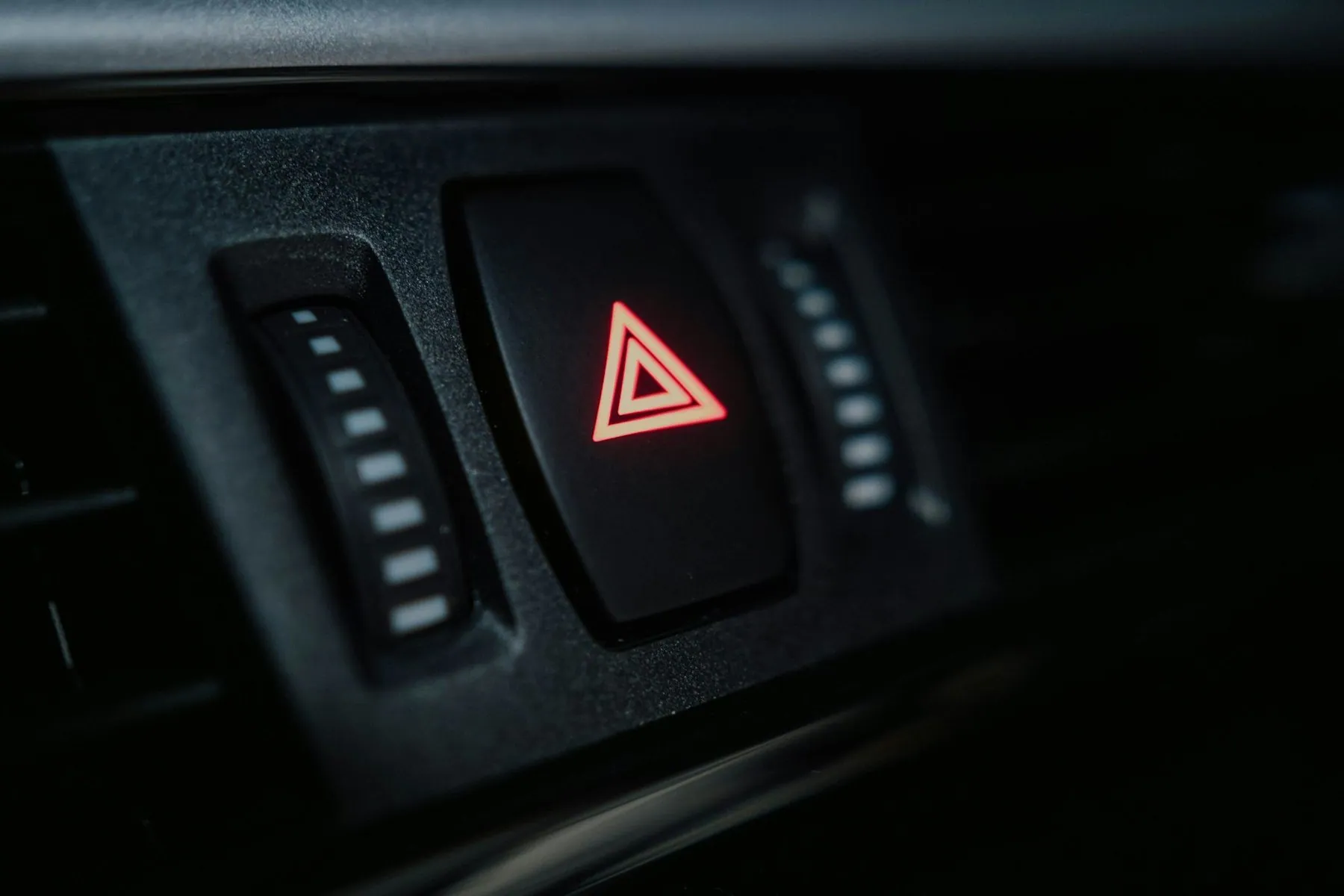
- Hazard lights on as soon as you know something is wrong, before you have worked out what.
- Use the momentum you still have to get to the left and, ideally, off the tarmac entirely — a lay-by, a shop forecourt, a side road, a wide verge. Coasting fifty metres to somewhere safe is worth far more than stopping instantly.
- Wheels straight, handbrake on, and on a slope, in gear or in park.
- Everyone out and off the road, on the left side, away from the traffic.
- Make yourself visible. Hazards, and side lights or parking lights if visibility is poor or it is dark.
- Now look at the vehicle.
What the law says
Under the Land Traffic Act B.E. 2522 (1979), lights must be on whenever people, vehicles or obstructions cannot be seen at 150 metres (s.11), and a parked vehicle must show parking lights where it is not clearly visible at 150 metres (s.61). Where a load projects beyond the vehicle, it must carry a red light at night or a red flag by day visible at not less than 150 metres (s.15). A traffic officer also has power to move or immobilise a vehicle that is obstructing traffic, with charges set by ministerial regulation at not less than 500 baht per vehicle plus not less than 200 baht a day for storage (s.59).
Warning triangles, and an honest gap
Whether Thai law requires a private car to carry a warning triangle, a first-aid kit, a reflective vest or a fire extinguisher is something we investigated and could not establish either way. The Act imposes equipment duties of that kind on vehicles carrying explosives or hazardous substances; for an ordinary car we found neither a clear requirement nor a clear absence of one. So we are not going to tell you it is not required.
What we will say is practical: a hire car may or may not have a triangle in the boot, and if it does not, buy one. They cost almost nothing at any petrol station or hardware shop, and on an unlit Thai road at night a reflective triangle placed a good distance back is worth considerably more than the sum you paid for it. A high-visibility vest is the same argument. What you will actually see used by Thai drivers is a branch, a stack of leaves, or a row of traffic cones improvised from whatever is to hand — effective at telling you something is there, useless at reflecting a headlight beam. What your vehicle must legally carry in Thailand covers the equipment question in more depth.
Working out what has failed
You do not need to diagnose it. You need to know enough to tell a mechanic what happened, and to know whether the vehicle can be driven a short distance.
| What you noticed | Likely area | Drivable? |
|---|---|---|
| Temperature gauge high, steam, sweet smell | Cooling system | No. Stop. See engine overheating. |
| Nothing at all when you turn the key; dim lights | Battery or charging | Possibly, after a jump. See flat battery and electrical faults. |
| Engine cut out cleanly and will not restart | Fuel or ignition | Check the gauge first. See running out of fuel. |
| Steering suddenly heavy, thumping, vehicle pulling | Tyre | Only at walking pace to somewhere safe. See punctures and where to get a tyre fixed. |
| Grinding or scraping from a wheel | Brakes or bearing | No. |
| Fluid on the road under the vehicle | Coolant, oil, brake fluid or fuel | No, until you know which. |
| Scooter loses drive but the engine runs | Drive belt or clutch | No. |
Who to call
The order depends on what you are driving and where you are.
- A hire car or hire bike: the rental company, first and always. Their agreement covers recovery, they know which garage they use, and arranging your own repair is the fastest route to an argument about the bill.
- Your own vehicle with a Thai voluntary policy: your insurer. Roadside assistance and towing are commonly included, and the number is on the policy card.
- On a highway: 1193, the Highway Police Division, which handles crashes and breakdowns on the highway network.
- On a motorway or for road conditions: 1586, the Department of Highways hotline; press 7 for motorways.
- On a Bangkok expressway: 1543, the Expressway Authority, option 1, 24 hours.
- Anyone injured: 1669, always first.
- You need an English speaker: 1155, the Tourist Police.
Roadside assistance in Thailand: who to call goes through what each of those actually gets you, and what rental and insurance breakdown cover typically includes.
Drop a map pin before you ring anyone. "Somewhere on the 4 past the turning with the temple" is not a location. Open your maps app, drop a pin, and either read out the coordinates or send the pin by message. Thai rural addresses are genuinely hard to describe, and this converts a twenty-minute conversation into a thirty-second one. Which navigation apps work here is worth sorting out before you set off.
Getting help locally
Thailand is unusually good at this, and it is worth knowing before you panic. Almost every village of any size has a motorbike repair shop, and they are competent with the small Hondas and Yamahas that make up most of the traffic. Tyre repair shops — look for a stack of tyres, a compressor and an air line — are everywhere on main roads. A pickup and a plank is the standard way a broken motorbike gets moved, and the sum asked will be modest.
Two pieces of practical advice. Agree a price before work starts, using a calculator or a phone screen if there is no shared language, and take a photograph of the part that is replaced. And if you are somewhere with nothing, walk to the nearest shop or petrol station and ask; you will usually be pointed at someone's cousin within five minutes.
Waiting safely
- Off the road, up the verge, behind a barrier where there is one.
- In the shade. Thai heat turns a two-hour wait into a medical problem faster than people expect.
- Water. Keep some in the vehicle as a matter of routine.
- Phone charged, and a power bank if you have one. Everything on this page depends on the phone.
- At night, something reflective on you, and the vehicle lit. Driving at night in Thailand explains what the traffic around you can and cannot see.
- In the rainy season, be aware of where water is running — see the rainy season and flooded roads.
Frequently asked questions
Is there a national breakdown service like the AA or ADAC?
Not in that form. Recovery comes from your insurer's roadside assistance if you hold a voluntary Thai motor policy, from the rental company if the vehicle is hired, from the highway or expressway authorities on their own roads, or from a local garage with a pickup. Save the relevant numbers before you set off.
Should I stay in the car or get out?
On an ordinary road, get out and stand well clear on the left. On an expressway or motorway, get out and get behind the barrier — a stopped vehicle in a live lane is the most dangerous place you can be.
Do I need to carry a warning triangle in Thailand?
We could not establish whether it is legally required, so we will not tell you it is not. Carry one anyway: they cost almost nothing and they work.
Can the police move my vehicle?
Yes. A traffic officer has power to move or immobilise an obstructing vehicle, with charges set by ministerial regulation at not less than 500 baht per vehicle plus not less than 200 baht a day for storage. Getting the vehicle off the carriageway yourself avoids the question.
My hire car broke down. Who pays?
Mechanical failure of the company's vehicle is normally the company's problem, and their agreement will say how recovery works. Damage you caused — wrong fuel, a kerbed wheel, driving through flood water — is a different conversation, and several of those sit outside the standard damage waiver anyway.
What if I break down somewhere with no phone signal?
Coverage in Thailand is good and genuine dead zones are rare outside the mountains. If you have none, walk to the nearest inhabited building rather than staying with the vehicle in the heat, and leave the vehicle visible with the hazards on.