A vehicle that turns over slowly, clicks, or does nothing at all with dim dashboard lights has a battery problem. A vehicle that starts fine, runs, and then dies while you are driving — or whose lights fade as you go — has a charging problem, which is a different and more expensive thing. Telling the two apart at the roadside takes about a minute and decides whether you need a jump start or a mechanic.
Batteries in Thailand lead short lives. Heat is far harder on a lead-acid battery than cold is, and a battery that would give five years in northern Europe will often give two or three here. On rental fleets, where vehicles sit unused for days between hires, it is one of the commonest reasons a hire car will not start in a hotel car park.
- Battery life in this climateShorter than at home — heat, not cold, kills them
- Automatic scootersCannot be bump started; use the kick starter
- Highway Police1193
Telling a flat battery from something worse
| What happens | Most likely | What to do |
|---|---|---|
| Nothing at all, no lights, no click | Completely flat battery, or a disconnected or corroded terminal | Check the terminals are tight and clean, then jump start |
| Rapid clicking, lights dim when you turn the key | Flat battery | Jump start |
| Turns over slowly, then catches | Weak battery or poor charging | It will get worse. Get it tested today. |
| Single loud click, lights stay bright | Starter motor or solenoid | A jump will not fix it. Mechanic. |
| Warning light on the dash while driving; lights dimming | Alternator or regulator not charging | Get to a garage before it dies, or stop somewhere useful |
| Started fine, cut out while driving, will not restart | Charging fault, or fuel, or ignition | Check the fuel gauge first. Then mechanic. |
| Scooter: starter whirrs but engine does not turn | Starter clutch | Kick start it and get to a shop |
Check the terminals before you assume the worst. Heat and humidity produce corrosion, and vibration loosens clamps. A terminal you can move by hand, or one with a crust of white or blue-green powder on it, will stop a perfectly healthy battery from starting a vehicle. Tightening a clamp with the spanner from the boot has rescued a great many roadside mornings.
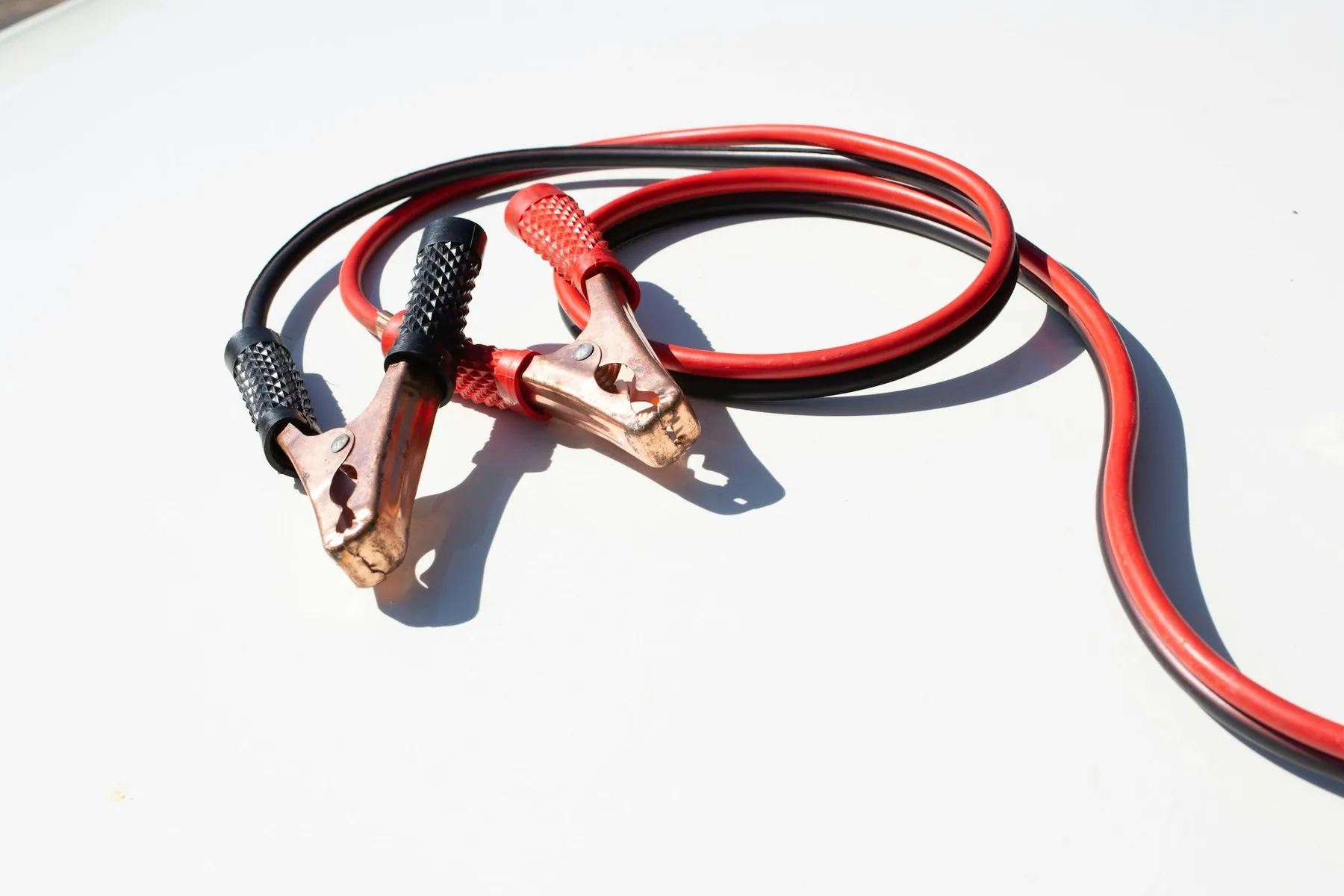
Getting a jump start
Finding help is the easy part in Thailand. Petrol stations, repair shops and, frankly, most drivers will help if you ask. What you need is leads, and those are worth buying on your first day if you have bought a vehicle here — they cost very little at any motor factor or hardware shop.
- Park the donor vehicle close but not touching. Both engines off, both handbrakes on.
- Red lead: donor positive first, then flat battery positive.
- Black lead: donor negative, then a bare metal point on the flat vehicle's engine or chassis, well away from the battery — not the flat battery's negative terminal.
- Start the donor and let it run for a few minutes.
- Start the flat vehicle. If it does not go within about ten seconds of cranking, stop and wait rather than grinding the starter.
- Remove the leads in the reverse order, and keep the revived engine running.
- Drive for at least twenty or thirty minutes, ideally at road speed rather than idling in traffic. A jump gets you going; it does not recharge a flat battery.
Do not jump start a modern car casually. Cars with stop-start systems, AGM batteries or sensitive electronics can have specific procedures and specific connection points, and getting it wrong can be expensive. On a hire car, ring the rental company first and let them arrange it — it is their vehicle and their problem, and a self-arranged jump that damages something becomes yours.
Motorbikes: the bump start question
Here is the point that catches visitors out. An automatic scooter cannot be bump started. The centrifugal clutch disengages below a certain engine speed, so pushing the bike and dropping it into gear does nothing at all — there is no gear to drop it into. What almost every Thai scooter does have is a kick starter: a folding lever on the right-hand side, often tucked away and often unused. Learn where it is on your rental bike, in the shop, on day one.
Using it: ignition on, fuel on if there is a tap, a little throttle, and a firm full-stroke kick rather than a stab. Two or three attempts. If the engine fires and then dies as soon as you release the starter, the charging system is not keeping up.
A geared motorbike with a manual clutch can be bump started — second gear, clutch in, push or roll downhill to a decent speed, drop the clutch. That is a small minority of the bikes a visitor will be riding.
Buying a replacement
Batteries are cheap and available everywhere in Thailand, and fitting is usually included or costs almost nothing. Motorbike batteries are stocked by every repair shop; car batteries by tyre shops, motor factors and the battery chains that advertise on every provincial main road. A shop will normally test the battery and the charging system before selling you one, which is worth having done — replacing a battery when the alternator is the problem simply flattens a new battery.
On a hire vehicle, do not buy anything. Ring the company. Roadside assistance in Thailand: who to call covers who does what.
Electrical faults that are not the battery
- Lights that do not work are a legal problem as well as a safety one — under the Act lights must be on whenever visibility is under 150 metres, and a parked vehicle must show lights where it is not visible at that distance. See lights and indicators: what Thai law requires.
- Water ingress. Riding through standing water in the rainy season gets into connectors, switches and coil packs. A bike that runs badly after a flooded road is often just wet — see the rainy season and flooded roads.
- Corroded connectors, which is what heat and humidity do to any exposed electrical joint over a couple of years.
- Aftermarket accessories. Extra lights, phone chargers and alarms fitted badly are a common source of parasitic drain on a bike that has been standing.
- A blown fuse, which is the cheapest possible fix and the first thing a shop will check.
Check the lights before you take a rental bike out. Both headlight beams, brake light, indicators and horn — in the shop, in daylight, before you have paid. On a machine that will be ridden at dusk this is the highest-value ninety seconds of the whole handover, and it is part of the same check as the tyres and the brakes. What to photograph before you drive away covers documenting it.
Preventing it
- If you own a vehicle here and it stands for weeks — common for long-stayers who travel — either disconnect the battery or fit a trickle charger.
- Have the battery and charging system tested when you have anything else done. It takes a minute and shops do it as a matter of course.
- Do not leave a scooter with the ignition on. It is easy to do on a keyless or push-button machine and it will flatten the battery overnight.
- Replace a battery that has already gone flat twice. In this climate, that is the battery telling you.
Frequently asked questions
Can I bump start a scooter?
No — an automatic scooter cannot be bump started, because the clutch disengages at low engine speed. Use the kick starter, which almost every Thai scooter has. A geared bike with a manual clutch can be bump started in second gear.
How long do car batteries last in Thailand?
Less than in a temperate climate. Heat is harder on a lead-acid battery than cold, and vehicles that stand unused for long periods fare worse still. Treat any battery that has flattened twice as finished.
The car started after a jump. Am I fine now?
Only if the battery was flat for an obvious reason — lights left on, a long period standing. Drive for at least half an hour at road speed afterwards, and have it tested. If it goes flat again, the battery or the alternator is failing.
Where do I buy a battery?
Motorbike batteries at any repair shop; car batteries at tyre shops, motor factors and the battery chains on provincial main roads. They are cheap, fitting is usually free or nearly so, and most shops will test the charging system before selling you one.
My hire car will not start. What should I do?
Ring the rental company before you arrange anything. It is their vehicle, mechanical failure is normally their responsibility, and a jump start you organise yourself that damages the electronics becomes your bill.
The scooter dies whenever I stop at lights. Is that the battery?
It can be a weak battery or charging fault, but it is just as often an idle-speed or fuelling issue, or a machine that simply needs servicing. Any village repair shop will look at it for very little.