Start at first light, drink far more than thirst suggests, take salt with it, and plan a riding day that ends by late morning. Thailand's heat is not the same problem as a Mediterranean summer, because the humidity stops sweat evaporating properly and therefore stops your body cooling itself. A rider who can comfortably do 140 kilometres in Spain in August may find 70 kilometres in Nakhon Ratchasima in April genuinely dangerous.
This is written for the touring cyclist, because heat is what most often ruins a first tour here. If you are hiring a bike for a couple of hours around Sukhothai, the short version is simple: go before 09:00 or after 16:00, carry water, and do not try to see all five zones in one midday push.
- Hot seasonMarch to May, peaking mid-April
- Coolest ridingNovember to February
- Best riding windowFirst light to about 10:00
- The compounding factorHumidity, not just temperature
Why humid heat is a different problem
In dry heat, sweat evaporates and takes heat with it, so a rider drinking enough can cope with surprisingly high air temperatures. In Thailand's humidity — routinely above 70 per cent, higher in the monsoon and near the coasts — evaporation slows down. Sweat runs off you instead of cooling you. You lose the fluid and the salt without getting the benefit, and your core temperature climbs anyway.
Two things follow. First, you can be well hydrated and still overheat, so drinking is necessary but not sufficient; you also need to shed load, find shade and stop. Second, dehydration arrives faster than in dry climates because sweat rates are enormous and largely invisible in the wind.
Thailand's seasons are conventionally three: a cool season from November to February, a hot season from roughly March to May, and the southwest monsoon from about June to October. The hot season is the one that catches people out. Mid-April is the peak, when the sun is close to directly overhead at midday and inland provinces regularly go past 38 degrees. Northern Thailand also has agricultural burning haze at that time of year, which makes hard breathing worse and turns the mountain views to grey.
Heat exhaustion is a judgement failure before it is a medical one. The first symptom most cyclists notice in themselves is not thirst or dizziness — it is deciding that the next town is close enough, or that they can skip a water stop. If you find yourself making optimistic decisions on a hot day, that is the signal to stop, not push on.
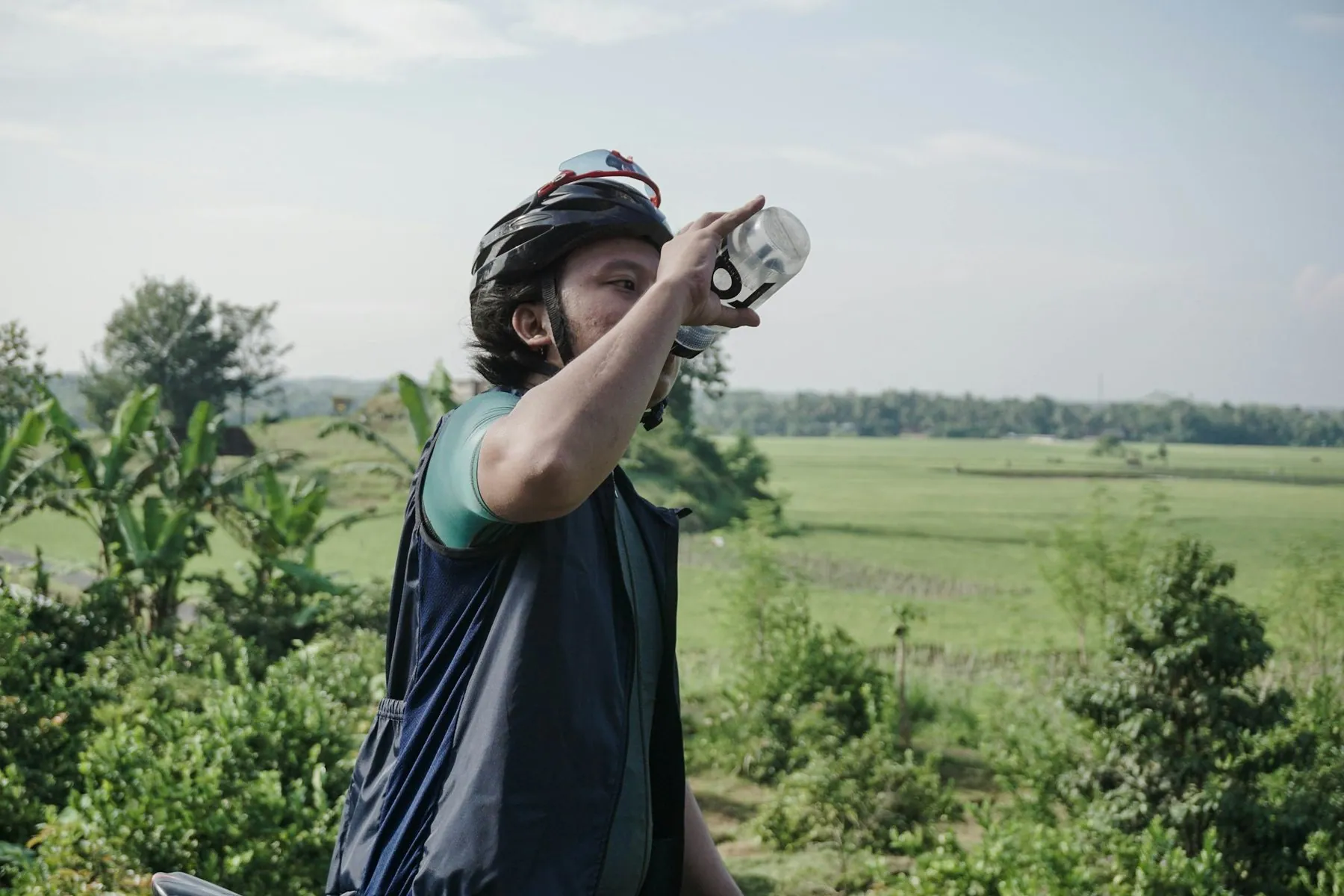
Structuring the day
Thailand sits close enough to the equator that daylight barely shifts through the year. First light is around 06:00 and dark comes quickly around 18:00 to 18:30, with very little twilight. That gives you a fixed and quite short useful window.
| Time | Conditions | What to do |
|---|---|---|
| 05:30–06:00 | Cool, still, dark to half-light | Pack, eat, get lights on and go |
| 06:00–09:00 | The best riding of the day; light traffic | Cover most of your distance here |
| 09:00–11:00 | Climbing fast; shade thinning | Finish the stage; drink at every shop |
| 11:00–15:30 | Peak heat and glare | Off the bike. Eat, sleep, sit under a fan |
| 15:30–17:30 | Still hot but bearable | Optional second leg, short |
| After 17:30 | Dark, dogs active, unlit traffic | Be finished. See night riding risks |
The long midday stop is not lost time, it is what makes consecutive days possible. Thai roadside culture supports it beautifully: every small town has a shop with plastic chairs, a fan and a fridge, and nobody will move you on. Riding through the middle of the day for one day is fine. Doing it for five is how tours end.
How much to drink, and what
Water alone is not enough on a long hot day. You will be losing sodium in quantity, and replacing only the water dilutes what is left — that is the mechanism behind the headache, nausea and confusion that riders often mistake for simple dehydration. You want fluid with salt in it, or fluid plus salt separately.
The practical answer in Thailand is cheap and everywhere: electrolyte powders from any pharmacy or 7-Eleven (oral rehydration salts are sold in sachets and are far better value than sports drinks), salty Thai food at every meal, and the ubiquitous 100 Plus and similar drinks. Coconut water from a roadside stall is a genuinely good recovery drink and costs very little.
- Two large bottles on the bike, minimum, plus a spare litre in a bag on long empty stretches
- Oral rehydration sachets — a strip of them weighs nothing
- Drink at every shop stop whether or not you feel thirsty
- Eat salt deliberately: soup, salted nuts, anything with fish sauce in it
- Check your urine colour rather than trusting how you feel
- Cold drinks over ice are fine and help; the folklore about them being harmful in heat is not supported
Ice is the underused resource. Bags of ice cost a few baht at any shop. Fill a bottle with ice and top it with water and it stays cold for an hour; tip a handful down the back of your jersey and the effect on core temperature is immediate. In small towns, ask for nam kaeng.
Sun
You are much closer to the equator than you are used to, and the UV is correspondingly harsh even on a hazy day. Riders burn on the backs of the hands, the back of the neck, the ears and the tops of the thighs, and a bad burn on day two costs you the rest of the week.
Cover beats cream for a tour: a long-sleeved lightweight jersey in a pale colour is cooler than bare skin in direct sun, because it stops radiant heating while still letting sweat move. Add a cap under the helmet with a peak, arm covers if you prefer them to sleeves, and high-factor sunscreen on everything left over, reapplied after every long stop because it sweats off. The same problem hits motorbike riders and the treatment is the same — see sunburn and dehydration on a bike.
Realistic distances
Reduce whatever you would do at home. A reasonable rule for a loaded tourer in the Thai hot season is around two-thirds of your European daily distance, and half of it if you are in the northern hills. In the cool season you can go back to near-normal figures, which is exactly why November to February is the season everyone recommends.
Terrain multiplies the effect. Climbing generates heat you cannot shed at 8 km/h with no airflow, which is why the northern climbs are cool-season objectives rather than April ones — see the north's hills and big climbs and, for the multi-day version, cycling the Mae Hong Son loop. Flat routes in Isaan are far more forgiving of heat, though Isaan gets brutally hot in April too.
Acclimatisation
It takes most people one to two weeks of daily exposure to adapt meaningfully: sweat starts earlier, is more dilute, and you lose less salt. Which means the worst days of your trip are the first three, exactly when enthusiasm is highest and you are most likely to overreach. Build a soft start — short stages, early finishes, a rest day in the first week — and the rest of the tour gets easier.
Sleep matters more than usual. A hot night in a fan room with poor sleep leaves you starting the next day already depleted. On a long tour, paying a little more for air conditioning on the hottest nights is a performance decision, not a luxury one.
Recognising trouble
Heat exhaustion looks like heavy sweating, weakness, headache, nausea, cramp and a fast pulse, and it responds to getting out of the sun, cooling down and drinking with salt. Heat stroke is a medical emergency: confusion, disorientation, sometimes skin that has stopped sweating, and it needs cooling and a hospital rather than a rest and a Coke. If a riding companion stops making sense, that is the sign to act rather than wait.
Thai hospitals in the provinces handle heat casualties routinely and treatment is not expensive by Western standards, but if you are somewhere remote the ambulance may be a long way off — Thai hospitals and what treatment costs sets out how the system works. Keep emergency numbers offline on your phone.
Frequently asked questions
How hot does it actually get for a cyclist in Thailand?
Air temperatures in the hot season commonly reach the high thirties inland and can exceed 40 degrees, but the number that matters is the combination with humidity. A 33-degree day at 80 per cent humidity is harder work than a dry 38-degree day, and the tarmac itself radiates a great deal of extra heat back at you.
Can I cycle in Thailand in April?
Yes, but with the day restructured around it — a dawn start, a long middle-of-the-day stop, short stages, and no ambitions in the northern mountains, where April also brings burning haze. It is the month experienced tourers here avoid if they can choose.
Are sports drinks or oral rehydration salts better?
Oral rehydration sachets from a Thai pharmacy contain more sodium and cost a fraction of a sports drink. Use them on hard days and use ordinary drinks the rest of the time. Salty food at meals does a lot of the work.
Does the rainy season solve the heat problem?
Partly. Rain brings the temperature down for a few hours, but the humidity goes up and the mornings before a storm can be oppressive. It is a real trade-off, and it is set out in cycling in Thailand's rainy season.
What should I wear in this heat?
Light-coloured, loose, long-sleeved and quick-drying, with a peaked cap under the helmet. Covering up beats bare skin in direct tropical sun. Specific kit choices are in cycling gear for a hot-climate tour.
Is it safe to ride with children in this climate?
Children overheat faster than adults and are worse at recognising it, particularly in a trailer or a child seat where they are not generating airflow. Shorter rides, early starts and constant drinking — see cycling with children in Thailand.