Chiang Mai is the easiest large Thai city to drive in, and the one where a hire car or a scooter genuinely earns its keep, because everything worth reaching — the mountain, the valleys, the loops — is outside the city and awkward to get to any other way. The city itself is small, flat and legible once you have grasped one piece of geometry: the old town is a square surrounded by a moat, the roads on either side of that moat are one-way, and they run in opposite directions.
Get the moat wrong on your first afternoon and every subsequent instruction from your satnav will sound like nonsense. Get it right and Chiang Mai stops being confusing within about half an hour.
- Old cityA moated square, roughly 1.5 km on each side
- Inner moat roadOne-way, anticlockwise
- Outer moat roadOne-way, clockwise
- Worst hoursSchool run, about 07:30–08:30 and 15:00–17:00
The moat, and the only rule that matters
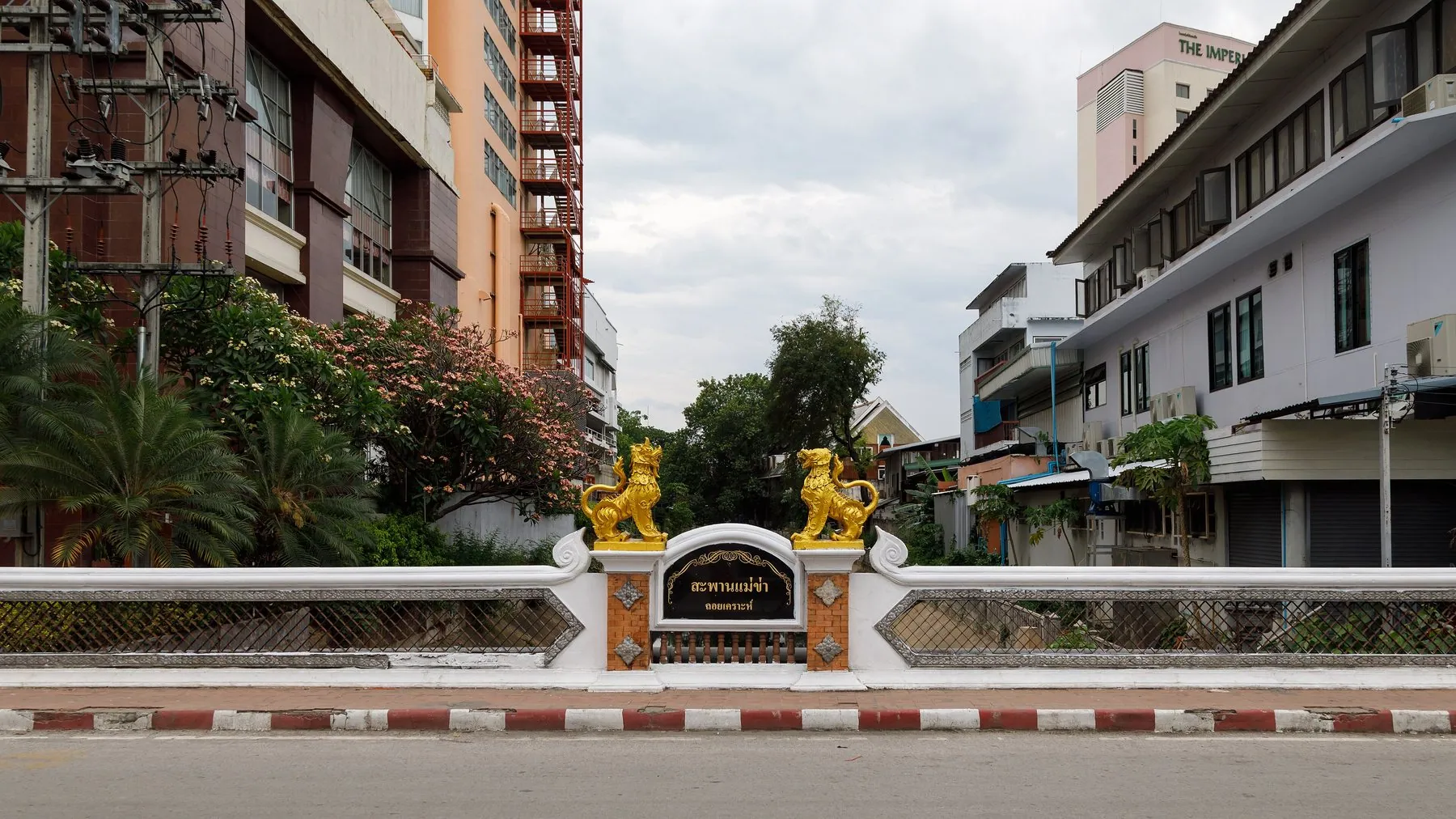
The old city sits inside a square moat with a road on each bank. Traffic on the road inside the moat runs anticlockwise. Traffic on the road outside the moat runs clockwise. In effect the water is a very wide central reservation and the two roads are the two carriageways of a one-way ring.
What that means in practice at, say, Tha Phae Gate on the eastern side: the inner road (Moon Muang) carries you north, and the outer road (Kotchasan) carries you south. On the northern side of the square the inner road takes you west and the outer road east, and so on around. If your destination is on the far bank, you cannot simply cross — you go on to a bridge or a gate, where the crossings are, and come back the other way.
If you are ever unsure which way a Chiang Mai street runs, look at how the parked cars are facing. On a one-way street they will all point the same way, and that way is the way you go. It is a faster check than reading a sign in Thai script, and it works everywhere in the country.
The corners of the moat are where things go wrong. Each corner carries a signalised junction plus turns onto the crossing roads, and visitors regularly find themselves committed to an arc they did not intend. If you miss your gate, do not attempt a U-turn on the moat road — carry on round. The loop is under six kilometres; going the long way costs you five minutes and nothing else. The general principles are in one-way streets in Thailand.
Inside the walls
The old city's internal grid is a mesh of narrow lanes, many of them one-way, several of them barely wide enough for a car with a scooter parked on one side. It is charming on foot and a nuisance in a vehicle. Ratchadamnoen Road runs east–west through the middle and is the main axis; almost everything else is a soi.
Two closures to know. On Sunday evening the Sunday Walking Street shuts Ratchadamnoen Road and much of the surrounding area to traffic. On Saturday evening the Saturday Walking Street closes Wualai Road, just south of the moat. Both start in the late afternoon and run into the night, and both create a ring of parked cars and diverted traffic around them. If you are staying inside the old city, work out in advance whether your hotel will be inside the closed zone.
Getting around the outside: the superhighway and the ring roads
Chiang Mai's traffic engineering is essentially a set of concentric rings. Immediately outside the moat is the local street network. Beyond it runs the Superhighway — the final stretch of Highway 11, which curves around the north and east of the city and ends at its junction with Huay Kaew Road to the northwest. It is the fastest way from one side of Chiang Mai to the other and it is where the big retail sits, including Central Festival.
Further out again is the outer ring road, Highway 121, which along part of its length runs beside the irrigation canal and is known locally as Canal Road. It carries the through traffic and is the road to use if you are crossing the region rather than visiting the city — heading for Hang Dong, San Kamphaeng or the road south, for instance.
Both are well signed. Once you are on either, the green distance signs give the next town in Thai and English, which is usually a faster way to orient yourself than hunting for a road number.
Where the traffic actually is
Chiang Mai does not have Bangkok's congestion, but it has concentrated pinch points and a pronounced school-run peak. The reliable ones:
- The moat corners, particularly the northeast and southeast, at both peaks.
- Huay Kaew Road where it meets the Superhighway and again at the Maya junction in Nimman — a slow, busy, pedestrian-heavy crossroads.
- Nimmanhaemin Road and its sois. Nimman is a dense grid of narrow sois with cars parked on both sides. Alternate-day parking restrictions apply on several of them and are widely ignored, which makes the streets narrower still.
- Chang Klan Road around the Night Bazaar in the evening.
- The Warorot market area and the river bridges near it, at almost any daylight hour.
- The Superhighway itself at the evening peak, especially at the Central Festival junctions.
Parking
Chiang Mai parking is far more relaxed than Bangkok's, but the same painted-kerb system applies — red and white means no stopping, and it is used liberally around the moat and the gates. There is metered and marked parking along parts of the moat roads and in the old city, and it fills early.
The reliable options are the malls: Central Festival on the Superhighway, Maya at the top of Nimman, and Central Airport Plaza near the airport all have large multi-storey car parks, usually free for a few hours against a purchase, with separate motorbike decks. For a day in the old city, park at one of the temple or market car parks near a gate and walk in; the old town is small enough that walking is faster than driving anyway. The law behind the kerb colours is in parking rules in Thailand.
The road up Doi Suthep is not a city road. Huay Kaew Road becomes Route 1004 and climbs steeply into hairpins for around fifteen kilometres. It is where a large share of Chiang Mai's visitor motorbike accidents happen: an underpowered scooter with two people on it struggles going up and overheats its brakes coming down. Use engine braking, stop if the brakes start to feel soft, and read mountain roads and hairpin bends before you set off.
The other road users
Chiang Mai's red songthaews are shared taxis with no fixed route. They stop wherever a passenger flags them or gets out, without much warning and often in the live lane. Leave room, and expect the stop rather than being surprised by it — songthaews and how they stop explains the pattern. Tuk-tuks behave similarly. Cyclists are common here in a way they are not in most Thai cities, particularly on Canal Road, and the city has a genuine road-cycling culture that puts groups on the mountain roads at dawn. Give them room, and expect them on the climbs before the traffic builds.
From roughly February to April, the burning season fills the valley with smoke. Visibility on the ring roads and the mountain roads drops, sometimes considerably, and dawn and dusk are the worst of it. Use dipped headlights and lengthen your following distance.
Is it worth having a vehicle here?
Yes — more so than in any other Thai city. Chiang Mai is the base for the best driving in the country, and almost all of it starts within an hour of the moat: the Samoeng loop as a half-day introduction, the climb to Pai on Route 1095, the full Mae Hong Son loop, and the run east to Chiang Rai on Highway 118. What the region demands of a vehicle is set out in driving in northern Thailand.
For the city alone, a scooter is usually the better tool than a car: parking is trivial, the old city lanes are easier, and the distances are short. Where to get one, and what the local shops expect, is in renting a motorbike in Chiang Mai.
Which way does traffic go around the Chiang Mai moat?
The road inside the moat runs anticlockwise and the road outside runs clockwise, each one-way. If you miss your turning, carry on round rather than attempting a U-turn.
Is Chiang Mai easy to drive for a first-timer in Thailand?
Relatively, yes. Traffic is lighter than Bangkok's, distances are short and drivers are patient. The two things to respect are the one-way moat system and the mountain roads immediately outside town.
Can I drive inside the old city?
Yes, but many lanes are narrow and one-way, and parking is scarce. It is usually quicker to park near a gate and walk. Note the Saturday and Sunday walking street closures.
Should I rent a car or a scooter in Chiang Mai?
A scooter for the city and short loops; a car if you are doing the Mae Hong Son loop with luggage, travelling with children, or visiting in the rainy season. The trade-offs are in scooter or car?
How bad is the traffic compared with Bangkok?
Far milder. Chiang Mai's congestion is concentrated in the school-run peaks and around a handful of junctions, and even at its worst it is a delay rather than a standstill.
Is the road to Doi Suthep safe on a scooter?
It is a steep mountain road with tight hairpins and heavy tourist traffic. A competent rider on a healthy 125cc machine, riding solo, will be fine. Two people on a small automatic with worn brakes is the combination that goes wrong.