Chiang Mai has the most developed motorbike rental scene in Thailand, and it shows in the way the shops behave. Several firms around the old city have been trading for decades, keep proper contracts, take a cash deposit rather than your passport, and will hand you a service history if you ask. That is not the norm on the islands. The rental cluster is easy to find: Moon Muang Road and the sois off it, the streets around Tha Phae Gate, and a run of big-bike specialists over towards Chang Moi Road.
The national picture — paperwork, insurance, deposits, what a shop can and cannot bill you for — is in our guide to renting a motorbike in Thailand. What is different about Chiang Mai is that renting is the easy part. The city's one-way moat, its ring roads and the mountain routes that start twenty minutes from your guesthouse are what actually shape the decision about which bike you take.
- Typical daily rateRoughly 150–300 baht for a 110–125cc automatic; 700–1,600 baht for a 400cc-plus machine
- TerrainFlat valley city, with mountain roads on three sides
- Best vehicle125cc for town; 150cc or a manual for the mountains
- Worst seasonLate February to April, when burning-season smoke fills the valley
The moat, and why people ride the wrong way round it
The old city is a square surrounded by a moat, and the roads on both sides of that moat are one-way. The usual description is that the outer carriageway runs clockwise and the inner one anti-clockwise, but the practical instruction is simpler: follow the arrows painted on the road and the direction of the traffic already moving, because visitors who try to reason it out from a map end up entering a lane the wrong way. Signage at the corner gates is not always obvious, and you cannot simply U-turn to fix a mistake — you complete the circuit.
The crossings at the corner gates are where the two carriageways interact and where most of the city's minor collisions happen — slow right down at Tha Phae, Chang Phuak, Suan Dok and Chiang Mai Gate. See one-way streets and wrong-way riders and driving in Chiang Mai. Outside the moat, the Superhighway (Route 11) and the ring roads are the quickest way across the city but are not comfortable on a small scooter; the rest is a flat grid of sois, genuinely pleasant at low speed.
The mountain is right there
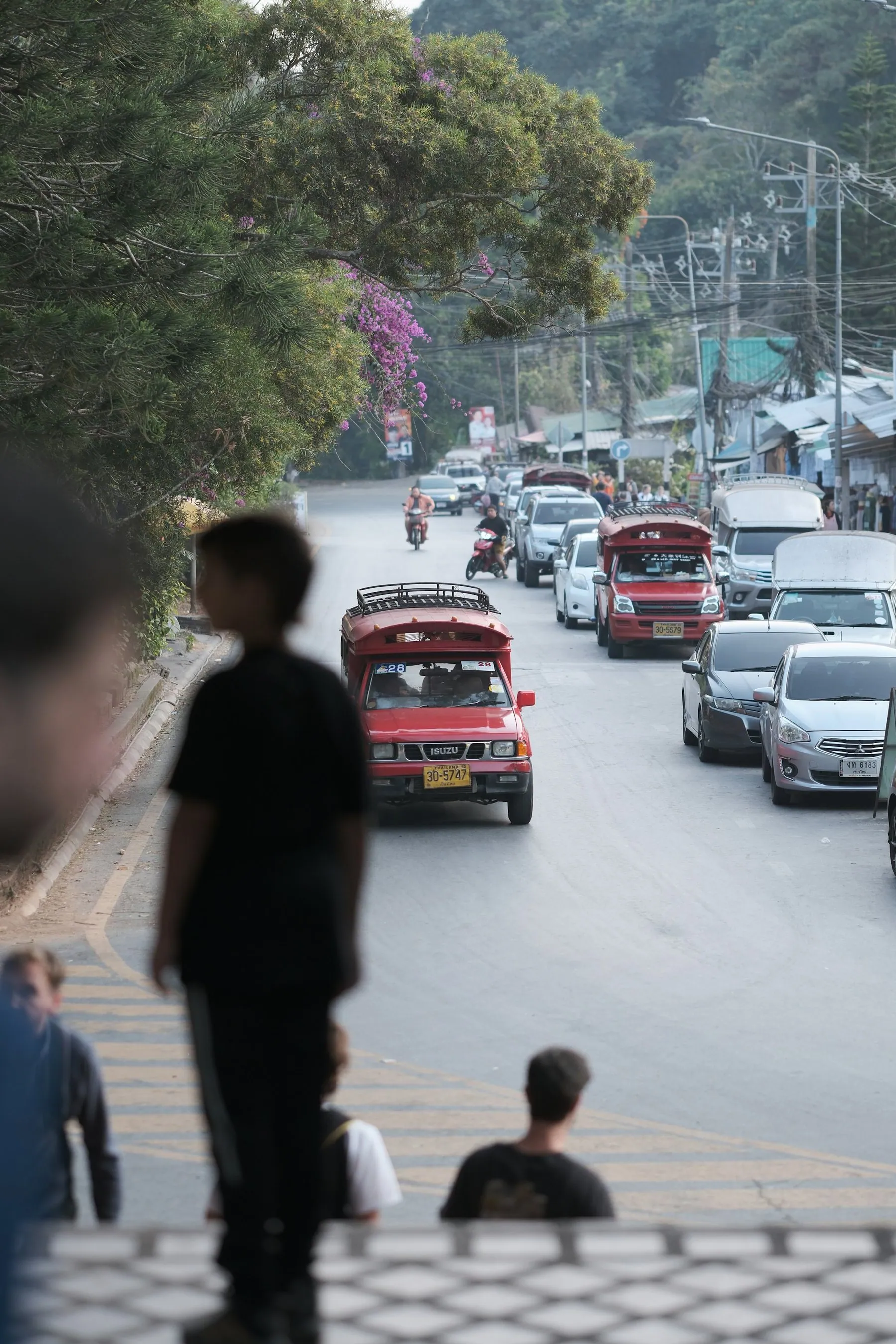
What makes Chiang Mai different from every other rental town in Thailand is that the good riding starts almost immediately. Route 1004 climbs from the western edge of the city to Doi Suthep and Doi Pui — a steady, twisting ascent with hairpins, tour minibuses and songthaews all the way up. The Samoeng loop is a half-day out, and Route 1095 to Pai and the Mae Hong Son loop both start here.
This changes what you should rent. A 110cc step-through is fine for the moat and miserable on Doi Suthep two-up. If mountains are on your list, take a 150cc at minimum, or a manual if you can ride one — engine braking on a long descent is worth more than power going up. See choosing a rental scooter and mountain roads and hairpin bends.
Chiang Mai is the place to rent a big bike. If you hold a full motorcycle entitlement at home, the 250–1,000cc rental market here is the deepest in the country, concentrated around Chang Moi Road and the eastern side of the old city. Shops renting real motorcycles ask real questions about your licence and take substantial deposits, which is a good sign. See renting a big bike in Thailand.
Shops that do deposits properly
The reason to compare shops in Chiang Mai is that here you have a real choice. A number of established firms advertise explicitly that they do not hold passports, taking a cash deposit or a photocopy instead, and several publish their damage pricing up front. That is the market you want to buy in — see passport as deposit for motorbike hire and rental deposits explained.
Chiang Mai is also the best city in Thailand for long-stay riders. The digital-nomad and retiree population supports a proper monthly rental market, with servicing included and rates far below the daily equivalent — see monthly motorbike rental in Thailand. Even in a mature market, do the video: the motorbike rental inspection video settles arguments that would otherwise come down to your word against a shop's.
The burning season is a real planning factor
From roughly late February to April, agricultural burning across northern Thailand and neighbouring countries fills the Chiang Mai valley with smoke. Air quality readings in March regularly reach levels many times the World Health Organization's daily guideline, and visibility of the surrounding hills drops sharply. For a rider this matters twice over: you are breathing it directly, and haze on mountain roads cuts sightlines through bends where you most need them.
It is not a reason to cancel a trip, but it is a reason to bring a proper filtering mask, to check an air-quality app before committing to a day in the hills, and to be honest with yourself if you have asthma. The smoke usually clears with the first serious rain in late April or May.
December and January mornings are cold in the hills. Chiang Mai city is mild, but the top of Doi Suthep or the road towards Pai before nine in the morning can be genuinely cold on a bike, and riders regularly set off in shorts and a T-shirt because it was warm at the guesthouse. Fog also sits in the valleys at dawn. Take a layer; see protective riding clothing in a hot climate.
Prices and seasons
Chiang Mai is cheaper than the islands and less volatile. A 110–125cc automatic typically runs around 150–300 baht a day (roughly £3.50–£7 / US$4.50–US$9), the lower end for older bikes on a weekly rate and the upper end for a new machine in high season; larger bikes climb steeply from there. See scooter rental prices in Thailand. The one week that sells out is Loi Krathong and Yi Peng in November, and again New Year.
Riding out of Chiang Mai
Most visitors who rent here end up riding further than they planned. Ask the shop directly whether the bike may leave the province — most say yes, a few charge extra for a Pai or Mae Hong Son trip because of what those roads do to tyres and brakes. See driving in northern Thailand and Chiang Mai to Chiang Rai.
Frequently asked questions
Is Chiang Mai a good place to learn to ride a scooter?
Better than most: flat, with quiet residential sois to practise in and low speeds inside the moat. The mistake is going from a first ride to Doi Suthep or the Pai road the same day.
Which shops do not take your passport?
Several long-established Chiang Mai firms advertise a no-passport policy and take cash or a photocopy instead. Ask before you agree anything; a shop insisting on the original is one to walk away from. See passport as deposit.
Can I rent in Chiang Mai and drop the bike in Pai?
Some shops offer exactly that for a one-way fee, and it is a popular way to ride the 1095 in one direction only. Confirm it in writing before you leave; Chiang Mai to Pai describes the road.
Do I need a bigger bike for Doi Suthep?
Not strictly — small automatics go up every day — but a 125 with two adults and a rucksack works hard on the climb and is short of engine braking coming down. A 150cc or a manual is safer.
How bad is the smoke, really?
Bad enough that Chiang Mai regularly appears near the top of world air-pollution rankings in March. Views disappear and sensitive people feel it within a day. If clean mountain air is the point of your trip, aim for November to January.
Is a rented scooter covered if I crash it in the mountains?
Rarely in the way visitors assume. Thai scooter rentals typically carry minimal cover and the damage bill lands on you. Read what voids your motorbike cover and motorbike rental damage claims.