Chiang Mai to Pai is about 135km and takes three to three and a half hours if you drive it without stopping. Almost all of that is Route 1095, a two-lane mountain highway credited with 762 bends, which works out at a corner roughly every 175 metres for the entire journey. It is the most-ridden mountain road in Thailand and the one that most often ends with a rental shop inspecting a scraped fairing.
The road itself is not the problem. It is properly built, well surfaced and generously signed. The problem is that it never stops, and that a very large proportion of the people on it are riding a motorbike they collected two days ago.
- DistanceAbout 135km
- Driving time3-3.5 hours without stops
- RoadRoute 107 then Route 1095
- Bends762 (the local count)
- Best seasonNovember to February
The route in order
Leave Chiang Mai north on Route 107 (Chotana Road), a wide, flat, four-lane road that runs about 35km to Mae Malai. This part is dull and busy and involves U-turn bridges rather than right turns; get it out of the way. At Mae Malai, Route 1095 branches left and the character changes immediately.
| Section | Road | Distance | What it is like |
|---|---|---|---|
| Chiang Mai - Mae Malai | 107 | about 35km | Flat, four lanes, traffic lights |
| Mae Malai - Mok Fa waterfall | 1095 | about 20km | Climbing, wide bends, easy |
| Mok Fa - the summit section | 1095 | about 40km | Continuous hairpins, steepest gradients |
| Summit - Pai | 1095 | about 40km | Descending, fast open bends, then valley |
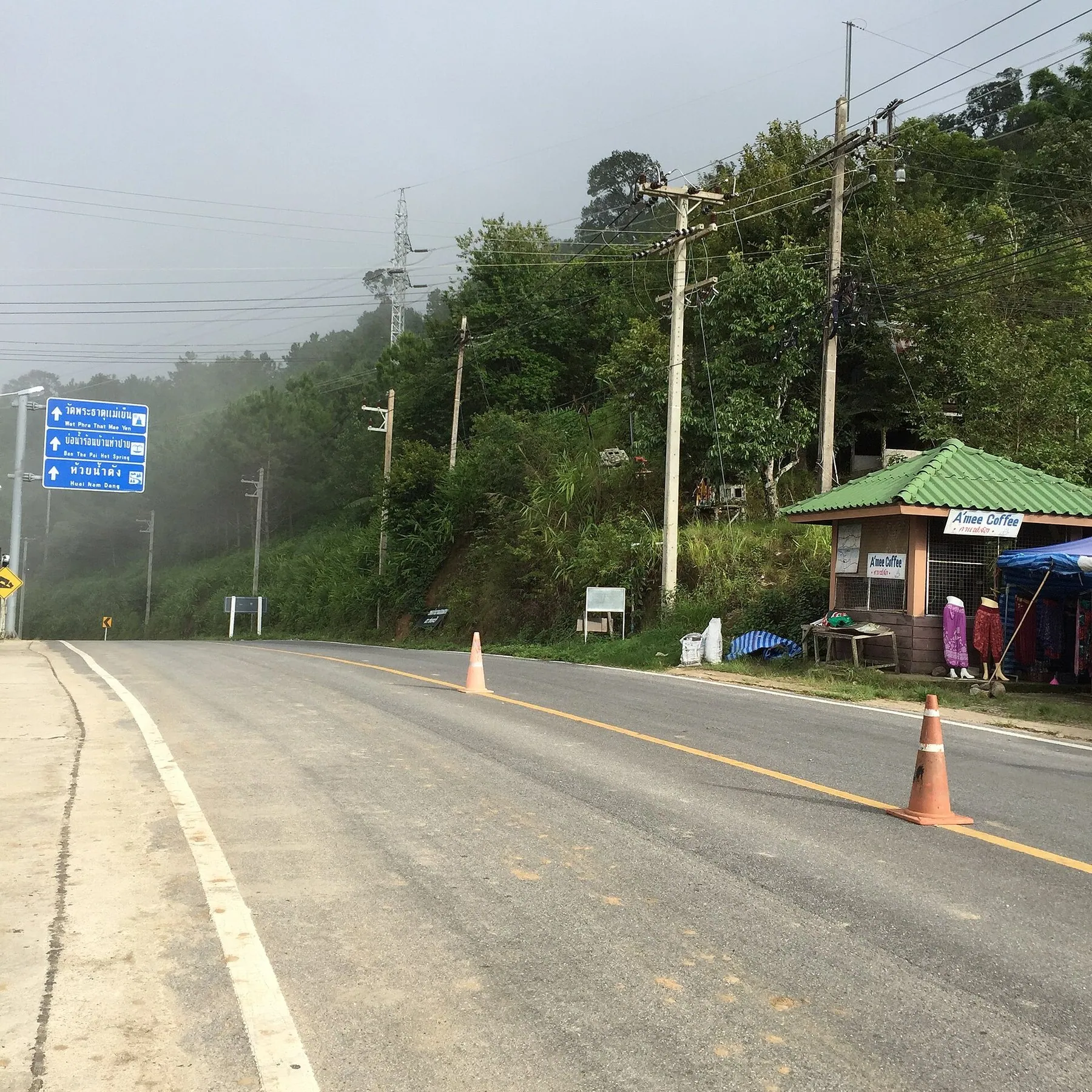
The middle section, roughly between kilometre 45 and kilometre 90 of Route 1095, is the real road. This is where the hairpins stack up one after another, where the gradient is steepest in both directions, and where every warning in this article applies. It lasts around an hour on a bike.
Where the road bites
Four specific things account for most of the trouble on the 1095.
Decreasing-radius bends. A great many of the hairpins tighten through the corner rather than holding a constant curve. If you set your line and your speed on the entry, you will run wide at the exit. The fix is to enter slower than feels necessary and only open up once you can see the exit — standard mountain technique, but a lot of visitors have never needed it before.
Blind crests with a bend behind them. Several climbs crest and immediately turn. You cannot see over them, and the road is narrow enough that anything oncoming and badly positioned will be in your lane.
Minibuses. The Chiang Mai to Pai minibus service runs the route on a timetable that does not respect the geometry. Drivers use the full width of the road, overtake into bends and descend fast. Their passengers are famously travel-sick, which tells you most of what you need to know. Position yourself on the assumption that a van will appear on your side of a blind left-hander, because eventually one will.
The descent into Pai. The last stretch drops steadily, and on a small automatic scooter ridden on the brake lever alone the drums will fade. Use the engine. On an automatic, that means easing off well before the corner and letting the transmission hold you back, and on the steepest sections it means stopping for a couple of minutes to let everything cool.
Pai's medical clinic sees a steady stream of foreign riders with road rash from this road and from the lanes around the town. The injuries are rarely dramatic and frequently expensive, because the wound needs cleaning, dressing and re-dressing for a week, and because the rental shop then bills for the bodywork. Long trousers and proper shoes cost you nothing and change the outcome considerably — see protective clothing in a hot climate and road rash and exhaust burns.
What it does to a small scooter
A 110cc or 125cc automatic will complete the run. It will also spend a large part of the climb near the top of its rev range at 40 to 50km/h with a queue of traffic behind it, and it will be genuinely slow two-up with luggage. The small wheels are less stable over the patched surfaces, and the brakes are the weak point on the descent.
None of that makes it a bad choice for one light rider on a dry day. It makes it a poor choice if there are two of you, if you have a rucksack each, or if you have never ridden a motorbike on a hill. In those cases either take a bigger machine — Chiang Mai has plenty, see renting a motorbike in Chiang Mai — or do not ride at all.
Ride one way and bus the other
Pai has a small airport with short flights to Chiang Mai, and minibuses run all day in both directions. If you want the road but not the round trip, several Chiang Mai shops will discuss a one-way arrangement, and a good number of visitors simply ride out, spend a few days, and let somebody else drive them back. Nobody is checking your credentials.
When to take the bus instead
This is the honest section. Take the bus, the minivan or the flight if any of the following are true:
- You have never ridden a motorbike before this holiday.
- There are two of you on a 125cc scooter with luggage.
- It is raining, or it rained in the last hour.
- You would be starting after about three in the afternoon and would finish in the dark.
- You have been drinking at any point that day.
None of that is moralising. It is the specific list of conditions under which this particular road produces injuries, and every one of them is avoidable by spending a small amount of money on a seat in a vehicle.
Where to break the journey
Mok Fa Waterfall is signed off the 1095 about 20km after Mae Malai, inside Doi Suthep-Pui National Park, so there is an entrance fee. It is a good leg-stretch early in the ride, before the hard part.
The coffee stops around the summit. The high section of the 1095 has accumulated a series of viewpoint cafes, some of them perched spectacularly. They are the natural halfway break and the one place to get off the bike for twenty minutes before the descent.
Pai Canyon (Kong Lan) is about 8km before Pai on the left. It is a set of narrow eroded ridges with drops on both sides and no railings whatsoever, and it is the most popular sunset spot in the district. Go, but be aware that the paths are genuinely exposed.
Pai itself is a small valley town that has been comprehensively taken over by tourism and is, depending on your temperament, either charming or unbearable. The walking street, the hot springs, the Chinese village at Ban Santichon and the bamboo bridge at Kho Ku So are all within a short ride. The lanes around Pai are also where a lot of visitors have their accident, because after the intensity of the 1095 the flat valley roads feel harmless — and they have gravel, dogs and unlit pickups on them.
Seasons
November to February. Dry, clear, cool. Mornings at the top of the pass are properly cold in December and January — take a layer, because you will be sitting in the wind for three hours. This is high season in Pai and accommodation needs booking.
March and April. Burning season across the north. Agricultural fires fill the valleys with smoke, the viewpoints show nothing, and the air is thick. The road is fine; the trip is not worth it.
May to October. Wet. The 1095 is one of the roads where heavy rain has real consequences — small landslips onto the carriageway, run-off across the surface, and mud carried out of side tracks. The rain usually falls in the afternoon, so an early start is the whole strategy. Read the rainy season and flooded roads if you are travelling in these months.
Fuel and practicalities
There are proper forecourts in Mae Malai at the start and in Pai at the end, plus a handful of village pumps in between. A full tank at Mae Malai will get any vehicle to Pai comfortably. Coming back, fill up in Pai — the climbing eats more fuel than the distance suggests.
Mobile coverage is intermittent through the high section. Download the map before you leave; navigation apps in Thailand covers how. There is one road, so getting lost is not really an option, but knowing how far you have left is worth something on a slow bike.
Motion sickness is a genuine issue on this route, for passengers in vehicles more than for riders. If you are prone to it, sit in the front, look at the road, and take something before you set off rather than an hour in.
Route 1095 does not end at Pai. It continues to Pang Mapha (Soppong) and on to Mae Hong Son, and that continuation is the first half of the Mae Hong Son Loop. If you are enjoying the road, carrying on is the obvious move.
Frequently asked questions
How long does Chiang Mai to Pai take by motorbike?
Three to three and a half hours moving on a bike that can hold a reasonable pace. On a 125cc scooter, particularly two-up, allow four. With photograph stops, a waterfall and lunch, most people take six to eight hours and treat it as the day's activity rather than a transfer.
Are there really 762 curves?
That is the local count and it is printed on stickers all over Pai. Nobody has independently verified it and the exact figure does not matter. What matters is that you will be cornering almost continuously for about two and a half hours once you leave Mae Malai.
Is the road in good condition?
Yes. It is a sealed two-lane national highway, resurfaced regularly, with guardrail on the serious drops. Occasional patched sections and, in the wet season, small landslips are the only surface issues. The difficulty is the geometry, not the tarmac.
Can I ride it two-up on a 125cc?
Physically yes, sensibly no, especially with luggage. The bike will be slow up the climbs and hard-pressed on the descent, and the extra weight makes the brakes fade sooner. Take a bigger machine or take the minibus.
Should I ride at night?
No. There is no street lighting on the mountain section, the bends are blind, and the road carries animals, unlit vehicles and oncoming full beams. Driving at night in Thailand explains why this is the single easiest risk to remove from your trip.
Is Pai worth the ride?
Pai divides people. The town is small, crowded in season, and geared entirely to visitors. The valley around it is beautiful and the surrounding roads are excellent. If you are going mainly for the riding, the answer is yes; if you are going for the town, read a few honest descriptions first and decide.
What licence and paperwork do I need?
Whatever you would need anywhere else in Thailand — this route has no special requirements, but it does have checkpoints. See the International Driving Permit and am I legal to drive in Thailand, and police checkpoints for what happens when you are stopped.
If you would rather try a mountain road closer to home first, the Samoeng Loop is 100km, uses the same kind of corners and gets you back to Chiang Mai for dinner. If you want the full northern trip, see the Mae Hong Son Loop and driving in northern Thailand. Renting at the far end is covered in renting a motorbike in Pai.