Where you may park in Thailand is decided by three things, in this order: the signs, the colour painted on the kerb, and whether anybody else has parked there. The kerb-colour code is the part visitors have never seen before and the part that gets cars clamped, so start there — red and white means do not stop at all, yellow and white means you may pause but not park, and a plain or black-and-white kerb means parking is generally permitted unless a sign says otherwise.
The Land Traffic Act deals with stopping and parking at length, but the numbers a visitor actually meets are the clamping and removal charges: a vehicle moved or immobilised by a traffic officer attracts a charge of not less than 500 baht, plus storage of not less than 200 baht a day.
- Red and white kerbNo stopping at all
- Yellow and white kerbNo parking; brief loading only
- Black and white or plain kerbParking normally allowed
- Clamp or tow chargeFrom 500 baht, plus 200 baht a day
The kerb colours
| Kerb | What it means | In practice |
|---|---|---|
| Red and white | No stopping and no parking, at any time, not even briefly | Marks junctions, bends, bus stops, fire access and anywhere stopping would block the road. Enforced by clamping and towing |
| Yellow and white | No parking, but you may stop briefly to pick up or set down passengers or goods | Common outside shops, hotels and markets. "Briefly" means you stay with the vehicle |
| Black and white, or unpainted | Ordinary kerb — parking generally permitted subject to signs | The default. Check for a sign and check which side of the street cars are on |
The kerb-colour code is a long-standing and consistently described convention. We have not been able to trace it to a published government instrument, so treat it as the settled convention that it is rather than as a section of the Act — and treat a posted sign as overriding the paint in every case. Where the paint is old and faded, the sign is what you obey.
Signs, and the odd-and-even date rule
Thai no-parking signs follow the international pattern: a red circle with a diagonal bar over a blue field means no parking, and a red circle with a cross means no stopping. Supplementary plates below the sign restrict the prohibition by time of day, or by date.
The date rule is the one that confuses visitors. On a good many streets in Bangkok, Pattaya and other towns, parking is allowed on one side of the street on odd-numbered dates and on the other side on even-numbered dates, so the whole street gets swept and nobody parks permanently. The signs carry Thai numerals and Thai text.
We are not going to give you a rule for which side goes with which date, because the way the restriction is expressed varies between municipalities and the descriptions circulating in English contradict each other. What works everywhere is the practical test: look at where the cars already are. On a street with an alternating restriction, one side will be lined with parked cars and the other side will be conspicuously empty. Park with the crowd.
An empty stretch of kerb in an otherwise full Thai street is not a lucky find. It is empty for a reason, and the reason is usually a restriction, a driveway, or a business that will have your car moved. If everyone else has walked further, walk further.
What the Act requires
What the law says
Section 61: where a parked vehicle is not clearly visible at a distance of 150 metres, parking lights must be shown. This applies at night and in poor visibility, and it applies on unlit roads where Thai drivers routinely leave vehicles on the verge.
Section 59: a traffic officer may move an obstructing vehicle, or immobilise it. The charges are set by ministerial regulation at not less than 500 baht per vehicle, plus storage of not less than 200 baht per day.
Section 159: obstructing an officer moving a vehicle, or damaging a wheel clamp, carries up to three months' imprisonment and/or a fine of up to 5,000 baht.
The 150-metre parking-light rule deserves more attention than it gets. Vehicles parked unlit on the verge of an unlit rural highway are one of the recognised night-driving hazards in Thailand, and if you are the one leaving a car there, section 61 makes the lights your legal obligation. Driving at night in Thailand covers the risk from the other direction.
Clamps and towing
Clamping is common in Bangkok and in the busier tourist centres. A clamped vehicle carries a sticker with a phone number; a towed one goes to a compound, usually a police station yard.
The charges start at 500 baht for the removal or immobilisation and 200 baht a day for storage, and those are floors rather than ceilings — the regulation sets a minimum. In Bangkok you should expect more. The one thing you must not do is attempt to free the vehicle yourself: damaging a clamp is a criminal offence under section 159 carrying up to three months and a fine of up to 5,000 baht, which is an entirely different order of trouble from a parking charge.
If it is a hire car, tell the rental company immediately. The vehicle is registered to them, the paperwork at the compound will be in their name, and the release usually needs their documents. Trying to sort it out yourself first and calling them afterwards adds a day and, in most rental agreements, an administration fee on top of the charges. See disputing a rental charge in Thailand.
Where to park instead
Shopping malls. The default answer in any Thai city. Central, Robinson, Big C, Lotus's and Makro all have large car parks, usually free for the first two or three hours and often free entirely with a purchase. They are secure, covered and easy to find.
Hotel and guesthouse parking. Ask when you book, not when you arrive. Many small hotels in old town centres have no parking at all and will direct you to a paid lot several streets away.
Temples and markets. Frequently have informal paid parking, often 20 to 50 baht, sometimes with an attendant who will move bikes to fit you in.
Paid street parking. Metered and attended street parking exists in central Bangkok. It is cheap by international standards and it is limited. Parking in Bangkok covers the specifics of that city.
Motorbike parking
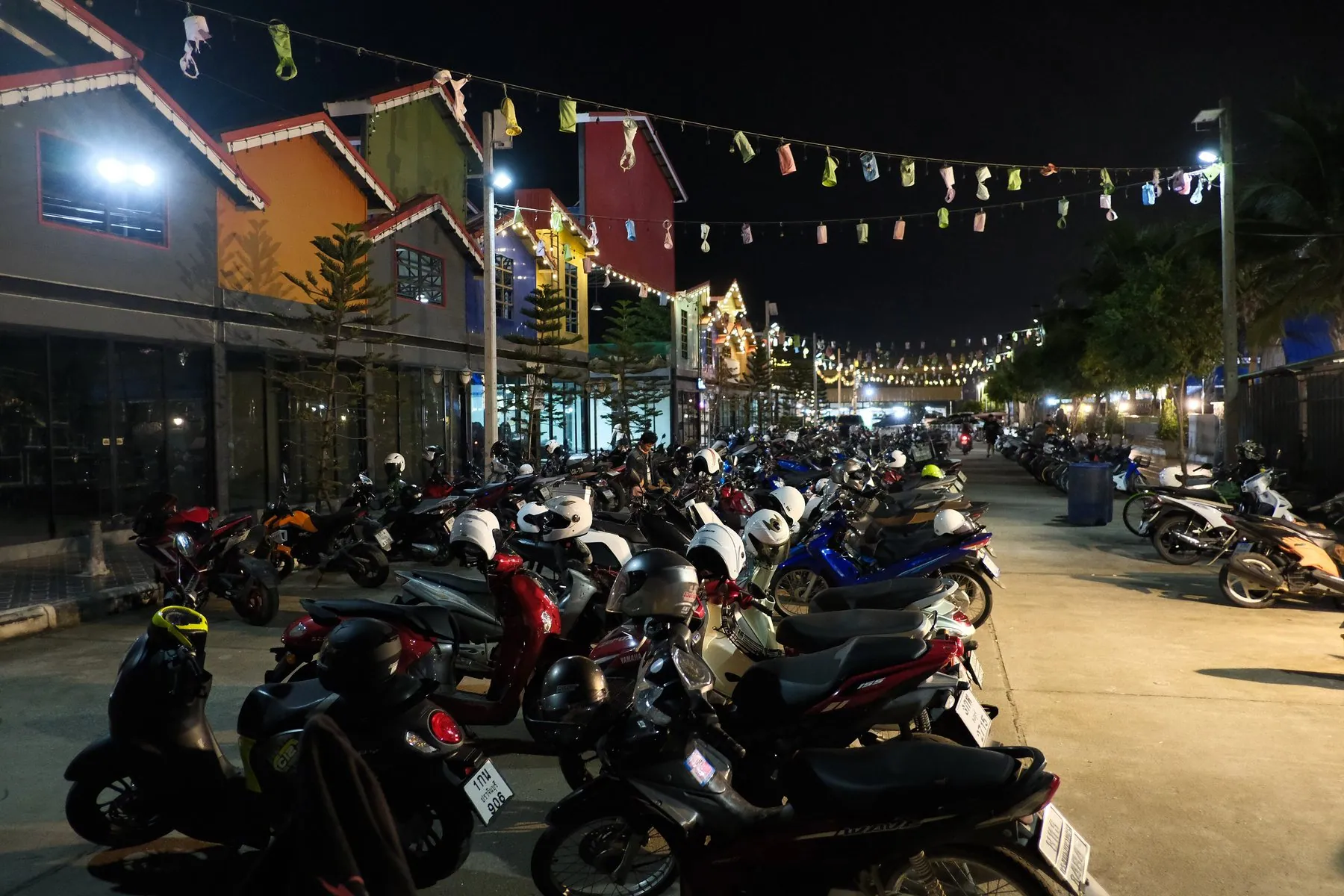
Scooters get their own bays, usually marked with painted boxes and often at right angles to the kerb. Malls have dedicated motorbike areas, generally in a separate part of the car park with a barrier and an attendant, sometimes with a small charge.
Two practical points. First, use the steering lock and, on a rental, the seat lock — motorbike theft in tourist areas is real and a stolen rental is charged to you in full. Second, park where a photograph shows the bike's condition when you left it, because rental damage disputes very often concern scratches that appeared while the bike was parked. What to photograph before you drive away and motorbike rental damage claims in Thailand cover this properly.
Blocking somebody in
You will see cars double-parked in Thailand with the handbrake off and the gearbox in neutral. This is deliberate: the convention is that a blocked-in driver pushes the offending car out of the way. In mall car parks it is normal and expected, and a phone number is often left on the dashboard.
As a visitor, do not adopt this habit. A hire car left in neutral on a slope is a claim waiting to happen, and if you are blocked in by a car in neutral, push it gently and straight rather than trying to find the owner.
Frequently asked questions
What do the coloured kerbs in Thailand mean?
Red and white means no stopping at all. Yellow and white means no parking, but a brief stop to load or set down is accepted. Black and white or an unpainted kerb means parking is normally allowed subject to any sign. Signs override the paint.
How much does it cost to get a clamped car released in Thailand?
The regulation sets a floor of 500 baht for moving or immobilising the vehicle plus 200 baht a day storage — roughly £11 and £4.50 respectively. Those are minimums, and in Bangkok you should budget for more. Never damage a clamp: that carries up to three months' imprisonment and a fine of up to 5,000 baht.
What is the odd-and-even parking rule?
On many Thai streets parking alternates between the two sides according to whether the date is odd or even, so the street is cleared regularly. The signs are in Thai. The reliable way to read it is to park on the side where the other cars already are.
Do I need to leave my lights on when parked?
Section 61 requires parking lights wherever the vehicle is not clearly visible at 150 metres. On a dark rural road that is a genuine obligation and a genuine safety measure, not a formality.
Is it safe to park a motorbike on the street overnight?
In most places, yes, but use the steering lock and the seat lock, and prefer a lit spot or an attended bay. A stolen rental scooter is charged to the hirer, and rental deposits are held against exactly this.
Why are cars left in neutral in Thai car parks?
So that a driver they have blocked in can push them out of the way. It is a normal convention in mall car parks. Do not do it with a hire car — leave a phone number instead, or park where you are not blocking anybody.