The short answer to parking in Bangkok is: don't park on the street. Use a shopping-centre car park. They are everywhere, they are covered, they are cheap or free for the first few hours against a purchase, and they remove the two problems that catch visitors — kerb markings you cannot read, and alternate-day restrictions that are signed only in Thai. A mall car park costs a few tens of baht an hour. An hour of misjudged kerbside parking costs an afternoon at a police station getting a clamp removed.
The second thing to know is that painted kerbs in Thailand are instructions, not decoration. Red and white means no stopping at all. Yellow and white means you may pause to drop someone or unload, but not leave the vehicle. An unpainted or black-and-white kerb is ordinary road, subject to whatever the signs say. The rules behind those colours, and what happens if you ignore them, are set out in Thai road markings and kerb colours and parking rules in Thailand.
- Best defaultA shopping-centre car park
- Red and white kerbNo stopping, at any time
- Yellow and white kerbBrief stop to load or drop off only
- Street parking in the centreAssume it is not allowed unless proven otherwise
Mall car parks: the system that actually works
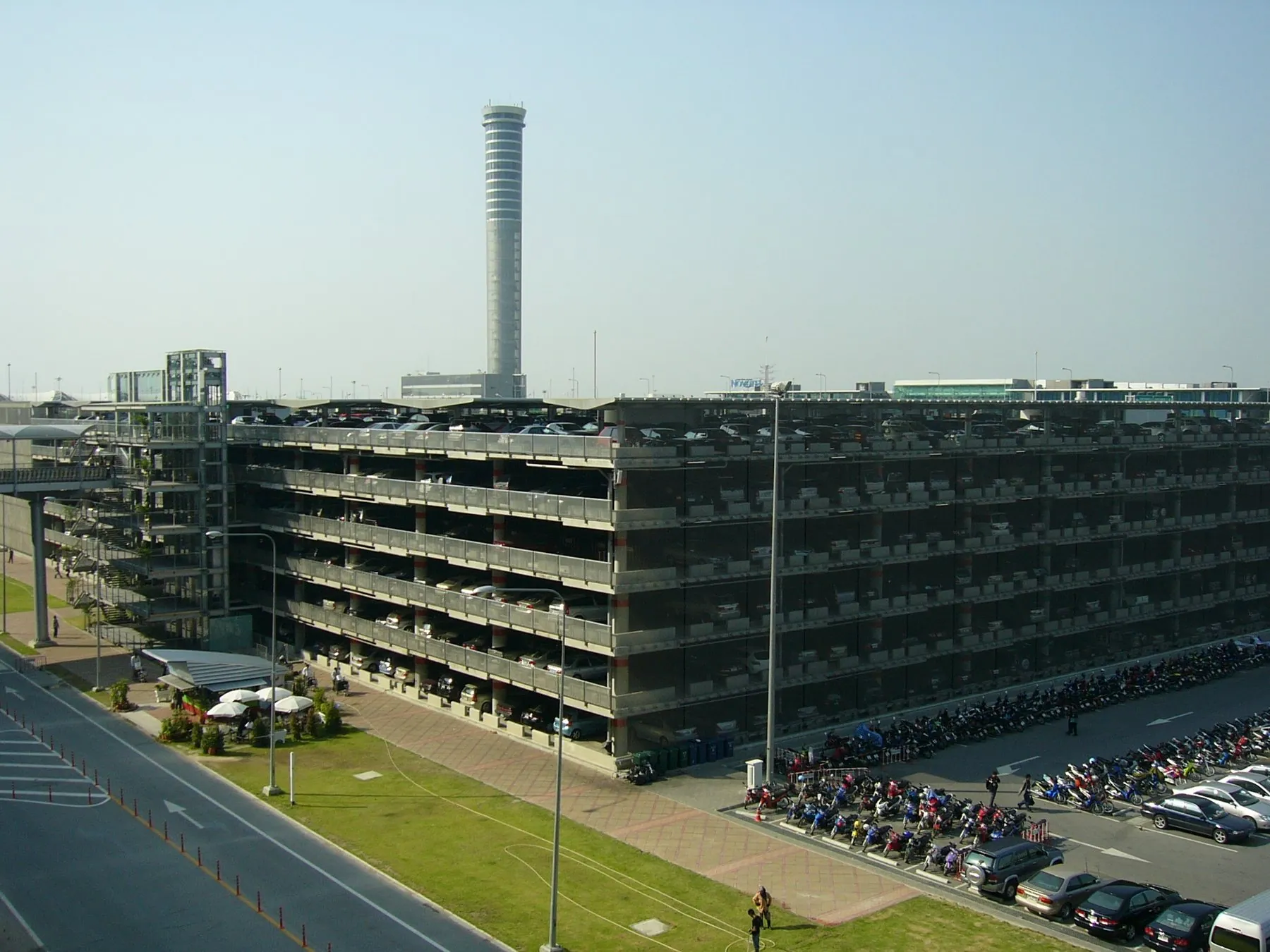
Bangkok's shopping centres were built with the assumption that everyone drives, and their car parks are enormous — multi-storey, air-conditioned in places, and attached to the metro. Siam Paragon, CentralWorld, Terminal 21, EmQuartier, Icon Siam, Central Rama 9, Central Ladprao and Mega Bangna all have thousands of spaces between them, and every one of them sits on or near a BTS or MRT station.
The mechanics are the same everywhere. You take a ticket or the barrier reads your plate on the way in. Inside the mall, you get the ticket stamped or validated at a customer service counter, or automatically at the till when you spend above a threshold — typically a few hundred baht of shopping, a cinema ticket, or a meal in a mall restaurant. That buys you a block of free hours. Beyond it, the rate steps up hourly, and it is still inexpensive by European standards.
The single best Bangkok parking move: drive to a mall on the edge of the centre, park in it for the day, and take the BTS or MRT the rest of the way. You pay a few tens of baht, your car is under cover, and you skip the part of the journey where a car is useless. Mega Bangna, Central Rama 9 and the Chatuchak-area car parks all work for this, and several MRT stations have their own park-and-ride decks.
Two practical warnings. First, note the floor and the colour-coded zone; these car parks are genuinely large and finding a small silver Toyota on level 6 of an identical-looking structure is a real waste of half an hour. Photograph the pillar number. Second, on Saturday and Sunday afternoons the popular malls fill, and the ramp queue to get in can run out onto the main road.
Hotels
Most Bangkok hotels above budget level have parking, but "has parking" covers a wide range. Larger hotels have their own basement or podium deck, usually free for guests, sometimes with a nightly charge at the top end. Smaller boutique hotels and guesthouses, particularly in the older parts of town and in the narrow sois off Sukhumvit, often have four or five spaces and a valet who parks cars nose to tail and shuffles them when someone needs to leave. That works, but it means you cannot simply collect your car at 05:00 without warning anybody.
Ask before you book, and ask specifically: is parking on site, is it free, and can I get the car out early? If you are picking a base for a driving trip, this question is worth more than the breakfast buffet.
Do not leave a car overnight in a soi because it looks quiet. Many residential sois in Bangkok operate one-sided parking that alternates by date — one side on odd-numbered days, the other on even — and the signs are frequently Thai-only. Clamping is routine and towing does happen. A vehicle that was legal at 20:00 can be illegal at midnight.
Street parking, if you must
There is legal kerbside parking in Bangkok, mostly outside the central business districts and mostly in the older residential grid. If you are going to use it, work through the following in order:
- Look at the kerb paint. Red and white means move on, full stop.
- Look for a sign with a date-based restriction — a circular no-parking sign with Thai text and often the numerals for odd or even days.
- Look for rush-hour tow-away restrictions on main roads; several arterial routes prohibit kerbside parking during peak hours to free a lane.
- Look at what the locals have done. If forty cars are parked in a line and you would be the forty-first, you are probably fine. If the kerb is conspicuously empty on a busy street, there is a reason.
- Never block a soi. Many are barely one car wide, and blocking one blocks everybody's morning.
- Never park in front of a fire hydrant, a bank entrance or a temple gate.
Attended private car parks exist too — patches of land beside markets and office blocks with a man, a whistle and a book of tickets. They are cheap and generally reliable, but they are also where the nose-to-tail shuffle happens, so expect to leave the handbrake off and the car in neutral if asked. That is normal practice, not a scam.
Motorbike parking
Motorbikes are far easier. Every mall has a dedicated bike area, usually at ground level or on a lower deck, and it is often free or nearly so. Sois, market edges and the aprons outside 7-Eleven are used routinely. The one rule that catches riders is that a bike left blocking a pavement route or a shop frontage in a busy commercial area will be moved, and in some districts removed. If you are riding rather than driving, the wider picture is in riding a motorbike in Bangkok.
What it costs, roughly
| Where | How it works | Rough cost |
|---|---|---|
| Shopping centre | Ticket stamped against a purchase; free hours then hourly | Free for the first hours, then tens of baht per hour |
| Hotel (mid-range and up) | On-site deck or basement | Usually free for guests |
| Attended private lot | Cash, ticket on the windscreen | A small flat fee, often per entry |
| Office building | Barrier, hourly, sometimes validated by tenants | Highest of the paid options |
| Street | Free where permitted | Free, and the riskiest |
Rates move, and every operator sets its own. Treat the figures above as a shape rather than a price list, and read the board at the barrier.
The wider point
Parking difficulty is one of the strongest arguments against keeping a car in Bangkok at all. If your itinerary is city-based, the maths rarely works — see driving yourself or taking Grab in Thailand. If Bangkok is a staging post for a road trip, collect the car the morning you leave and the parking problem disappears with it; car hire in Bangkok covers where to do that, and Bangkok rush hour covers when.
Can I park on the street in Bangkok?
In places, yes, but not in the central business districts and not without reading the kerb paint and the signs. Alternate-day restrictions are common and the signage is often Thai-only. A mall car park is almost always the better choice.
What does a red and white kerb mean in Thailand?
No stopping and no parking at any time — not even briefly. Yellow and white means you may stop momentarily to pick up or set down, but not leave the vehicle. See Thai road markings and kerb colours.
Will my car be clamped or towed?
Clamping is the usual response in Bangkok and it is common. Towing happens too, particularly on main roads during peak-hour restrictions. Either way you will be retrieving the car in person, and the penalties are covered in parking rules in Thailand.
Is mall parking free?
Usually for a limited number of hours if you validate the ticket against a purchase, a cinema ticket or a restaurant bill. After that it is charged hourly at a modest rate. Get the ticket stamped before you leave the mall, not after.
Do Bangkok hotels have parking?
Most mid-range and larger hotels do, generally free for guests. Small guesthouses in narrow sois often have only a handful of spaces and a valet who double-parks. Confirm before booking if you will have a car.
Where do I park to visit the Grand Palace or Chinatown?
Neither is a place to arrive by car. Park at a mall or a park-and-ride near an MRT station and take the metro or a river boat in. The old city's lanes are narrow, frequently one-way, and heavily restricted.