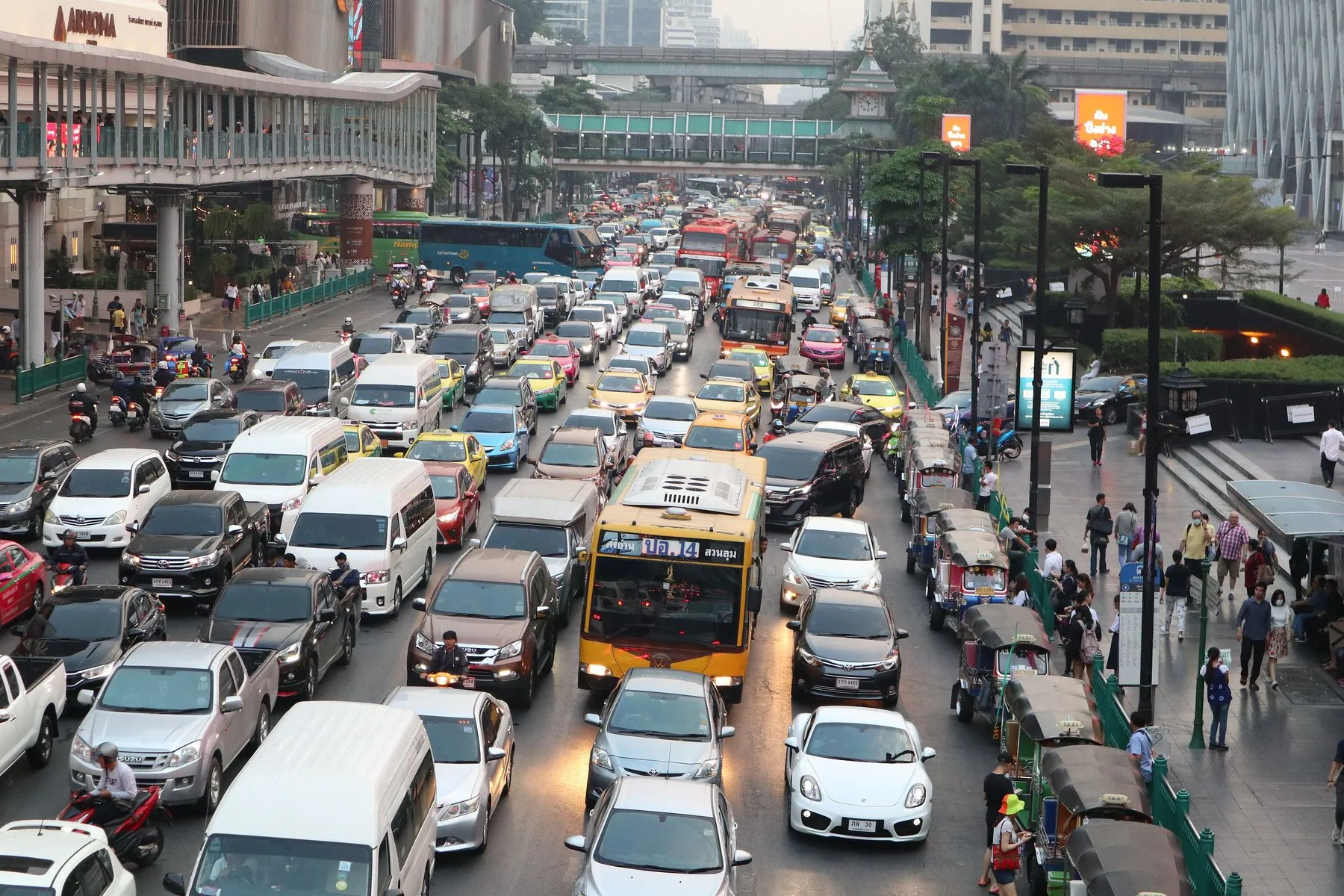
Bangkok's rush hour runs roughly 07:00 to 09:30 in the morning and 16:00 to 20:00 in the evening, and the evening peak is much the worse of the two. Between those blocks the city does not clear — the midday "off-peak" is merely bad rather than hopeless — and the genuinely easy windows are before about 06:30 and after about 21:30. In this city the clock is a bigger variable than the route. The same eight kilometres can take twenty minutes or an hour and a quarter depending on nothing but when you left.
The practical consequence for a visitor with a hire car: never plan to cross Bangkok during the evening peak if you have any choice, and always leave the city early in the morning rather than late.
- Morning peakAbout 07:00–09:30, hardest 07:30–09:00
- Evening peakAbout 16:00–20:00, hardest 17:00–19:00
- Worst single eveningFriday, and the last Friday of the month
- Genuinely easyBefore 06:30 and after 21:30, and Sunday morning
The shape of a Bangkok day
Traffic starts building around 06:30 as the school run and the commute overlap, and by 07:30 the arterial roads into the centre are queueing. Surveys of Bangkok traffic put the average vehicle speed across a working day at around 20 km/h, and lower again in the evening peak — figures that describe a city where the median journey is a crawl rather than a flow.
The morning peak eases from about 09:30. What follows is not free-running traffic but a workable middle of the day, and it is when a visitor should do any driving they cannot avoid. From around 15:00 the school pick-up starts, and it runs straight into the office exodus at 17:00 without a gap. That combination is why the evening is worse than the morning: two peaks stacked on each other, in a city where a great many schools sit on main roads.
After about 20:00 it thins, and after 21:30 Bangkok becomes a genuinely pleasant city to drive. The expressways run at speed, the U-turns are clear and you can cross the centre in twenty minutes.
If you are collecting a hire car to drive out of Bangkok, book the earliest pick-up the branch offers and be on an expressway before 06:30. Leaving at 07:30 instead can cost you ninety minutes before you have even reached the ring road. Where to collect one is covered in car hire in Bangkok.
The days that are worse
Friday evening is the reliably worst slot of the week, as the weekend exodus to Hua Hin, Pattaya and the provinces adds to the normal commute. It is compounded at the end of the month, when Thai salaries are paid and discretionary trips cluster. The Friday before a long weekend or a public holiday is worse again, and the days either side of Songkran in April and of New Year are in a category of their own — see driving during Songkran and New Year.
Monday mornings are heavier than the rest of the week. Saturdays have no morning peak but a broad, slow shopping-and-leisure load from late morning until evening, concentrated around the malls. Sunday morning is the quietest weekday-equivalent window in the city, and Sunday evening is busy again as the weekend traffic returns from the coast.
Rain changes everything
A heavy afternoon downpour is the single largest variable in Bangkok traffic. Drainage cannot cope with a sustained tropical storm, underpasses flood, and journey times do not degrade gracefully — they collapse. On the eastern side of the city there are documented evenings where continuous rain left drivers stationary on Bang Na–Trat Road for five or six hours from late afternoon into the night.
If it starts raining hard during the evening peak, stop. Park in a mall, eat, and leave two hours later. You will get home sooner than if you join the queue, and you will not spend the evening in standing water of unknown depth. What to do if you are already in it is in the rainy season and flooded roads in Thailand.
Where the queues actually form
Congestion is concentrated, not uniform. The junctions and corridors that dependably back up include:
- Asok–Phetchaburi junction — where Phetchaburi Road, Asok Montri and Asok–Din Daeng meet. Consistently named the worst single hotspot in the city.
- Rama IV Road — the link between the Sukhumvit side and Silom/Sathorn, slow through most daylight hours.
- Sathorn and the Surasak junction — office density plus the expressway ramps.
- Din Daeng and Victory Monument — the funnel where northern traffic meets the inner city.
- Rama IX intersection — offices, schools and an expressway interchange in the same place.
- The river bridges — every crossing between the Bangkok and Thonburi sides is a pinch point, and Krung Thonburi Road on the Thonburi side is among the most congested roads in the city.
- Bang Na–Trat Road — the eastern artery, and the one that fails worst in rain.
What the expressway does and does not fix
The elevated toll network is the main tool for beating the peak, and outside 17:00–19:00 it works extremely well. During the worst of the evening, though, the expressways queue too — not because the elevated road is full but because the exit ramps are, and the queue backs up onto the deck. Being stuck on an expressway is worse than being stuck on the surface, because there is no way off.
The rule that experienced drivers use: take the expressway in the morning peak and in the midday period without hesitation, but in the evening peak check the live traffic layer before you commit to a ramp. The network itself is explained in Thailand's expressways and motorways, and the tolls in toll roads in Thailand.
| Time | What it is like | Verdict |
|---|---|---|
| Before 06:30 | Open roads, empty expressways | The best window of the day |
| 06:30–09:30 | Building, then solid on arterials | Avoid; use the expressway if you must |
| 09:30–15:00 | Slow but moving | The realistic time to drive |
| 15:00–17:00 | School run, thickening | Getting difficult |
| 17:00–19:00 | Peak, and worse in rain | Do not drive across the city |
| 19:00–21:30 | Easing | Tolerable, improving fast |
| After 21:30 | Free-flowing | Bangkok at its most driveable |
Timing a trip out of the city
Leaving Bangkok is a different problem from moving within it, because you are fighting the outbound flow. Going south towards Hua Hin, the Rama II corridor is the constraint and Friday afternoon is the worst possible moment — see driving Bangkok to Hua Hin. Going east towards Pattaya, the Bang Na corridor and the motorway interchanges load from mid-afternoon on a Friday. Going north, the tollway and the road up to Bang Pa-in are busiest on Friday evening and on the eve of public holidays.
In every direction the same advice applies: go early, or go late. A 05:30 start turns a dreaded departure into an easy one, and for long hauls such as Bangkok to Chiang Mai by road it is the difference between arriving in daylight and arriving after dark, which matters for reasons set out in driving at night in Thailand.
When not to bother with a car at all
If your journey is entirely within the central corridors during a peak, the BTS, the MRT or a motorbike taxi will beat a car comfortably and without the parking problem afterwards. The honest comparison for visitors is in driving yourself or taking Grab in Thailand, and the wider picture of what the city is like behind the wheel is in driving in Bangkok.
What time does Bangkok rush hour start and end?
Broadly 07:00 to 09:30 in the morning and 16:00 to 20:00 in the evening, with the hardest hours 07:30–09:00 and 17:00–19:00. The evening peak is longer and worse because the school run and the commute overlap.
Is there a quiet period in the middle of the day?
Not a quiet one, but a workable one. Between about 09:30 and 15:00 traffic moves, if slowly. That is the window to use for any driving you cannot avoid.
Which is the worst day to drive in Bangkok?
Friday, particularly the last Friday of the month and any Friday before a public holiday. Sunday morning is the easiest.
Does rain really make that much difference?
Yes — it is the biggest single factor after the time of day. Sustained heavy rain during the evening peak can turn an hour into four or five, and floods underpasses. Wait it out somewhere with a roof.
Do the expressways avoid the rush hour?
Mostly, but not at the height of the evening peak, when the exit ramps back up onto the elevated deck and you cannot get off. Check the live traffic layer before committing.
When should I leave Bangkok to drive somewhere else?
Before 06:30 if you can, or after 21:00. Avoid Friday afternoon in every direction, and avoid the day before a public holiday altogether.