You can hire a car almost anywhere in Bangkok, but the easiest place by a wide margin is one of the two airports. Suvarnabhumi keeps its rental counters in the arrivals area, signposted from baggage reclaim, and several of them run around the clock; Don Mueang's desks sit in the Terminal 2 arrivals hall. City branches exist — in office towers along Sukhumvit and Silom, in shopping-mall car parks, and in the back streets near Victory Monument — but they keep shop hours, they are harder to reach with luggage, and the fleet is thinner.
The general rules of Thai car hire — documents, deposits, insurance excess, the handover inspection — are all covered in our guide to renting a car in Thailand, and they apply here unchanged. This page is about what Bangkok specifically does to a hire car: the tolls, the parking, the traffic, and the honest question of whether you want one at all.
- Typical daily rateRoughly 900–1,600 baht for a small automatic; more over Songkran and New Year
- TerrainFlat, dense, multi-level; expressways stacked above surface roads
- Best vehicleThe smallest automatic you can live with
- Easiest pickupAirport arrivals, not a city branch
Should you rent a car in Bangkok at all?
For most visitors staying in the city, no. Bangkok has a metro and a Skytrain that go where tourists go, and ride-hailing is cheap and everywhere; a hire car in the centre mostly buys you a parking problem. The case for a car is when Bangkok is the start or the end of a road trip — collect at Suvarnabhumi or Don Mueang, get straight onto the motorway network, and do the city sightseeing on foot and by train after you have dropped the car back. Our comparison of driving yourself against taking Grab is the fuller argument.
Collect on the way out, not on the way in. If your itinerary is three days in Bangkok then a week on the road, book the car from day four and collect it at the airport or a branch near the expressway, rather than paying for three days of hotel parking you will not use.
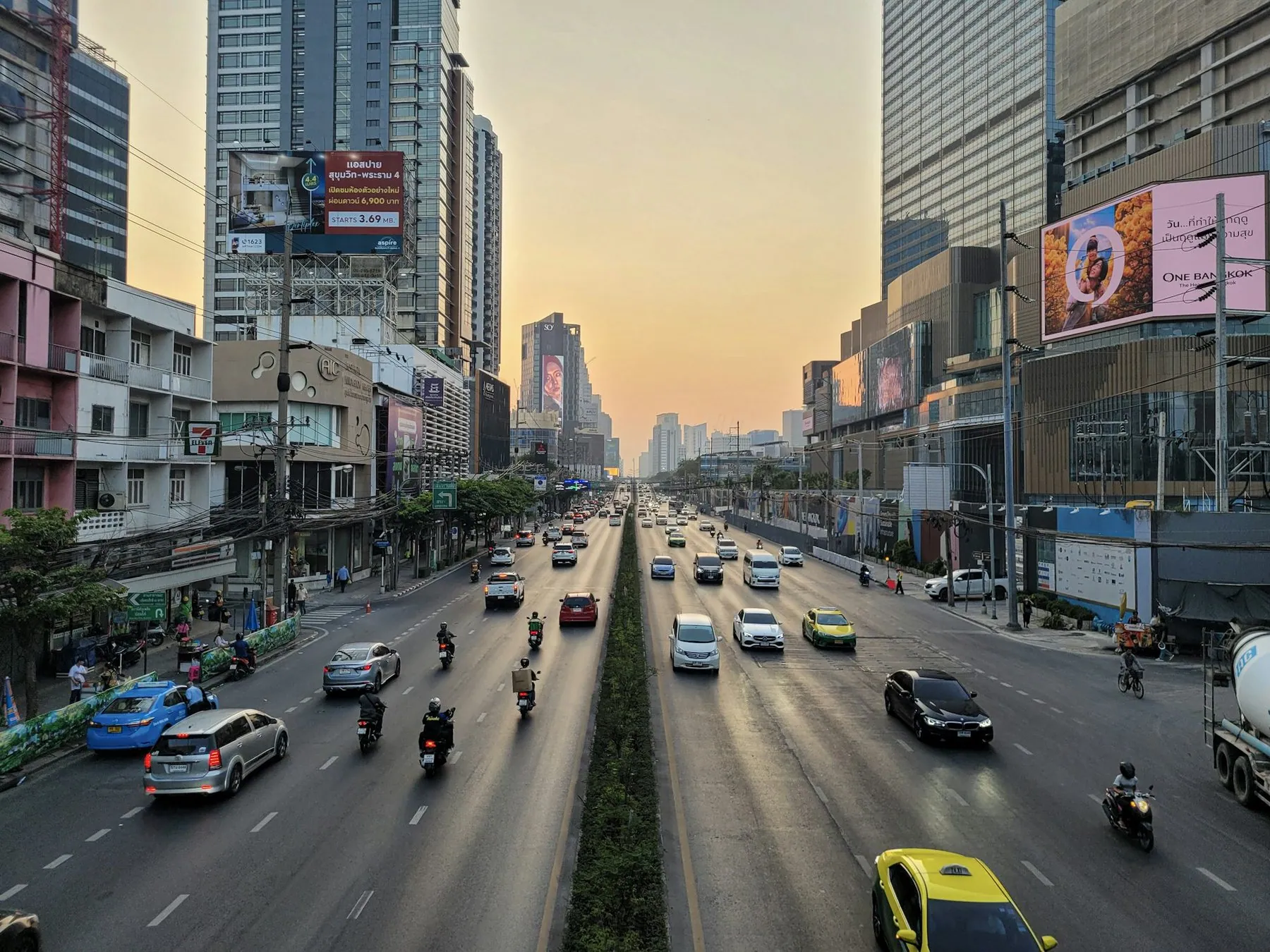
The expressways are the whole trick
Bangkok's surface roads and its elevated expressways are two different cities. Down at street level you are dealing with lane changes, motorbikes filtering on both sides, U-turn queues and buses stopping in the live lane. Up on the expressway you are in something closer to normal motorway driving, and journeys that look impossible on a map become routine. Learning which ramp to take is the single most useful Bangkok driving skill; our guide to Thailand's expressways and motorways explains how the network fits together.
Two practical points for a hire car. Ask at the desk whether the car has an Easy Pass or M-Flow tag and how charges are settled — some firms bill you afterwards, some hand you a tag with a balance, some hand you nothing. And keep small notes in the door pocket, because cash lanes at toll booths are still the norm.
Timing matters more here than anywhere else in Thailand: leaving central Bangkok at 06:30 rather than 08:00 can save an hour and a half on the same journey — see Bangkok rush hour. If your route is genuinely just "get past Bangkok", the outer ring road exists so you never have to enter it.
Parking is the thing that decides your car
Bangkok parks vertically. Shopping malls, office buildings, hospitals and larger hotels have multi-storey car parks, and those ramps and bays are tight — narrow, sharply angled, and built for the small Japanese hatchbacks and eco-cars that dominate the local fleet. If you have booked a large SUV because it looked good value, you will spend your week regretting it in spiral ramps.
Street parking is a different problem. Kerb colours carry meaning, many roads alternate parking sides by date, and the enforcement is real. Read Thai road markings and kerb colours before you leave the car anywhere that is not obviously a car park, and see parking in Bangkok for what the mall car parks cost and how hotel parking usually works.
Check the hotel actually has parking before you book the car. A large number of central Bangkok hotels, especially in the older Sukhumvit sois and around Khao San, have no car park at all or a handful of spaces reserved for the manager. "Valet parking" sometimes means a member of staff will find you a spot in a public car park three streets away. Ask, by email, and get the answer in writing.
What the driving is like
Bangkok traffic is heavy but not aggressive. Lane discipline is loose, gaps close quickly, and motorbikes occupy every space you leave — but drivers are broadly patient and horns are used far less than in most large Asian cities. The specific things that catch out new arrivals are U-turn bridges instead of right turns, expressway exits that appear with very little warning, sois that turn one-way without much signage, and flooding in underpasses during heavy rain. Driving in Bangkok goes through all of this properly, and your first day driving in Bangkok is written for the person doing it cold. A phone on a good navigation app beats the car's built-in unit, which may only speak Thai, and handles the expressway ramps far better.
Where to actually pick the car up
| Pickup point | Suits | Watch out for |
|---|---|---|
| Suvarnabhumi arrivals | Most road trips; widest choice of firms; long opening hours | Some brands park off-site and shuttle you to the lot |
| Don Mueang arrivals | Domestic connections; heading north on the motorway | Fewer desks than Suvarnabhumi |
| City branch | Long-term hire, monthly deals, local firms | Shop hours, small fleets, harder returns |
| Hotel delivery | Convenience if you must start in the city | Delivery fee; the handover happens on a busy street |
Airport pickup usually carries a surcharge; see airport car rental in Thailand. Wherever you collect, do the handover inspection properly and know what to photograph before you drive away.
Seasons and prices
Bangkok is less seasonal than the islands. Rates drift up from roughly November to February and again around Songkran and the New Year holiday, when the whole country moves and fleets empty out — book weeks ahead for either. Outside those peaks, a small automatic typically runs somewhere in the region of 900–1,600 baht a day (roughly £20–£38 / US$25–US$47), less on a weekly rate and much less on a monthly contract. Local Thai firms usually undercut the international brands: big chains or local firms.
Frequently asked questions
Is it better to rent at Suvarnabhumi or in the city?
At the airport, almost always. The desks are in one place, they open longer hours, the fleets are bigger, and you can be on the motorway within minutes instead of threading out through the city. The exception is a long-term hire, where a city branch or a local firm may quote a much better monthly rate.
Can I drive a Bangkok hire car to Chiang Mai or Phuket?
Usually yes, though a minority of contracts cap the mileage or fence off a region. See taking a hire car between provinces and one-way car rental.
Do I need a credit card to hire a car in Bangkok?
The mainstream firms want a credit card in the driver's own name for the security hold; debit cards are frequently refused. Credit card holds on Thai car rentals explains why, and what you need to rent a car in Thailand lists the rest of the paperwork.
Should I rent a motorbike in Bangkok instead?
Only if you are an experienced rider and you have a clear-eyed view of the risk. Bangkok traffic is dense, fast-moving between lights, and unforgiving of hesitation. Riding a motorbike in Bangkok is an honest assessment rather than an encouragement.
What happens if I get stopped at a checkpoint?
Roadside checks are routine, particularly late at night and around holiday weekends. See police checkpoints in Thailand, and know which licence you can use before you drive.
Where do I leave the car if my hotel has no parking?
Nearby shopping-mall car parks are the usual fallback and many allow overnight stays, though a few lock in cars left past closing. Confirm with the car-park desk rather than assuming.