Bangkok is a bad place to learn to drive in Thailand and a surprisingly easy place to arrive in one. Those two facts sit together because the hard part of Bangkok is not the traffic — it is slow, and slow traffic is forgiving — but the road system: elevated expressways stacked over surface roads, one-way sois, U-turn bridges, and junctions where the lane you are in decides where you go three hundred metres before you get there. Get the geometry right and your first day is uneventful. Improvise it at the wheel and you will spend an hour going round in circles.
What follows is what actually happens from the driver's seat, and how to arrange a first day so it is dull.
- Traffic speedSlow. Very slow at peak
- The peaksRoughly 07:00-09:30 and 16:00-20:00
- Motorbikes on expresswaysBanned, at every engine size
- Best first roadAn expressway out of the city
Before you turn the key
Set your navigation before you move, not at the first red light. Bangkok's junctions come up quickly and the decision about which lane to be in is usually made well before you can see the junction itself. Have the route loaded, the phone mounted where you can glance at it, and a rough idea of the first three or four turns in your head, so that a lost signal under an expressway does not strand you.
Have your documents to hand rather than in the boot: licence, international driving permit, a copy of the vehicle registration and the rental agreement. Checkpoint stops are routine and are usually a licence check that takes under two minutes if everything is in the same place.
Pick the car up somewhere easy. Suvarnabhumi and Don Mueang both feed almost directly onto the expressway network, which means your first ten minutes are on a wide, well-signed, one-directional road rather than in the middle of Sukhumvit. A city-centre branch is the harder start by a wide margin — see car hire in Bangkok.
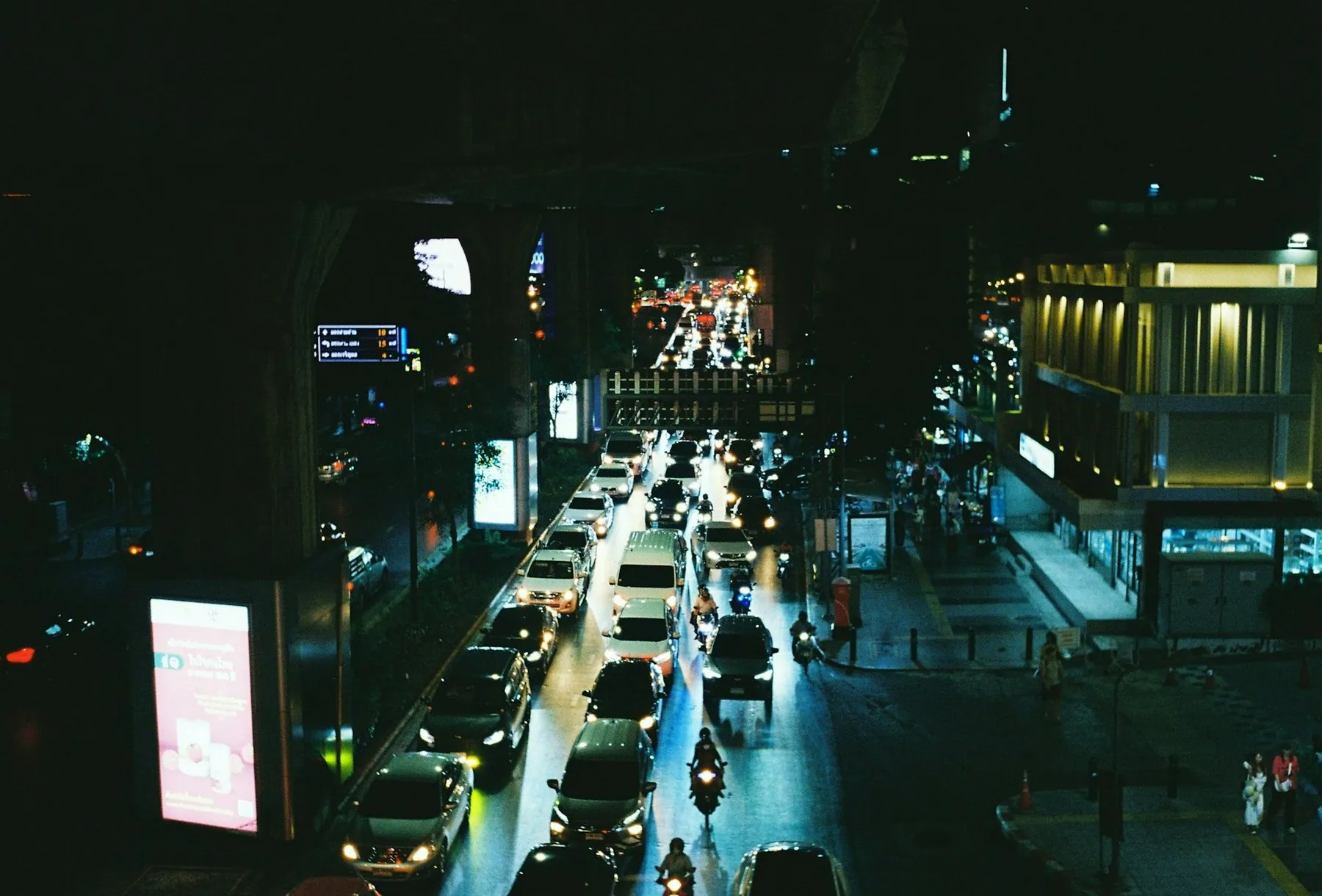
The first thing you will notice: the motorbikes
At every red light a shoal of motorbikes filters up both sides of you and gathers across the front of the queue. When the light changes they go first, in a mass, and then disperse. This is normal, expected by everyone, and not something to resist — do not try to close the gap they use, and do not set off into the space they are occupying. Let the shoal clear and then move.
The rest of the time they are simply present: alongside you, between the lanes, on the inside as you turn left. Two habits handle almost all of it. Mirror-check before every lane change as a genuine look rather than a glance. And before any move to the left — turning into a soi, pulling in, opening a door — check down that side, because that is where they are.
Lanes, and why the lane decides your route
Bangkok's main roads have lanes that commit you. A left lane may become a slip road, an inside lane may be bus-only at certain hours, and the outside lane may feed a U-turn bridge or an expressway ramp that lifts you out of the city whether you intended it or not. The signage tells you, but often only once and not far in advance.
The practical rule for a first day: choose your lane early and stay in it. If you miss a turn, take the miss. Missing a junction costs you five minutes; a panicked cut across three lanes of motorbikes costs a great deal more.
U-turn bridges and the absence of right turns
Many of Bangkok's arterial roads have a solid central divider and no right turns at all. To go the other way you use a U-turn — sometimes an at-grade gap in the barrier, more often a dedicated bridge or underpass that lifts you over the oncoming carriageway and drops you back facing the other way. Navigation apps handle these reasonably well but describe them oddly, so expect an instruction that reads like nonsense until you see the ramp.
The at-grade U-turns are the ones requiring care: you emerge from a standing start across two or three lanes of traffic that is moving. Wait for a real gap, commit clearly, and do not creep. U-turns in Thailand covers the rule and the technique.
The expressways are your friend
Bangkok's elevated expressway network is the best thing about driving in the city. It is fast, well surfaced, goes where you probably want to go, and motorcycles are banned on all of it at every engine size — which removes most of the complexity in one stroke. If a journey can be made on the expressway, make it there, even if the surface route looks shorter on the map.
Tolls are paid at booths, in cash, at each section — keep small notes and coins in the door pocket rather than digging for a wallet with a queue behind you. Some lanes are for electronic tags only; if your hire car has one, ask at the desk how it is billed, and if it has not, stay out of those lanes. Toll roads in Thailand explains both systems.
What the law says
Motorcycles are prohibited on Thailand's expressways and motorways, on all of them and at every engine size. The prohibition rests on section 139 of the Land Traffic Act, which gives a traffic officer power to prohibit categories of vehicle, together with the regulations on traffic in special lanes. The reported fine for riding on an expressway is up to 1,000 baht — roughly £23, US$28 or €26.
Roads not to start on
Some Bangkok roads are simply harder than others, and there is no reason to meet them in your first hour.
| Avoid on day one | Why |
|---|---|
| Sukhumvit at peak | Dense, slow, constant bus and motorbike movement, and sois branching off both sides in quick succession. |
| Silom and Sathorn in the evening | A one-way system with contraflow bus lanes and heavy pedestrian crossing. |
| The Victory Monument circle | A large, busy roundabout with no consistent give-way convention and traffic entering from every direction. |
| Chinatown and the old city lanes | Narrow, crowded, stalls encroaching on the carriageway, and street parking on both sides. |
| Rama II southbound at a holiday weekend | Long-running roadworks and heavy traffic out of the city. |
Timing your first drive
The peaks are roughly 07:00 to 09:30 and 16:00 to 20:00, and Friday evening is the worst window of the week — also when rain most reliably makes it worse. If you have a choice, do your first Bangkok drive mid-morning or on a Sunday, when the same roads are a different proposition. Bangkok rush hour goes through the pattern in detail.
Parking, which is the real constraint
Parking, not traffic, is what makes visitors give up on driving in Bangkok. Shopping malls have large multi-storey car parks and are frequently the sensible answer — park at the mall and take the Skytrain to wherever you were actually going. Hotels usually have parking, but not always for non-residents. Kerbside parking is governed by kerb colours rather than signs and enforced by clamping and towing. Parking in Bangkok covers where to leave a car and what it costs.
Kerb colours are the rule, not signs. Do not assume an empty stretch of kerb with cars already on it is legal parking; enforcement is uneven and the fact that others are parked there means nothing. If in doubt, use a paid car park. A tow in central Bangkok will cost you more than a day's car hire and most of an afternoon.
If it goes wrong
Getting lost in Bangkok is normal and rarely serious. Pull into a petrol station or a mall car park, stop properly, and sort the navigation out stationary rather than in a moving lane. If you have taken a wrong expressway ramp, ride it to the next exit.
If you are stopped by police, hand over your licence and IDP, be polite, and expect it to be brief. Officers cannot confiscate a driving licence at the roadside — that power was removed in September 2019 — and an official ticket is a demand for payment later at a bank, convenience store, post office or online, not for cash at the kerb. On-the-spot traffic tickets in Thailand describes what a legitimate one looks like. If communication is the problem, the Tourist Police line on 1155 reaches an English-speaking officer.
Should you be riding here instead?
Bangkok on a scooter is a different question and a considerably harder one. It is genuinely faster than a car, which is why so many residents do it, and it is also the most demanding riding environment in the country for someone who has just arrived. Riding a motorbike in Bangkok is the honest assessment.
Frequently asked questions
Is driving in Bangkok actually dangerous?
Less than its reputation suggests, for a car driver. Speeds are low, drivers are patient and the traffic is not aggressive. It is stressful and slow rather than dangerous. The danger in Bangkok concentrates on two wheels and after dark — see is it safe to drive in Thailand.
Can I use my phone for navigation while driving?
Mount it. Holding a phone while driving is an offence in Thailand and was named by the Royal Thai Police among ten offences for strict enforcement from April 2026, with a maximum the police quote as 4,000 baht. A cheap windscreen mount avoids the whole question.
Do I need cash for tolls?
Yes, keep small notes and coins to hand. Cash booths remain on most sections, but the electronic lanes are useless to you without a transponder or a registered plate, and getting into one by mistake in a queue is awkward to undo.
What if I damage the hire car in traffic?
Stop, photograph everything, and call the rental company's number before you agree anything with the other party. Low-speed contact in dense traffic is the most common way a visitor damages a car here, and the Safety section sets out the order to do things in.