Thai tolls are cheap and the process is simple: you drive up to a plaza, pick a lane, hand over cash or let a tag beep, and the barrier lifts. Fares on the Bangkok expressways are typically a few tens of baht per section for a car; a long run down the motorway to Pattaya or up towards Korat costs rather more but still lands in the low hundreds. Nobody plans a Thai road trip around the toll budget.
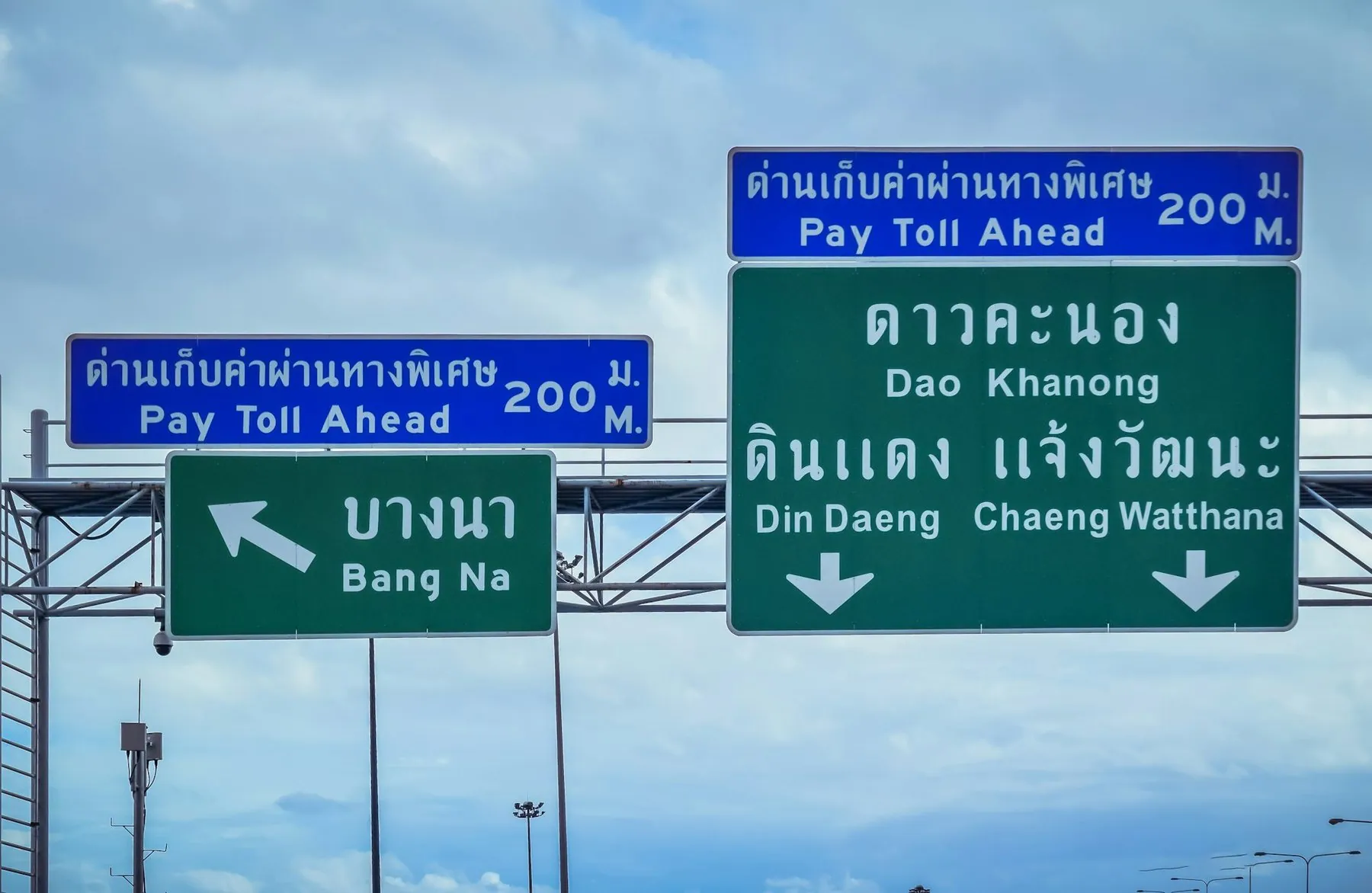
What does cause trouble is lane selection. Thai toll plazas mix cash lanes, electronic-tag lanes and — increasingly — barrier-free camera lanes across the same row of booths, the signage arrives late, and once you are committed to a lane there is no reversing out of it. Read the overhead gantry early and move across in good time. That single habit prevents almost every toll problem a visitor has.
- Payment methodsCash, Easy Pass or M-Pass tag, or M-Flow number-plate billing
- Cash lanesUsually the leftmost lanes, marked with a banknote symbol
- CardsNot accepted at the booth
- Typical car fareTens of baht per expressway section; low hundreds for a long motorway run
What a Thai toll plaza actually looks like
A plaza is a wide fan of booths across the carriageway with a gantry over the approach. On the gantry, each lane gets its own panel. A banknote or coin symbol, and the Thai word เงินสด, means cash and a human being in a booth. The Easy Pass or M-Pass logo means a tag-only lane with an automatic barrier. An M-Flow panel means no barrier and no booth at all: cameras read your plate and bill it afterwards.
Cash lanes tend to sit on the left of the plaza and tag lanes on the right, but this is a convention rather than a rule and it varies from plaza to plaza. Lorry lanes are usually signposted separately at the far left. If you cannot read the panel in time, aim for a lane with a visible queue of ordinary cars stopping at a booth — a stopping queue means cash is being handled.
Paying cash: the whole transaction
Slow to walking pace on approach and stop level with the window. Say where you are going only if the plaza is distance based and asks; on the Bangkok expressways the fare is fixed for that entry point and the attendant will simply state it or show it on a small display. Hand over the money. You get change and, if you ask, a small receipt. The barrier lifts. The whole thing takes about eight seconds when you have the right money and about forty when you do not.
Keep small notes in the door pocket. Twenty, fifty and hundred baht notes plus a scatter of ten baht coins will cover any toll in the country. A thousand baht note at a booth is possible but slow, and on quiet plazas late at night the attendant may genuinely not have the change.
Bank cards are not accepted at the booth. Nor, at most plazas, are the QR payment codes that work everywhere else in Thailand. Assume cash.
Flat fares and distance fares
The Bangkok expressways mostly charge a flat fare by section: you pay when you join, and you pay again if you cross onto a different section, which is why a run across the city can involve two or three plazas. The intercity motorways are different — M7 towards Pattaya uses a closed, distance-based system on part of its length, so you take a ticket or are logged in at entry and pay according to how far you have travelled when you leave. Hold on to anything the machine gives you.
Fares also vary by vehicle class. A standard car and a pickup pay the four-wheel rate; a small truck pays the six-wheel rate; anything larger pays more again. Rental cars and pickups almost always fall in the cheapest bracket.
Electronic payment
Two prepaid tag systems exist. Easy Pass is the Expressway Authority's tag and works on the Bangkok expressway network. M-Pass is the Department of Highways equivalent for the motorways. They have been made cross-compatible, so one tag will generally see you through both networks, and cars registered in Thailand mostly carry one stuck to the inside of the windscreen behind the mirror.
The newer system, M-Flow, is different in kind: no barrier, no tag, no stopping. Cameras photograph the plate and the toll is billed to whoever registered that vehicle. It is fast and it is also the one that generates bills for visitors weeks after they fly home. Getting a tag as a short-stay visitor is rarely worth the effort, but understanding the barrier-free lanes is essential — see Easy Pass and M-Flow explained.
If you end up in the wrong lane
It happens. Three scenarios, three responses.
- You are in a tag lane with no tag. Stop at the barrier and wait. Do not reverse. Attendants patrol the plazas and one will come over; the usual outcome is that they take cash and raise the barrier manually. Hazard lights on while you wait.
- You are in a cash lane with a tag. Harmless. Pay cash and drive on.
- You have gone through an M-Flow gate. There is no barrier, so nothing stops you and nothing tells you what has happened. The toll has to be settled online within a short window or it escalates. This is the one that matters, and it is dealt with in full in the M-Flow guide.
Never reverse at a toll plaza. There is traffic behind you, cameras above you and no safe way to do it. Whatever the mistake, going forwards and sorting it out on the far side is always the better option.
Tolls in a hire car
Thai rental companies do not usually supply an Easy Pass tag, and if the car has one fitted, the balance may be empty or belong to the previous hirer. Ask at handover: is there a tag, does it have credit, and what happens if a toll bill arrives after I return the car? Get the answer written on the rental agreement if you can. Most firms simply pass any post-hire toll or fine on to the card they hold, with an administration fee added, which is covered in disputing a rental charge in Thailand.
The safe default for a two-week trip is to pay cash every time and stay out of the barrier-free lanes.
Which roads are tolled
Almost none of Thailand outside the Bangkok region. The great majority of the country's road network — including Highway 4 the whole way to Malaysia, Highway 2 into Isaan, every mountain road in the north and every island road — is free. Tolls apply to the Bangkok expressway network, the Don Mueang Tollway, the motorways, and parts of the outer ring road. Drive from Chiang Mai to Krabi and you may not pass a single toll booth.
Frequently asked questions
How much does it cost to drive across Bangkok on the expressway?
Usually two or three plazas at a few tens of baht each, so the low hundreds for a full cross-city run in a car. Fares are set by the operating authority and change from time to time; the current schedules are published by the Expressway Authority of Thailand.
Can I pay a Thai toll by credit card or phone?
Not at the booth. Cash or an electronic tag. Card payment is used only when topping up a tag or settling an M-Flow bill online afterwards.
Do I need exact change?
No — the attendant gives change. But small notes make the transaction faster and avoid awkwardness at quiet plazas late at night.
Are motorbikes charged a toll?
The question does not arise: motorbikes are not permitted on the expressways or the motorways at all, at any engine size.
What if I have no cash at all when I reach the barrier?
Stop, hazard lights on, and speak to the attendant. Plazas deal with this regularly. You will normally be recorded and asked to settle later rather than left stuck at the barrier. Do not attempt to reverse or to follow the car in front through the barrier.
Will a toll bill follow me home?
A cash toll cannot. An unpaid M-Flow charge on a hire car can, because the rental company is the registered keeper and will charge whatever it is billed to your card. This is the main reason to avoid the barrier-free lanes in a rental.